Part 2: An Elderly Biker Tore a Young Mother’s Custody Papers Apart Outside Family Court — Until Police Saw the Missing Page He Had Already Replaced Inside His Leather Vest
PART 2
Earl Dawson had not come to family court for Natalie.
He came every Monday.
For the past four years, he had volunteered with a small courthouse assistance program called Second Chair, which paired trained community volunteers with people entering family court without attorneys. The volunteers could not interpret laws, predict rulings, or tell parents what arguments to make, but they could help them locate filing counters, organize documents, find legal-aid offices, and recognize when a packet appeared incomplete.
Earl was better at noticing missing pages than most.
He checked numbers twice.
He examined signatures.
He looked for staples removed and returned in the wrong order.
Other volunteers sometimes teased him for carrying colored tabs, spare envelopes, two pairs of reading glasses, and a portable stapler inside the saddlebags of his Harley.
They did not know that paperwork had once taken his daughter from him more effectively than any locked door.
Thirty-two years earlier, Earl was a twenty-four-year-old mechanic with limited reading ability, a newborn daughter named Rebecca, and a marriage collapsing faster than he could understand. His wife left after months of arguments and filed for temporary custody.
Earl received an envelope containing court documents.
He recognized his name, Rebecca’s name, and the courthouse address. The rest seemed written in a language designed to make frightened people feel stupid.
He asked a coworker to explain it.
The coworker glanced at the first page and told him the hearing had been postponed.
It had not.
Earl missed the date.
A temporary order was entered without him.
He later signed another document he believed arranged weekend visits. It actually accepted a restricted schedule and waived his immediate right to challenge several findings.
By the time Earl understood, the legal situation had hardened around him. He saw Rebecca only sporadically, then lost contact after his former wife moved to another state.
He blamed the court.
Then himself.
Then anyone holding a briefcase.
For years, he reacted to legal envelopes by leaving them unopened on the kitchen table.
At fifty-three, Earl finally entered an adult literacy program.
The first document he brought to class was the old custody order.
He read every word.
That was when he discovered the page he had misunderstood was not the only problem.
His copy had also been incomplete.
PART 3
Natalie arrived at court carrying a red folder, a paper cup of coffee she never drank, and a fear she was trying to hide beneath practical questions.
Where was Courtroom 3B?
Did she need three copies or four?
Could she bring her phone inside?
Would the judge allow her to speak if she did not have a lawyer?
Earl first noticed her near the records counter, where she stood behind two attorneys and repeatedly checked the courthouse clock. Her son was not with her. Owen was at school, unaware that adults were deciding where he might sleep after the end of the week.
Natalie’s former partner, Daniel Price, had requested expanded custody.
The relationship had ended eighteen months earlier after several incidents involving intimidation, unpredictable anger, and one night when Natalie locked herself and Owen inside a bedroom until police arrived.
No criminal conviction followed.
There was, however, a temporary family-court order requiring Daniel’s visits to remain supervised while both parents completed evaluations.
Natalie’s former attorney possessed the complete order.
The photocopy given to Natalie did not.
Earl saw her remove the packet and immediately noticed several small problems. The staple had been replaced. The bottom corner of page four showed part of a paragraph continuing onto another sheet, yet page six began under a new heading.
“May I look at the page numbers?” he asked.
Natalie pulled the folder closer.
“Are you an attorney?”
“No.”
“Then I’m sorry, but I can’t risk taking advice from strangers.”
“That is smart.”
His answer surprised her.
Earl showed her the Second Chair volunteer badge clipped beneath his vest. It clearly stated that he could provide navigation assistance, not legal advice.
“I’m not telling you what the missing page means,” he said. “I’m telling you there is a missing page.”
Natalie checked.
Her face changed.
She searched the folder twice, then opened her handbag and emptied receipts, pencils, and loose papers onto a bench.
“It has to be here.”
“It may never have been included.”
“My lawyer said this was everything.”
Earl looked toward the records counter.
“How long until your hearing?”
“Twenty-two minutes.”
“Stay near the courtroom.”
“Where are you going?”
“To ask for a complete certified copy.”
Natalie caught his sleeve.
“What if they won’t give it to you?”
Earl looked at her name printed across the first page.
“They won’t give it to me.”
He paused.
“But they may give it to you if I help you find the right window.”
PART 4
The records clerk confirmed Natalie’s identity and located the full temporary order in the court system.
There were seven pages.
Natalie had six.
Page five contained language requiring supervised contact until further review, along with factual findings the judge had signed after the earlier emergency hearing. The page did not guarantee Natalie would win the current case, but it mattered enough that entering court without it could distort what the existing order actually said.
The clerk could print a certified copy for a small fee.
Natalie opened her wallet.
She had eleven dollars.
The copy cost eighteen.
Earl placed seven dollars on the counter.
Natalie shook her head.
“I’ll pay you back.”
“No need.”
“I said I will.”
Earl recognized the pride beneath her panic.
“Then pay the next person who is seven dollars short.”
The clerk stamped the packet and handed it to Natalie. Earl compared every page number before returning it to her.
They should have walked directly to the courtroom.
Instead, Natalie removed the defective photocopy and said she might submit both versions in case anyone questioned where the first packet came from.
Earl worried the incomplete version could become mixed with the certified copy during the rushed hearing. He told her to mark it clearly as incomplete.
Natalie handed him a pen.
The ink would not work.
The courtroom doors opened. A deputy called several names. Daniel’s attorney appeared at the far end of the hallway.
Natalie’s hands began trembling.
Earl made a quick decision.
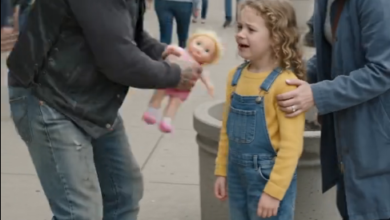
He removed the incomplete packet from her folder, separated it from all original documents, and tore the photocopied pages across the center so nobody could mistake them for the certified order.
He intended to explain immediately.
Natalie saw only paper tearing.
She screamed, “What did you do?”
Every face in the hallway turned.
Security Officer Malcolm Green reached Earl first, followed by Deputy Sarah Lopez. They saw an elderly biker holding torn court papers while a young mother cried beside him.
“Drop the documents,” Malcolm ordered.
Earl placed them on the bench.
Natalie’s breathing became shallow.
“That was my custody order.”
“No,” Earl said gently. “That was the incomplete copy.”
But fear had already filled the hallway faster than explanation could catch it.
Sarah moved between them.
“Sir, step back.”
Earl obeyed.
Then he reached toward his vest.
Both officers tensed.
Earl stopped immediately and asked permission.
“The complete certified order is inside my left pocket.”
PART 5
Deputy Lopez removed the packet herself.
The courthouse stamp was still fresh. Seven pages sat beneath the certification sheet, properly numbered and secured with a new staple.
Sarah compared them to the torn photocopy.
Then she noticed the gap.
Four.
Six.
No five.
The hallway became quiet.
Natalie took the complete packet with both hands and turned directly to page five. She read the first paragraph, then the second, her lips moving slightly as though the words needed to pass through her whole body before she could trust them.
“My attorney never gave me this.”
Earl remained several feet away.
“I don’t know why.”
“Would I have lost today?”
“I can’t answer that.”
His refusal mattered.
Earl did not pretend to be a lawyer simply because he had noticed something important.
He continued carefully.
“But you deserved to walk into that room with the complete order.”
Daniel’s attorney had stopped nearby. She looked at the certified copy, then at the torn pages, but said nothing.
Natalie’s court-appointed legal-aid advisor arrived moments later after being delayed in another courtroom. She reviewed the documents quickly and confirmed that page five was relevant to the existing safety restrictions.
The judge postponed the substantive hearing for two hours so both parties could review the complete record.
Natalie sat on the hallway bench after everyone dispersed.
Her anger had not disappeared.
“You should have asked before tearing anything.”
“Yes.”
“You scared me.”
“I know.”
“You thought you were helping.”
“I was helping badly.”
That answer loosened something in her expression.
Most adults defended themselves when confronted with harm caused by good intentions. Earl accepted that finding the missing page did not excuse frightening her.
Natalie looked toward the courtroom doors.
“How did you notice so fast?”
Earl sat at the far end of the bench, leaving space between them.
“Because nobody noticed mine.”
He explained Rebecca, the missed hearing, the documents he could not read, and the incomplete copy he kept unopened for nearly three decades.
Natalie listened without interrupting.
“Did you ever find your daughter?”
Earl looked down at his tattooed hands.
“No.”
“Did you try?”
“Too late and not well enough.”
She folded the complete order against her chest.
“Then why keep coming here?”
Earl looked toward the families moving through the hallway.
“Because late is not the same as useless.”
PART 6
The hearing did not end with a dramatic speech or instant victory.
Family court rarely worked that way.
The judge reviewed the complete temporary order, heard from both parents, and considered updated reports from the supervised visitation center. Daniel’s attorney argued that he had complied with several requirements and deserved increased contact.
Natalie’s legal-aid advisor did not ask the court to erase Owen’s father from his life.
She asked for changes to occur gradually, with professional oversight, because the child’s safety and stability mattered more than either parent’s pride.
The judge continued supervised visits, ordered both parents into a structured evaluation process, and scheduled another review after ninety days.
Natalie retained primary physical custody.
The result was not permanent.
It was not perfect.
But Owen would return to her home that afternoon.
Outside the courtroom, Natalie leaned against the wall and cried without hiding her face. Earl waited near the elevator, uncertain whether approaching would feel like another intrusion.
She called his name.
He turned.
“You were right about the page.”
“I was wrong about tearing it without permission.”
“Both things can be true.”
Earl nodded.
Natalie removed a photograph from her folder. It showed Owen wearing a dinosaur backpack and missing one front tooth.
“This is who was on that page.”
Earl accepted the photograph only after she offered it twice.
“He looks fast.”
“He never stops moving.”
“Good.”
Natalie watched him study the picture.
“What did Rebecca look like at six?”
Earl took out his wallet. Behind his driver’s license was a faded school photograph of a little girl with red ribbons in her hair.
“She hated photographs.”
“She looks angry.”
“She usually was when asked to sit still.”
Natalie smiled.
Then a woman standing near the records counter spoke.
“Dad?”
Earl froze.
The woman was in her early forties, with auburn hair, cautious gray eyes, and a courthouse employee badge clipped to her cardigan.
She had heard enough of the conversation to recognize the name.
Rebecca Dawson had recently transferred into the court’s financial-services department.
For thirty-two years, Earl had imagined their reunion in a hundred impossible ways.
None included torn photocopies, a family-court hallway, or a stranger’s dinosaur photograph in his hand.
Rebecca did not run into his arms.
Earl did not ask her to.
She remained several feet away and said, “I’ve seen you volunteering here.”
Earl’s voice nearly failed.
“I didn’t know you worked here.”
“I didn’t know you had learned to read those papers.”
“I should have learned sooner.”
Rebecca looked at Natalie’s complete order.
“So should a lot of people.”
PART 7
Earl and Rebecca did not repair thirty-two years in one hallway.
They began with coffee.
Rebecca chose a public café near the courthouse and gave Earl forty minutes. She asked difficult questions he could not soften with stories about confusing documents.
Why had he stopped writing?
Why had he assumed she did not want him?
Why had he blamed her mother instead of fighting harder?
Earl answered as honestly as he could.
He had been ashamed.
He had been angry.
He had confused helplessness with proof that nothing could be changed.
The missing page contributed to what happened, but it had not made every later decision for him.
Rebecca needed to hear him admit that.
They met again two weeks later.
Then again.
Some conversations ended gently. Others did not.
Earl never asked her to call him Dad.
He remained grateful whenever she called at all.
Natalie also stayed in contact with Second Chair. She completed the court process with legal-aid support and eventually began volunteering twice a month, helping parents organize files before hearings.
She never gave legal advice.
She carried colored tabs, extra pens, and a stapler.
Earl pretended not to notice the resemblance.
The courthouse changed one small procedure after the incident. Self-represented parents receiving copies of multi-page orders were shown the total page count on the certification sheet and encouraged to verify that every numbered page was present before leaving the counter.
It could not solve every problem.
It could prevent one.
Earl kept the torn photocopy inside a clear plastic sleeve. Natalie had written across it in thick black marker:
INCOMPLETE — DO NOT FILE.
Beside it, she added:
A missing page can change a life. So can someone who notices.
Months later, Owen met Earl during a community literacy event. The boy inspected the patches on his leather vest and asked whether bikers were allowed inside courthouses.
“After security checks everything twice.”
“Did you save my mom?”
Earl shook his head.
“Your mother saved herself by showing up.”
“But you found the page.”
“I noticed a number was missing.”
Owen considered this, then held up both hands.
“I can count to one hundred.”
“Then you are already more qualified than I was at your age.”
Natalie laughed.
Rebecca stood nearby.
She had come voluntarily.
When Earl looked toward her, she did not turn away.
Years later, people still remembered the morning security surrounded an elderly biker accused of destroying custody records. Most told the story as though Earl had heroically saved a mother from losing her child.
He corrected them every time.
“The complete order helped,” he said. “The lawyer helped. The judge listened. Natalie fought for her son. I only saw page five was gone.”
But those who knew him understood why that small act mattered.
A young father had once lost his way inside language he could not understand. Decades later, an old biker learned enough to recognize the same trap closing around another family.
He could not return the years taken from him and Rebecca.
He could not repair every mistake with one correct packet.
But when a frightened mother stood before a courtroom holding an incomplete story, Earl made sure the missing page did not remain invisible.
And sometimes redemption begins exactly there—not by rewriting the past, but by refusing to let the same silence take another child.
Follow this page for more unforgettable biker stories about misunderstood courage, second chances, and ordinary people who turn their deepest regrets into protection for someone else.