Part 2: A Sheriff and Twenty Bikers Surrounded a Frail Old Man’s House at Sunrise — Until Neighbors Learned Every Motorcycle Outside Had Once Been Saved by His Hands
PART 2
Walter Hayes had once owned the smallest motorcycle repair shop in eastern Oklahoma.
Hayes Motor Works stood behind an abandoned gas station with one service bay, a rusted sign, and a coffee pot that produced something closer to engine solvent than coffee. The roof leaked even then, but the tools were clean, the work was honest, and nobody left stranded if Walter could prevent it.
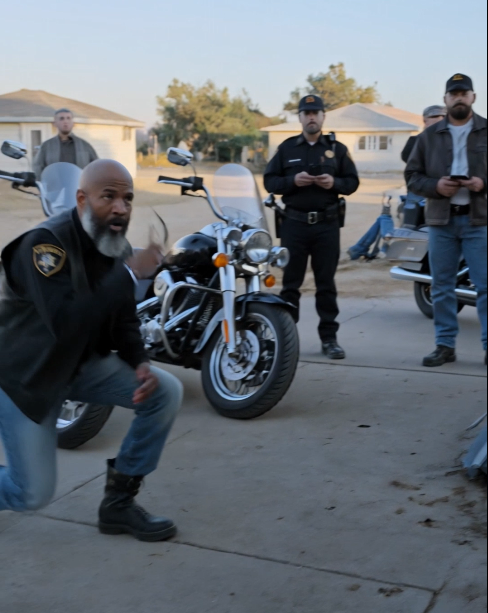
Bear first met him in 1984.
Raymond Collins was twenty-one years old, recently discharged from the Army, angry at nearly everyone, and riding a damaged 1973 Harley that broke down seventeen miles outside Tulsa.
He had six dollars in his pocket.
Walter arrived in an old tow truck after a passing driver called the shop. He loaded the Harley, brought Raymond inside, and spent three hours replacing a damaged fuel line and repairing wiring that should have failed months earlier.
When Raymond asked the price, Walter said twelve dollars.
Raymond stared at him.
“The parts cost more than that.”
“Then bring me the rest when the road stops being mean to you.”
Raymond returned the next week with eight dollars and two friends whose motorcycles also needed work.
That was how the relationship began.
The group eventually became the Iron Guardians Motorcycle Club, though in those early years they were simply young men trying to keep cheap machines alive long enough to reach the next paycheck.
Walter repaired tires after midnight.
He stored broken bikes without charging.
He kept spare gloves, rain jackets, and canned food in the back room because he understood that a mechanical problem was often only the first problem a rider carried through his door.
When one member lost his job, Walter invented work for him.
When another rider’s wife became ill, Walter refused payment for six months.
He never called it charity.
He called it balancing the books.
“You pay me when you can,” he would say. “Until then, stay alive.”
The club grew older.
The motorcycles improved.
Some members moved away, raised families, built businesses, or buried friends whose names were later stitched onto memorial patches.
Walter eventually closed the shop.
The riders still visited at first, but life stretched the time between calls. A month became six months. Six months became several years.
Everyone assumed someone else was checking on him.
That assumption lasted until Sheriff Marcus Reed called Bear on a Thursday afternoon.
“Do you remember Walter Hayes?”
Bear sat upright.
The sheriff continued quietly.
“Someone needs to.”
PART 3
Sheriff Reed learned about Walter through a postal carrier named Denise Carter.
Denise had delivered mail along Willow Bend Road for eleven years. Walter usually met her at the porch, even during winter, and always asked whether her delivery van was “making that knocking sound again.”
Then he stopped appearing.
For four days, the mail remained untouched.
Denise noticed the porch light burning in daylight and smelled damp wood near the roofline. She knocked, heard movement inside, but received no answer.
She requested a welfare check.
Marcus found Walter sitting on the kitchen floor.
He had fallen while reaching for a can of soup and lacked the strength to stand. He had been there for most of the night, wrapped in an old mechanic’s jacket and too embarrassed to press the emergency button hanging around his neck.
Paramedics examined him.
Walter refused hospitalization after they confirmed he had no serious injury. He agreed to a follow-up appointment but became defensive when Marcus asked about family.
“My son is busy.”
“When did he last visit?”
Walter looked toward the window.
“Recently enough.”
The dust-covered calendar told a different story.
Marcus found the son’s number on a note beside the telephone. The first call went unanswered. During the second, a man named Derek Hayes explained that he lived in Dallas, had work obligations, and believed his father should enter assisted living.
“Has anyone helped him apply?”
“He refuses everything.”
“His refrigerator is nearly empty.”
“He gets Social Security.”
“Money does not open jars from the kitchen floor.”
Derek became irritated.
He insisted Walter had always been stubborn and ended the call by saying he would “handle it soon.”
Marcus had heard those words before.
Soon often meant after a second fall.
Or after winter.
Or after a funeral.
While inspecting the kitchen, Marcus noticed a framed photograph showing a younger Walter standing beside twenty motorcycles. A much younger Bear stood near the center.
The Iron Guardians patch was visible on several vests.
Marcus knew Bear through community events and veteran fundraisers. He photographed the picture and sent it with one question.
Does your club know this man is alone?
Bear called within thirty seconds.
“What does he need?”
Marcus looked around at the sagging ceiling, broken lock, empty refrigerator, and old man pretending not to listen.
“Everything he once gave you,” the sheriff replied. “Just returned differently.”
PART 4
Bear called an emergency club meeting that evening.
Twenty-seven riders attended.
Some had not seen Walter in fifteen years. One had last spoken to him at a funeral. Another still carried the socket wrench Walter gave him after his first roadside repair.
Nobody offered excuses.
Bear did not permit them.
“We thought someone else was checking,” a rider named Leon said.
Bear nodded.
“So did everyone.”
Silence settled over the clubhouse.
Then they began making lists.
A roofing contractor named Miguel Ortiz volunteered materials and a four-person crew. Denise “Red” Morgan, a retired electrician, offered to inspect the wiring. Two members owned grocery stores. Another installed security systems. One rider’s wife worked for an elder-care agency and agreed to help Walter understand the services available without pressuring him to surrender his home.
Bear called Sheriff Reed with the plan.
Marcus approved the welfare visit but made the boundaries clear.
“No one enters without Walter’s permission.”
“Understood.”
“No confronting his son.”
“Understood.”
“No turning his yard into a show.”
Bear looked around at twenty motorcycles.
“That part may be harder.”
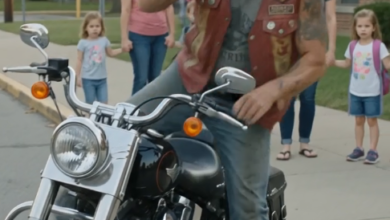
They agreed to arrive at dawn before traffic increased. Engines would be shut down at the end of the road, and the bikes would be pushed toward the property to minimize noise.
That careful plan did not prevent the neighbors from panicking.
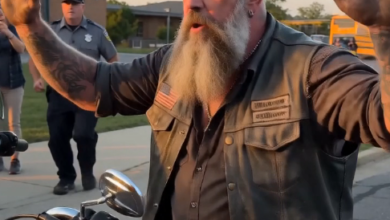
Twenty leather-clad bikers beside a sheriff’s cruiser looked less like a repair crew than the beginning of a raid.
Walter heard the motorcycles before he reached the door.
The sound carried him backward forty years.
For a moment, he thought he was standing inside Hayes Motor Works again while young riders argued over spark plugs and drank his terrible coffee.
Then his weak legs reminded him where he was.
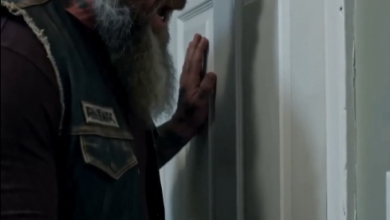
He shuffled toward the entrance using the wall for support.
Bear’s voice came through the wood.
“Walter, it’s Raymond.”
Walter placed one hand on the lock.
It would not turn.
Bear heard the metal scraping.
“Lock broken?”
“It’s fine.”
“You always were a bad liar.”
Sheriff Reed asked permission to enter through the back door. Walter hesitated, then agreed.
When Marcus finally opened the front entrance from inside, Bear saw the man who had once lifted motorcycle engines alone.
Walter now looked as though the morning wind might move him.
Bear lowered his eyes before Walter noticed the tears.
PART 5
Walter did not want help.
At least, that was what he said during the first ten minutes.
He objected to the roofing materials, the groceries, the replacement lock, and especially the refrigerator.
“That one still works.”
Miguel opened the old refrigerator.
The light did not come on.
Walter crossed his arms.
“It works quietly.”
Bear looked inside at the expired milk and mustard.
“It also appears to be fasting.”
Walter almost smiled.
That small crack in his resistance gave everyone room to breathe.
Bear sat at the kitchen table rather than standing over him.
“We are not taking your house.”
“I did not say you were.”
“You were thinking it loudly.”
Walter looked toward the bikers waiting outside.
“I cannot pay twenty people.”
“Good. None of us wants another argument about your labor rates.”
Walter rubbed his trembling hands together.
“I helped you boys because you were broke.”
“We are helping because we remember.”
“That is not the same.”
“No,” Bear said. “It is overdue.”
Sheriff Reed explained the welfare resources available, including meal deliveries, home-health assessments, transportation to appointments, and a voluntary emergency-contact plan. Walter could accept some services and reject others.
For the first time that morning, the decisions remained his.
He approved the roof repair after water dripped beside Bear’s chair.
He approved the new lock after the old one jammed again.
He allowed groceries after Red promised not to purchase “the low-salt nonsense” without asking him.
Work began.
The quiet house filled with sounds it had not heard in years: hammers overhead, tools across the porch, boots in the hallway, laughter from men arguing about measurements.
Nobody entered Walter’s bedroom.
Nobody discarded personal belongings without permission.
Old photographs were covered before dust began falling.
The bikers treated the house like an extension of the man who owned it—damaged in places, stubborn everywhere, and deserving care rather than pity.
Around noon, a silver SUV stopped at the curb.
Derek Hayes stepped out.
He was fifty-two, wearing an expensive jacket and the expression of someone arriving after discovering strangers had entered a family problem he preferred to keep private.
“What is happening here?” he demanded.
Walter looked toward his son.
The entire yard became still.
PART 6
Bear moved first, but Sheriff Reed stopped him with one glance.
This was not the club’s confrontation.
Marcus approached Derek and explained the welfare check, the unsafe conditions, and Walter’s consent to the repairs.
Derek looked past him at the bikers carrying groceries.
“My father does not need charity.”
Walter answered from the porch.
“I needed food.”
Derek froze.
The sentence contained no anger.
That made it heavier.
“I told you I would arrange something,” Derek replied.
“You said that in February.”
“It is April.”
“I know.”
Derek looked down.
He had not intended to abandon his father in the dramatic way people imagine abandonment. There had been no single decision to walk away forever.
There were postponed visits.
Unreturned calls.
Work emergencies.
Arguments about assisted living.
A growing resentment that his father refused every suggestion, followed by relief whenever distance allowed Derek to stop trying.
Neglect had entered gradually enough for him to keep calling it a scheduling problem.
Walter’s voice weakened.
“You wanted me to leave this house because helping me here was inconvenient.”
Derek opened his mouth.
Nothing useful came out.
Sheriff Reed asked whether he was prepared to participate in a realistic care plan. Derek said yes too quickly.
Walter raised one hand.
“Do not promise because people are watching.”
That stopped him.
The bikers returned to work, deliberately giving father and son privacy on the porch. Their conversation lasted nearly an hour. It did not repair years of distance, but Derek finally admitted he had avoided visiting because seeing Walter’s decline frightened him.
Walter did not immediately forgive him.
He asked for consistency, not emotion.
One scheduled call every evening.
One in-person visit each month.
Transportation to medical appointments shared with community services.
Derek agreed.
This time, Sheriff Reed wrote the plan down.
By late afternoon, the roof no longer leaked. The front door closed securely. A new refrigerator hummed beside cabinets filled with easy-to-open food. Red installed brighter lights and an emergency button Walter could wear without embarrassment because she attached it to a leather cord resembling a motorcycle key strap.
Derek helped assemble the new porch rail.
Nobody congratulated him for doing what should have happened earlier.
They simply handed him the next tool.
PART 7
The Iron Guardians returned the following Saturday.
Only five riders came that time.
Bear understood that twenty motorcycles could express love once, but dependable care required something quieter.
They brought coffee, replacement batteries, and a rebuilt lawn mower Walter had not requested but immediately criticized.
“You set the idle too high.”
“It has not started in three years.”
“That does not mean you should insult it.”
Walter’s strength improved slowly. A home-health nurse visited twice each week. Meals arrived on weekdays. Sheriff Reed checked in during patrols without making every visit official.
Derek kept most of his promises.
Not all.
When he missed a scheduled call, Walter did not pretend it was fine. Derek called the next morning, apologized without excuses, and drove up the following weekend.
Repairing a relationship proved harder than replacing a roof.
Both men kept working.
The bikers created a rotating schedule, though Walter refused the name “watch list.” They renamed it the maintenance calendar and included ridiculous tasks such as checking coffee quality, discussing motorcycle history, and ensuring Walter had someone available to criticize.
His kitchen became busy again.
Young club members began visiting to learn repairs from him. They brought carburetors, damaged starters, and questions Walter answered from a chair near the garage door.
His hands still trembled.
His knowledge did not.
One afternoon, a nineteen-year-old rider offered money after Walter diagnosed a wiring problem.
Walter pushed the bills back.
“Bring me the rest when the road stops being mean to you.”
Bear heard the sentence from across the garage.
For a moment, neither man spoke.
Months later, the club installed a small workbench at the correct height for Walter’s chair. Above it, they mounted the original sign from Hayes Motor Works, rescued from storage and cleaned without removing every mark of age.
Walter ran one hand across the faded lettering.
“You boys kept this?”
Bear shrugged.
“Some things know where they belong.”
The neighbors changed too.
The woman who had filmed the bikers arriving brought soup the following week. Another neighbor repaired the mailbox. Two teenagers began carrying Walter’s trash bins to the road.
Nobody posted photographs.
Walter’s dignity did not need an audience.
On his eighty-fifth birthday, twenty motorcycles returned to Willow Bend Road. This time, the neighbors did not call police.
They brought folding chairs.
Sheriff Reed arrived carrying a cake shaped like an engine block, though the decoration looked so inaccurate that Walter threatened to arrest the baker himself.
Derek stood beside his father.
Not perfectly reconciled.
Present.
Before cutting the cake, Walter looked toward the motorcycles lining his yard. Some were old. Others were worth more than his first house. Many belonged to riders he had never met.
“All this because I repaired a few machines?” he asked.
Bear shook his head.
“You repaired men who happened to arrive on motorcycles.”
Walter looked away.
His eyes had filled.
No one embarrassed him by mentioning it.
Years later, after Walter died peacefully inside the house whose roof no longer leaked, the Iron Guardians rode behind the hearse. Derek rode with them on Walter’s restored shop motorcycle, the machine his father had kept covered in the garage for decades.
The procession passed the location where Hayes Motor Works once stood.
Every motorcycle slowed.
Bear remembered the frightened old man asking who had called them that first morning.
He remembered his answer.
It remained true long after Walter was gone.
Every machine he had saved remembered the road home.
And so did every person.
Follow this page for more unforgettable biker stories about loyalty, forgotten kindness, and the people who return when an old debt of love finally finds its way home.