Part 2: A Twelve-Year-Old Foster Boy Asked Santa for One Day as a Biker — After a Hundred-Mile Ride, the Club President Gave Him Something No Placement Ever Had
PART 2
Ethan’s fascination with bikers had begun two years earlier, outside a roadside diner in Dayton.
His foster family at the time had stopped for breakfast during a move to another county. Ethan sat near the window with two plastic bags containing everything he owned while adults discussed paperwork as though he were not close enough to hear.
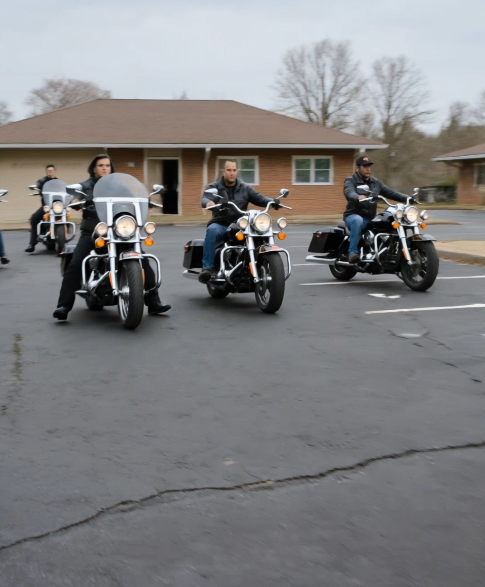
A motorcycle club entered the parking lot.
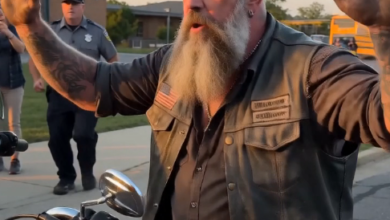
There were perhaps fifteen riders, men and women of different races and ages, wearing weathered leather vests covered in patches Ethan could not understand. They looked intimidating until one older rider noticed a waitress struggling with a broken trash cart.
Without being asked, four bikers repaired the wheel.
Another held the door for an elderly man using a walker. A woman in the group carried a frightened stray dog away from traffic and shared bacon from her breakfast plate.
What stayed with Ethan was not the motorcycles.
It was how they moved together.
Nobody entered the diner alone.
Nobody ate until every rider had a chair.
When one man discovered he had forgotten his wallet, another paid without making him feel ashamed. When they left, the final rider waited until everyone else had safely pulled onto the road.
Ethan had watched them disappear through the window.
“Do they all live together?” he asked his foster father.
“No.”
“Then why do they stay together?”
His foster father shrugged.
“Club rules, probably.”
Ethan remembered the answer because rules had never kept adults beside him.
Rules had moved him from house to house.
They arrived inside manila folders and plastic bins. They decided which school he attended, who could cut his hair, and whether he was allowed to call former foster siblings.
Yet the bikers appeared to have rules designed to prevent anyone from being left behind.
Ethan began drawing motorcycles in school notebooks. He memorized different models, watched restoration videos, and learned the meaning of words such as road captain, sweep rider, and formation.
He liked the sweep rider best.
That person rode at the back.
Their job was to notice anyone falling behind.
When Angela asked foster children to write holiday wishes, Ethan almost left his card empty. He no longer believed in Santa, and asking adults for impossible things had become another way to practice disappointment.
Then he remembered the riders outside the diner.
He wrote the letter quickly before courage could leave.
Afterward, he folded it twice and told Angela, “You don’t actually have to send it.”
She sent it.
Three days later, the letter reached Bear Collins.
Bear read the final sentence twice.
Then he called an emergency club meeting.
PART 3
The Iron Guardians had fulfilled unusual requests before.
They had escorted a bullied teenager to school, delivered birthday cards to a hospitalized veteran, and helped a widow repair the motorcycle her husband left unfinished.
Ethan’s letter silenced the clubhouse.
Some riders focused on the practical problems. A twelve-year-old could not simply be placed on a motorcycle and carried across Ohio without preparation, permission, proper equipment, insurance, planned stops, and adult supervision.
Bear agreed with every concern.
Then he read the sentence aloud again.
Bikers look like they always know who belongs with them.
A female rider named Denise “Red” Morgan lowered her coffee.
“He isn’t asking for a ride.”
“No,” Bear said. “The ride is just the language he knows.”
The club coordinated everything with foster services. They created a controlled hundred-mile route over safe roads, avoided highways with heavy traffic, arranged a support vehicle, scheduled three rest stops, and assigned Ethan to ride behind Luis “Doc” Ramirez, a fifty-one-year-old Latino American biker and former paramedic known for being the calmest rider in the club.
The agency required that Ethan’s foster guardian, social worker, and a licensed support driver remain involved throughout the day.
The club welcomed every condition.
Safety was not the obstacle.
Trust was.
Angela explained that Ethan often withdrew before positive experiences ended. He sometimes refused birthday parties, school trips, or visits with prospective families because enjoying something made the loss afterward worse.
“He may change his mind,” she warned.
Bear looked at the letter.
“Then we let him.”
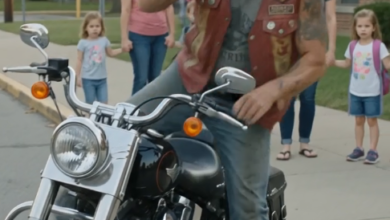
On Saturday morning, the riders arrived without revving their engines. They parked in a wide semicircle and waited while Ethan watched through the foster home window.
He had expected three or four bikers.
There were eighteen.
They brought no cameras, reporters, or social-media crew. Bear had forbidden anyone from turning Ethan’s wish into publicity.
When Ethan finally stepped outside, he carried the same two plastic bags he used during placements.
Angela gently told him he would not need them.
“I know,” he replied.
He did not put them down.
Bear noticed but said nothing.
Instead, he introduced every rider by road name and real name. Ethan shook hands carefully, as though memorizing faces he might later need to forget.
Then Bear presented the vest.
Ethan traced the name patch.
Beneath it was another small patch shaped like a compass.
“What does this mean?” he asked.
“It means you can find your way back,” Bear answered.
Ethan looked at him suspiciously.
“Back where?”
Bear did not give him an easy promise.
“Somewhere people expect you.”
PART 4
The first mile frightened Ethan.
The motorcycle vibrated beneath him more powerfully than any video had suggested. Wind pressed against his helmet, and every turn made him tighten both arms around Doc’s waist.
Doc did not accelerate quickly.
Through an agreed hand signal, he asked whether Ethan was comfortable.
The boy tapped his shoulder twice.
Yes.
The Iron Guardians rode in staggered formation along the quiet county road. Bear led. Two riders remained between Ethan and the front, while Red served as sweep at the rear.
Ethan looked back repeatedly.
Each time, Red was still there.
At the first stop, twelve miles into the route, the riders gathered at a small lakeside park. Ethan climbed from the motorcycle with trembling legs and immediately pretended he was fine.
Doc handed him water.
“You can stop anytime.”
“I’m not scared.”
“I didn’t say you were.”
Ethan stared across the lake.
“What happens if someone can’t keep up?”
“We slow down.”
“What if they keep falling behind?”
“Then someone rides beside them.”
“What if they have to leave?”
Doc understood the question was no longer about motorcycles.
“Sometimes people leave because they must,” he said. “But leaving is different from pretending you never mattered.”
Ethan looked away.
At the second stop, the club ate lunch at a roadside diner. Bear had reserved no private room. They took two ordinary tables and made space in the center for Ethan.
The waitress asked whether he was someone’s son.
Every adult became quiet.
Ethan prepared himself for the awkward explanation.
Bear answered first.
“He’s riding with us today.”
The waitress smiled.
“So he’s club family?”
Bear looked at Ethan rather than answering for him.
The boy hesitated, then nodded once.
“Today,” he said.
During lunch, he learned that Red drove a school bus, Doc worked at a rehabilitation clinic, and a massive Black American biker named Marcus “Anchor” Reed baked wedding cakes with his wife.
Ethan seemed almost disappointed that none of them were outlaws.
“Television lied to you,” Anchor said solemnly.
“So what do bikers actually do?”
“Complain about our knees and spend too much money on chrome.”
Ethan laughed.
It was the first unguarded sound Angela had heard from him in months.
At mile seventy-three, the weather changed.
Cold rain began falling.
The support vehicle offered Ethan a warm seat for the remainder of the trip.
He refused.
Bear crouched beside him.
“You have nothing to prove.”
Ethan looked toward the riders pulling on rain gear.
“If they finish, I finish.”
Bear studied the boy.
Then he helped fasten Ethan’s gloves.
“Nobody finishes alone.”
PART 5
The final destination was not the clubhouse.
Ethan expected it to be.
Instead, the motorcycles entered the parking lot of a small community garage renovated by the Iron Guardians. The building contained tool benches, a kitchen, shelves of donated books, and several motorcycles in various stages of repair.
A wooden sign above the main door read:
THE LAST RIDER HOME IS STILL HOME.
The club used the garage to teach mechanical skills to veterans, foster teenagers, and young adults aging out of care.
Ethan removed his helmet.
“How long has this place been here?”
“Seven years,” Bear said.
“You help foster kids?”
“Some.”
“Why didn’t Angela tell me?”
“Because today was supposed to be your choice, not a program somebody enrolled you in.”
Inside, one wall held photographs of young people who had learned welding, engine repair, carpentry, and basic financial skills there. Some wore graduation gowns. Others stood beside their first cars or apartments.
Ethan recognized one face.
A twenty-four-year-old Black American man named Jordan Fields had once spoken at Ethan’s foster agency about aging out of care.
Jordan entered from the workshop wearing grease-stained coveralls.
“You made the hundred?”
Ethan nodded.
“First time I rode with these guys, I threw up at mile thirty.”
Anchor called from across the room.
“Still our most memorable lunch stop.”
Jordan smiled and showed Ethan the motorcycle he was rebuilding. He explained that Bear had helped him obtain an apprenticeship after foster care, but the club had not saved him.
“They gave me tools,” Jordan said. “I still had to build something.”
Ethan touched the edge of the workbench.
“Do you have to be eighteen to come here?”
“Usually fourteen for the workshop.”
His shoulders dropped.
Bear noticed.
“But readers are allowed at twelve.”
“I’m not good at reading.”
“Neither am I,” Anchor said.
Several riders nodded.
Ethan looked around.
“You’re just saying that.”
Bear walked to a cabinet and removed a binder. Inside were training forms written with large print, diagrams, colored labels, and simple instructions created for people with different learning needs.
“Brotherhood is useless if it only works for people who need nothing,” he said.
The club then presented Ethan with a small metal toolbox. It contained no expensive equipment, only beginner tools engraved with his initials.
Ethan stared at them.
“These are mine?”
“Yes.”
“What if I get moved again?”
“The box moves with you.”
“What if somebody loses your number?”
Bear placed a laminated card beneath the tools.
The clubhouse address, phone number, and Angela’s approved contact instructions were printed clearly.
“Then you still know where we are.”
PART 6
As sunset approached, Ethan became quieter.
The ride had ended. The vest would need to come off. The riders would return to homes where people expected them for dinner.
Ethan understood endings better than beginnings.
He folded his gloves carefully and placed them beside the helmet. Then he removed the child-sized vest.
Bear was speaking with Angela when Ethan carried it toward him.
“Thanks,” Ethan said.
Bear looked at the vest.
“Why are you giving it back?”
“The day is over.”
“The ride is over.”
“That’s what I mean.”
Bear excused himself from the conversation and sat on a wooden bench. Ethan remained standing.
“Did you enjoy today?”
The boy shrugged.
That meant yes.
“Then why do you look angry?”
“I’m not.”
Bear waited.
Ethan’s eyes filled before he could stop them.
“You shouldn’t put someone’s name on something they can’t keep.”
Bear looked toward Angela.
The social worker covered her mouth.
The vest had never been borrowed.
Nobody had explained that clearly enough.
Bear took it from Ethan, opened the inside lining, and showed him a stitched label bearing his full name.
ETHAN MILLER — IRON GUARDIANS YOUTH MEMBER
“This was made for you.”
Ethan shook his head.
“I’m twelve.”
“So?”
“I don’t have a bike.”
“Neither does our treasurer. His wife made him sell it.”
A rider protested from across the garage.
“It was a mutual financial decision.”
For a moment, Ethan almost smiled.
Then the fear returned.
“You don’t know where I’ll live next month.”
“No.”
“You can’t promise I’ll stay in this county.”
“No.”
“You can’t adopt me.”
Bear’s face tightened.
“No, Ethan. I can’t promise that either.”
The boy looked down.
“Then what are you promising?”
Bear stood and placed the vest gently over Ethan’s shoulders.
“That when it is safe and your caseworker approves it, our door remains open. That somebody here will answer the phone. That your name stays on the wall even when your address changes.”
Ethan stared at him.
“You barely know me.”
Bear nodded toward the hundred-mile route marked on a map behind them.
“We know how you held on when the rain came. We know you asked whether the last rider gets left behind. We know you gave Anchor your napkin when he spilled soup on himself.”
Anchor raised one hand.
“A dark chapter in club history.”
Bear lowered his voice.
“You do not have to earn every place by becoming easy to keep.”
Ethan’s lips trembled.
“Then do I have to ask again next Christmas?”
Bear placed one tattooed hand over the name patch.
“You don’t need to ask.”
He looked toward the club.
Every rider stood.
“You’re already one of us.”
PART 7
The Iron Guardians did not become Ethan’s legal family overnight.
There was no sudden adoption, no judge ending years of uncertainty with one emotional speech, and no miracle erasing the reasons he had entered foster care.
The club became something different.
Consistent.
Every arrangement remained coordinated through Angela and Ethan’s foster placements. Approved riders attended school events, took him to the community garage, and called on scheduled evenings. When he moved to another foster home four months later, Bear and Doc helped carry his belongings.
For the first time, Ethan used cardboard boxes instead of plastic bags.
His vest traveled on top.
The new foster parents, Michael and Sandra Hayes, initially felt uncertain about the bikers. They imagined loud engines, unpredictable visits, and adults encouraging a child to reject authority.
Bear met them without his entire club.
He brought background-check documents, the youth-program rules, insurance details, and a calendar approved by social services.
Sandra looked through the papers.
“You prepared all this?”
“We learned that good intentions make poor seat belts.”
Michael smiled.
The relationship began slowly.
Ethan attended the garage twice each month. At fourteen, he entered the official workshop program. Jordan taught him to rebuild a carburetor, Red showed him basic electrical repair, and Anchor continued proving that cake decorating and motorcycle maintenance required equally steady hands.
Ethan struggled at school.
Reading remained difficult, and moving between placements had left gaps no leather vest could repair. The club paid for nothing secretly and made no decisions without his case team. They supported tutoring through approved channels and celebrated progress without turning grades into the price of belonging.
At fifteen, Ethan failed an important exam.
He disappeared from the garage for three weeks.
Bear finally found him sitting behind the foster home with the toolbox unopened beside him.
“You quitting?” Bear asked.
“I’m bad at everything.”
“You are excellent at dramatic conclusions.”
“I failed.”
“Yes.”
Ethan looked up, surprised by the lack of comforting denial.
Bear continued.
“Failure tells you what happened once. Shame tries to convince you it is your name.”
Ethan touched the patch on his vest.
Bear tapped it.
“That is your name.”
Ethan returned the following Saturday.
At seventeen, he rebuilt his first complete motorcycle engine. The machine belonged to a single mother who could not afford standard shop prices but needed transportation to work.
Ethan repaired it without charging labor.
Bear watched from across the garage.
“Why free?”
Ethan wiped grease from his hands.
“She can pay when the road gets kinder.”
The old sentence had traveled again.
Shortly before Ethan’s eighteenth birthday, Michael and Sandra asked whether he wanted to remain with them through an extended-care arrangement while finishing school.
Ethan said yes.
The answer frightened him, but he said it anyway.
On his eighteenth birthday, the Iron Guardians repeated the hundred-mile ride. This time Ethan rode his own legally licensed motorcycle, a modest restored bike assembled from parts donated by several club members and paid for partly through months of his own work.
They stopped at the same lake.
Ate at the same diner.
Rode through rain during the final twenty miles.
When they returned to the garage, Bear presented Ethan with a full adult club-support patch. Membership would still require time, responsibility, and the same rules applied to everyone.
Ethan understood.
Belonging did not mean rules disappeared.
It meant rules no longer existed only to move him somewhere else.
Years later, Ethan became a certified motorcycle technician and youth mentor at the community garage. Each December, he visited the foster-services office and read anonymous holiday letters.
Most requested ordinary things.
Shoes.
Headphones.
Books.
One year, a thirteen-year-old girl asked for a day inside a mechanic’s shop because she wanted to learn how to repair something nobody could take away from her.
Ethan carried the letter to Bear, now gray-haired and slower but still president.
“What do you think?” Bear asked.
Ethan looked toward the old child-sized vest hanging inside a glass case. The name patch had faded slightly, but the compass beneath it remained clear.
“I think we should make room at the workbench.”
On the morning the girl arrived, Ethan waited near the door with a toolbox bearing her initials.
She asked whether she could keep it.
He understood the real question.
“Yes,” Ethan said. “Even if you move.”
She held the box against her chest.
“Why?”
Ethan looked toward the motorcycles outside, each one waiting until every rider was ready.
“Because the last person home is still home.”
The wish Ethan made at twelve had never truly been about becoming a biker for one day.
It was about finding people who would remember him after the engines stopped.
The Iron Guardians gave him the ride.
But the greater gift came at the end, when a frightened child tried to return the vest and learned that brotherhood was not something he had borrowed.
It already carried his name.
Follow this page for more unforgettable biker stories about chosen family, quiet promises, and the people who make sure no child is left riding alone.