Part 2: An Elderly Man Was Ordered Out of an Ambulance Because They Said It Wasn’t an Emergency — Then a Tattooed Biker Blocked the Vehicle Before Anyone Realized What He Had Seen
Part 2
Caleb Mercer had spent most of his life being judged by people who looked at him once and decided they had learned enough.
It came with the vest.
It came with the tattoos.
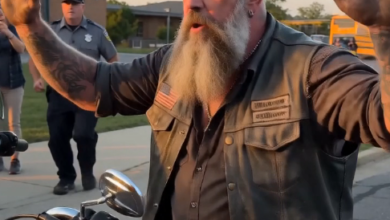
It came with the beard, the boots, the road-worn face, and the motorcycle that made polite people step aside before he ever opened his mouth. He had stopped resenting it years ago because resentment was heavy, and he already carried enough weight from places most strangers would never ask about.
Before he was a biker, Caleb had been an Army medic.
That part did not show as clearly as the leather.
It lived in smaller things. The way his eyes moved across a room. The way he noticed breathing before conversation. The way he watched hands, faces, balance, skin tone, panic, silence. The way a human body could tell the truth even when a person was too scared, too proud, or too sick to explain.
So when Caleb saw Henry Wallace sitting inside that ambulance, he did not see a difficult old man.
He saw a man trying not to collapse in front of strangers.
The EMT was not cruel. That mattered. His name was Evan Brooks, twenty-six years old, white American, clean-shaven, nervous around the edges, and clearly near the end of a long shift. Caleb could see exhaustion in him too. The kind that makes people follow procedure faster than instinct because instinct takes energy.
“Sir, we can’t use emergency transport for a non-emergency complaint,” Evan said, not unkindly.
Henry blinked slowly.
“My… arm…”
Evan checked the clipboard again.
“You told dispatch you felt weak. Your blood pressure is not alarming right now. We’ll get you into the waiting area.”
Henry looked toward the hospital doors.
They seemed very far away.
Caleb stood beneath the awning, watching.
He saw Henry try to lift his left arm.
It barely rose.
He saw Henry’s mouth move as if the words had to travel through mud.
He saw one shoe drag slightly when the EMT helped him stand.
That was when Caleb stepped closer.
“Hey,” he said, voice low. “How long has he been talking like that?”
Evan glanced at him once, then looked away.
“Sir, please step back.”
Caleb did not move closer.
He only pointed at Henry’s face.
“His speech is slurred.”
“He’s elderly.”
“His arm is weak.”
“He’s tired.”
Caleb’s jaw tightened.
“Those are not the same thing.”
Evan’s expression hardened, not because he was heartless, but because correction in public feels like accusation when someone is already overwhelmed.
Security noticed the tension.
The ambulance crew began closing paperwork.
And Henry stood between them, swaying slightly, too ashamed to ask again.
That was the moment Caleb understood nobody was going to stop unless someone made the pause impossible to ignore.
Part 3
Blocking an ambulance is the kind of thing people remember without remembering why.
That was what made it dangerous.
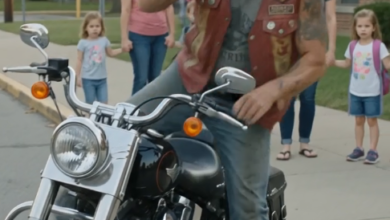
Caleb knew that as he swung one leg over the Harley and rolled it toward the ambulance bay. He did not gun the engine. He did not shout. He did not make a scene larger than necessary. He simply placed the motorcycle in front of the ambulance at a careful angle, stopped, killed the engine, and kept both hands visible.
The ambulance could not leave.
The whole bay erupted.
“What are you doing?”
“Move that bike!”
“Sir, step away!”
A security guard named Martin Hayes, a forty-four-year-old Black American man with a shaved head and a yellow rain jacket, jogged toward him with one hand raised. Officer Lisa Grant, a thirty-nine-year-old white American police officer with auburn hair tucked under her cap and a calm but firm posture, stepped from near the entrance and moved fast enough to show she was taking it seriously.
Caleb understood why.
From the outside, he looked like exactly the problem.
A massive biker blocking emergency equipment.
A leather vest where a hospital badge should have been.
A stranger inserting himself into something already tense.
He accepted the suspicion because Henry needed the time.
Officer Grant stopped six feet away.
“Sir, move the motorcycle now.”
Caleb looked past her.
Henry had been guided toward a metal bench under the awning, where he sat with his head slightly lowered, left hand limp against his thigh. Rain began tapping the edge of the roof. A nurse pushed a wheelchair past them and slowed, sensing something wrong but unsure where to enter the moment.
“Officer,” Caleb said, “I’ll move when someone checks his face, his arm, and his speech.”
Grant’s eyes narrowed.
“Are you medical staff?”
“Former Army medic.”
“That does not give you the right to block an ambulance.”
“No, ma’am. It gives me the reason.”
The sentence landed hard enough to silence the people nearest them.
Evan, the EMT, turned back from the ambulance door.
Caleb pointed again, this time more gently.
“That man is trying to tell you something his body is already saying.”
Henry lifted his head.
His lips moved.
No sound came out.
Officer Grant saw it.
So did the nurse with the wheelchair.
That was when everyone stopped shouting.
Part 4
The nurse reached Henry first.
Her name was Patricia Lewis, a fifty-six-year-old Black American charge nurse with silver-threaded braids, navy scrubs, and the kind of eyes that could cut through panic without becoming cold. She crouched in front of Henry, not too close, not too loud, and placed one hand on the armrest beside him.
“Sir, look at me.”
Henry tried.
His left eyelid seemed heavier than the right.
Patricia’s face changed, but only slightly.
“What’s your name?”
“Hen… Henry…”
The word dragged.
Patricia turned her head toward Evan.
“How long has he sounded like this?”
Evan’s face went pale.
“He was hard to understand when we picked him up, but dispatch said weakness and anxiety.”
Caleb closed his eyes for one second.
Not in victory.
In fear of how close they had come to missing it.
Patricia continued carefully.
“Mr. Henry, can you lift both arms for me?”
His right arm rose.
The left barely moved.
Officer Grant lowered her hand from her belt and looked at Caleb, then back at Henry. Security guard Martin stopped beside the ambulance, breathing hard, suddenly much quieter.
Patricia called for a stroke alert.
The words moved through the ambulance bay like a bell.
Not loud.
Not dramatic.
But every trained person within hearing distance understood what they meant.
The same EMT who had said it was not an emergency now moved fast. He grabbed equipment. He called inside. He helped Patricia transfer Henry carefully into the wheelchair, his face tight with shame and focus.
Henry’s eyes filled as they lifted him.
“I… told…”
Patricia leaned close.
“I know, baby. We hear you now.”
That sentence nearly broke Caleb.
Henry turned his head toward him, struggling against the weight of his own body.
Caleb stepped closer, but only after Patricia nodded.
The old man’s right hand reached weakly.
Caleb took it with both of his tattooed hands.
Henry tried to speak.
The words were broken, but Caleb understood enough.
“Thank… you.”
Caleb’s throat tightened.
“You don’t owe me that.”
Henry’s eyes stayed on him.
Caleb squeezed his hand carefully.
“You asked for help. That should have been enough.”
Behind them, the Harley sat blocking the ambulance, rain beading on the black tank.
Nobody was yelling at it anymore.
Part 5
The motorcycle moved only after Henry was inside the hospital.
Officer Grant did not ask Caleb to move it again until Patricia and the emergency team had taken Henry through the sliding doors and the stroke alert had pulled nurses, doctors, and equipment into motion. By then, the ambulance bay had gone from noisy anger to the stunned quiet of people realizing they had almost mistaken urgency for inconvenience.
Caleb rolled the Harley back by hand.
He did not start the engine.
That felt too loud.
Evan approached him near the curb, rain sticking his hair to his forehead. The young EMT looked smaller than he had ten minutes earlier, not because his body had changed, but because certainty had drained out of him.
“I missed it,” Evan said.
Caleb wiped rain from his beard.
“You got tired.”
“That’s not an excuse.”
“No.”
Evan swallowed.
Caleb looked at him for a long second.
“But it is a warning.”
The young man nodded, taking the sentence harder than an insult.
Officer Grant stepped closer.
“You still blocked an ambulance,” she said.
Caleb nodded.
“Yes, ma’am.”
“You understand I could cite you for that.”
“Yes, ma’am.”
She studied him.
Then her eyes shifted toward the hospital doors.
“I’m not going to.”
Caleb did not smile.
He only said, “Thank you.”
Security guard Martin walked over next. He had been the first to run toward Caleb, and now he looked embarrassed enough to avoid eye contact.
“I thought you were just causing trouble.”
“I was.”
Martin blinked.
Caleb tilted his head toward the hospital.
“For the right person.”
A small, tired laugh escaped Martin before he could stop it.
Inside, Henry was already being assessed. Patricia came out once, only long enough to tell them Henry’s daughter had been called and that the team had caught the situation in time to treat it seriously. She did not promise miracles. Nurses like Patricia did not sell comfort cheap.
But she did place one hand on Caleb’s arm.
“You bought him minutes,” she said.
Caleb looked down at her hand.
“No,” he answered. “He bought them by holding on.”
Part 6
Henry’s daughter arrived twenty minutes later.
Her name was Denise Wallace, a forty-nine-year-old Black American woman in a green work blouse, black slacks, and rain-damp flats, with her father’s same steady eyes and none of his patience for being ignored. She came through the ambulance bay doors fast, phone still in one hand, fear sharpened into anger because fear needs somewhere to go when it arrives too late.
“Where is he?”
Patricia met her at the entrance and explained what she could.
Caleb stayed near his motorcycle, expecting to remain outside the family’s story now that Henry was no longer alone. That was how he preferred it. Help, then step back. Do not make another person’s emergency about your own need to be seen.
But Denise looked over when Patricia pointed toward him.
She walked straight to Caleb.
“You’re the one who stopped them?”
Caleb held his hands loosely at his sides.
“Yes, ma’am.”
Denise stared at him for a moment.
Then her mouth trembled.
“My daddy hates ambulances,” she said. “He only calls if he is scared.”
Caleb nodded.
“I figured.”
“He said they told him it wasn’t urgent.”
Caleb did not answer.
He did not need to.
Denise looked toward the ambulance bay, the bench, the wet pavement, the place where her father had nearly been left to wait like an inconvenience. Her shoulders rose and fell as she fought to control herself.
Then she looked back at Caleb.
“Thank you for being difficult.”
That one almost made him smile.
“My ex-wife used to call it stubborn.”
“My father would call it necessary.”
Denise held out her hand.
Caleb shook it gently.
Later, Henry stabilized enough to speak in short, tired fragments. The stroke had been serious, but he had reached treatment faster because a man nobody expected to listen had refused to let everyone keep moving. Henry’s recovery would not be simple. It would involve therapy, patience, frustration, and days when words would still be hard to catch.
Caleb visited once.
Only once at first.
He brought no flowers. No balloons. No dramatic biker procession.
Just a small notebook with thick lines and a pen that was easy to grip.
Henry looked at it, then at him.
“For when they don’t listen fast enough,” Caleb said.
Henry smiled crookedly.
This time, it was on purpose.
Part 7
The hospital changed a policy because of Henry Wallace.
Not publicly at first. Institutions rarely announce the moments that humble them. But inside Mercy General, ambulance bay staff were retrained on refusal language, neurological red flags, and what to do when a patient’s complaint did not match a quick first impression. The broken habit of calling something “non-urgent” too early was discussed in rooms where Caleb’s name was never written but everyone knew the story.
Patricia made sure of that.
Evan stayed in emergency medicine.
That surprised Caleb when he heard it. He had expected the young EMT to transfer out, hide from the shame, or harden himself against it. Instead, Evan asked for extra training. Months later, he sent Caleb a message through Patricia.
I check twice now.
Caleb kept that message.
Not because he needed credit.
Because people becoming better after being wrong is rare enough to honor.
Henry recovered slowly. His speech returned in pieces, his left hand never quite became what it had been, and his pride had to learn new shapes around the assistance he still hated needing. Denise came to every appointment with a notebook, and Henry complained about it loudly enough that the nurses knew he was improving.
Caleb and Henry became friends in the strange way men do when one of them saves the other and both pretend it was not emotional.
They drank coffee in the hospital café.
They argued about football.
Henry asked too many questions about motorcycles.
Caleb answered too many of them.
One spring afternoon, nearly a year after the ambulance bay incident, Henry walked outside with a cane and stood beside Caleb’s Harley. He ran one hand over the seat, careful and reverent.
“This the one?”
Caleb nodded.
“This is the criminal vehicle.”
Henry laughed, slower than before but real.
Then he looked toward the ambulance bay where everything had nearly gone wrong.
“You blocked it for me.”
“I blocked it because they weren’t hearing you.”
Henry’s eyes stayed forward.
“Same thing.”
Caleb did not argue.
Some gifts should not be corrected.
Years later, whenever Caleb passed Mercy General, he still glanced toward the ambulance bay. Not with bitterness. With memory. He knew the people inside were human, which meant they could be tired, wrong, rushed, defensive, and still capable of learning before the next Henry Wallace arrived.
And Henry, for his part, kept the thick-lined notebook beside his recliner long after he no longer needed it every day.
On the first page, in crooked handwriting, he had written one sentence.
The biker heard me.
That was all Caleb had ever tried to do.