Part 2: A 59-Year-Old Biker Snatched the Microphone From a Little Girl During Her School Talent Show — Until the Technician Found the Hidden Spark Near Her Feet
Part 2
Earl Maddox knew what bad wiring sounded like before most people knew how to be afraid of it.
For twenty-seven years, before his knees got stiff and his beard turned silver, he had worked maintenance for county buildings, fixing old lights, faulty outlets, broken stage panels, and cheap extension cords that should have been thrown away five school events earlier. He had seen sparks small enough to be ignored and dangerous enough to change a life before anyone finished saying, “It’s probably fine.”
That was why he noticed the sound.
Not the music.
Not the crowd.
The tiny dry snap behind the curtain.
It came while Grace Bennett was being introduced by Mrs. Helen Carter, a forty-six-year-old Black American music teacher with short natural hair, pearl earrings, and a proud smile that had steadied half the nervous children in the school.
“Next we have Grace Bennett, singing a song she has practiced for six weeks,” Mrs. Carter said.
The audience clapped warmly.
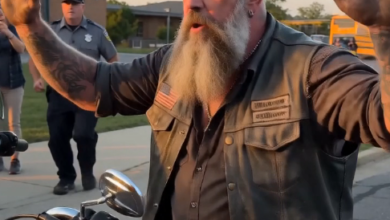
Grace walked out carefully, every step measured, like the stage might change its mind beneath her. Earl had met her fifteen minutes earlier near the cafeteria doors when she saw his leather vest and asked if he was really allowed inside a school looking like that.
Her mother had turned red with embarrassment.
Earl had laughed.
“Depends if I behave,” he said.
Grace had smiled then, a tiny flash of courage.
Now, beneath the stage lights, that courage sat on her shoulders like something fragile and holy.
Earl wanted her to have her moment.
He wanted every adult in that room to hush, every phone to record, every nervous breath to become the beginning of a memory her mother would keep forever.
Then the spark snapped again.
This time Earl saw it.
A quick flicker near the cable junction behind the microphone stand.
The wire had been pinched under the metal base, and when Grace shifted her foot, the cord moved just enough to expose the damage. The microphone cable ran into the same tangle, and the stage monitor near her feet hummed with a sound Earl did not like at all.
He looked toward the sound booth.
Nobody there saw it.
He looked toward Mrs. Carter.
She was smiling at Grace.
The music track began.
Grace lifted the microphone.
Earl’s body moved before permission could catch up.
Part 3
From the audience, it looked unforgivable.
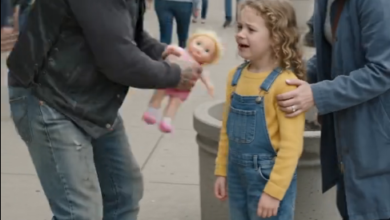
A huge biker stormed onto a school stage and took a microphone from a little girl.
That was all anyone saw at first.
They did not see the exposed copper. They did not hear the electrical crackle beneath the music. They did not know Earl’s eyes were not on Grace’s face, but on the cable near her white shoe. They only saw Grace’s smile vanish and her small fingers open in shock as the microphone disappeared from her hands.
“Hey!” someone shouted.
“What is wrong with you?”
A father in the second row stood so fast his folding chair folded backward with a sharp metal snap. Two teenagers near the aisle began filming. Mrs. Carter rushed forward, confused and horrified, while Grace stood frozen in the center of the stage with tears slipping down her cheeks.
Earl stepped between Grace and the wire.
Not toward her.
Between her and the cable.
He held the microphone away from both of them, arm extended, as if it were something hot.
The school security officer, Mark Daniels, a thirty-five-year-old Black American man with close-cropped hair and a navy security jacket, came running from the side entrance. His hand went to the radio on his shoulder.
“Sir, put that down and step away from the child.”
Earl did not look offended.
He looked urgent.
“Cut power to the stage.”
“Step away now.”
“Cut the power,” Earl repeated, louder this time.
Sarah Bennett reached the front of the stage, face pale and furious.
“That’s my daughter!”
“I know,” Earl said, and his voice cracked in a way nobody expected. “That’s why I moved.”
Grace wiped her face with the back of her hand.
She looked at Earl like he had broken something inside her.
That hurt him more than the shouting.
But he kept his boots planted.
He pointed down with two tattooed fingers, careful not to touch the cable.
Mrs. Carter finally followed the direction of his hand.
Her smile died.
“Mark,” she whispered. “Wait.”
Then the wire sparked again.
This time, everyone in the first three rows saw the flash.
And the auditorium went silent.
Part 4
The sound technician killed the power so fast the stage lights cut out before the echo of the gasp finished moving through the room.
For one strange second, the entire auditorium sat in darkness, phones glowing like little moons above frightened faces. Grace whimpered softly. Sarah reached for her daughter from the foot of the stage, but Mark Daniels held up one hand and guided her around the safe side instead of letting her climb near the cables.
“Everyone stay seated,” Officer Linda Brooks called from the aisle.
She was the school resource officer, a forty-two-year-old Latina American woman with dark hair pulled into a tight bun, a dark uniform, and a calm voice that had stopped more cafeteria fights than anyone remembered. She had been halfway to the stage when the lights went out. Now she moved carefully, flashlight angled low, not dramatic, not panicked.
The technician, Paul Rivers, a fifty-year-old white American man with thinning hair, glasses, and a gray school polo, climbed from the sound booth and hurried onto the stage with a handheld flashlight. Earl stepped back immediately when Paul arrived, but he still kept one arm between Grace and the damaged wire until Mark helped her move toward her mother.
Sarah wrapped both arms around Grace.
Grace sobbed into her mother’s shoulder.
Earl looked away.
He had saved her from something he could barely explain, and still he had given her a memory of fear on a night that should have belonged to her voice.
Paul crouched beside the microphone stand.
Nobody spoke while he inspected the cable.
Then his face changed.
He looked up at Officer Brooks.
“This cable’s exposed.”
“How bad?” she asked.
Paul swallowed.
“Bad enough that if she’d kept holding the mic and stepped back into it, we could’ve had a serious shock.”
The words moved through the room like cold water.
Sarah pulled Grace tighter.
Mrs. Carter covered her mouth with both hands.
Mark Daniels looked at Earl, then at the microphone still in his hand, and all the anger in his face collapsed into something closer to shame.
Earl lowered the microphone slowly.
“I’m sorry,” he said, though no one had asked him to.
His eyes stayed on Grace.
“I didn’t have time to make it gentle.”
Part 5
The auditorium needed several minutes to understand what had almost happened.
People do not like being wrong in public, especially when their anger has already filled a room. Some parents lowered their phones. Others looked at the floor. The father who had stood up in the second row picked up his fallen chair and set it right with both hands, his face red but quiet.
Grace stayed wrapped in her mother’s arms.
She would not look at the stage at first.
Earl did not blame her.
He sat on the edge of the lowest step, far enough away that she did not feel crowded, close enough that she could hear him if she chose to. The microphone rested across his open palms now, no longer stolen, no longer raised, just held like something borrowed and precious.
Officer Brooks stood nearby, but she did not interrupt.
Sarah looked at Earl with wet eyes.
“You scared her.”
“I know.”
“You scared me.”
“I know.”
The honesty took some of the heat out of her face.
Earl’s voice dropped.
“I saw the wire split. I heard it before I saw it. I thought if I yelled, she might step back. If I ran for the booth, she might start singing before they cut power. So I took the one thing connecting her to that cable.”
Sarah looked toward Paul, who was still kneeling near the ruined equipment with Mark and Mrs. Carter.
Paul nodded once.
“He’s right.”
That did not make Grace stop crying.
Not immediately.
Children do not recover on command just because adults find the explanation.
Earl turned the microphone in his hands, checked that it was now unplugged, and then stood slowly. He took two steps toward Grace and stopped when Sarah’s arm tightened protectively.
Smart mother, he thought.
He extended the microphone with both hands.
Not one.
Both.
Like an apology should have weight.
“Grace,” he said softly, “I’m sorry I scared you. But I’d rather you be mad at me than your mama lose you.”
Grace looked at him then.
Her cheeks were wet.
Her lower lip trembled.
For a moment, the whole auditorium seemed to hold its breath again, but differently this time.
Grace reached for the microphone.
Then she asked, “Are you staying to hear me sing?”
Earl’s eyes filled before he could stop them.
“Yes, ma’am,” he said. “Front row, if your mama allows it.”
Part 6
The talent show did not continue right away.
It became something quieter first.
Paul replaced the cable, then replaced the microphone, then checked every connection twice while Officer Brooks watched and Mrs. Carter stood beside Grace, speaking to her in a low voice. The principal came onto the stage and explained, carefully, that there had been an equipment problem and that everyone would take a short break before deciding whether Grace wanted to continue.
Nobody pressured her.
That mattered.
A child who has been frightened in front of a room full of people should not be forced to become brave on schedule.
Grace sat in the front row with her mother on one side and Mrs. Carter on the other. Earl sat three seats away because Sarah nodded once to allow it, but not closer. He kept his hands folded, his vest open, his boots tucked under the chair so he did not look as large.
After a while, Grace looked at him.
“Do motorcycles get scared?” she asked.
Earl thought about laughing, then decided she deserved a real answer.
“People riding them do.”
“What do they do?”
“Slow down. Look around. Keep both hands steady.”
Grace considered that.
“I cried.”
“So have I.”
That surprised her.
“You?”
“Yes, ma’am.”
“You’re big.”
“Big people leak too.”
Grace almost smiled.
Sarah covered her mouth, and this time it was not fear.
When the stage was cleared, Mrs. Carter knelt in front of Grace.
“You don’t have to sing tonight.”
Grace looked at the stage.
Then at her mother.
Then at Earl.
“Will it spark again?”
Paul, from the side, held up the new cable.
“No, sweetheart. I checked it three times.”
Grace nodded, but fear still sat in her shoulders.
Earl leaned forward slightly.
“Remember what I said about motorcycles?”
“Slow down. Look around. Keep hands steady.”
“That works for singing too.”
Grace stood.
Not proudly.
Not dramatically.
Just bravely enough for one more step.
And sometimes that is the only kind of bravery that counts.
Part 7
When Grace walked back onto the stage, nobody clapped at first.
Not because they were unimpressed.
Because they understood that loudness might break the small courage she was carrying.
Sarah stood near the stage steps this time, close enough for Grace to see her. Mrs. Carter held the new microphone cable safely away from the floor. Paul stood beside the sound booth with one hand ready near the power switch, though he had already checked everything more times than necessary. Officer Brooks stayed at the side aisle, not as security now, but as witness.
Earl sat in the front row.
He looked too big for the folding chair, elbows on his knees, gray beard resting near his clasped hands. The same vest that had made parents fear him earlier now looked strangely harmless beneath the soft stage lights. Or maybe not harmless. Maybe useful. Maybe a wall does not become gentle just because it protects you.
Grace held the new microphone.
Her hand trembled.
Earl noticed.
So did Sarah.
Grace looked down once at the taped mark on the floor, then at the safe cable behind her, then at Earl.
He did not give a thumbs-up. He did not make a big gesture. He only placed both hands flat on his knees, steady and still, like he was showing her what calm looked like when words were too much.
Grace took a breath.
Then she sang.
Her voice was small at first, thin from tears and fright, but it stayed. By the second line, it warmed. By the third, the room had changed completely. Parents who had booed earlier sat silent with shame and relief. Mrs. Carter cried openly. Sarah pressed one hand to her heart again, but this time she was not trying to stop fear. She was trying to hold joy in place.
When Grace finished, the auditorium rose carefully, then fully.
The applause did not roar like noise.
It rose like forgiveness.
Grace ran to her mother first.
Then, after a long moment, she walked to Earl.
He stood, unsure if he should kneel or step back, but Grace solved it by holding out her small fist. Earl looked at it, then gently bumped it with two tattooed knuckles.
“Was I louder than a motorcycle?” she asked.
Earl smiled.
“Much louder.”
Years later, Grace would not remember every face in that auditorium or every note she sang, but she would remember the man everyone booed before they understood him. She would remember the microphone returned with both hands. She would remember that sometimes someone can ruin a moment for exactly the right reason, then stay long enough to help you get it back.
And Earl would remember the same thing every time he heard a child sing into a microphone.
He would remember the spark.
The silence.
The little girl’s question.
Are you staying to hear me sing?
He stayed.
Because saving someone is not always the end of the job.
Sometimes, after you pull them away from danger, you owe them the dignity of watching them finish what fear interrupted.