Part 2: A Tattooed Biker Was Arrested for Stealing a Blind Man’s Wallet at a Bus Stop — Until the Blind Man Recognized His Voice and Told Police Who Had Really Been Standing Beside Him
Part 2
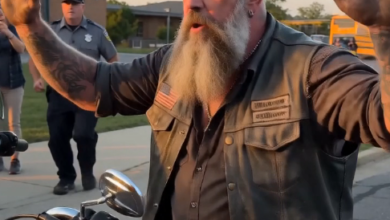
Raymond Collins had never meant to become part of Isaiah Brooks’s mornings.
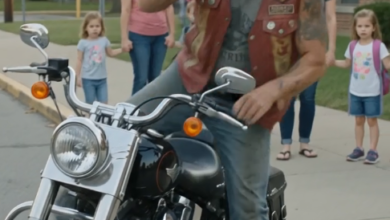
It started six months earlier, during a thunderstorm that turned downtown Indianapolis into a blur of headlights, wet pavement, and impatient horns. Raymond had been waiting beside his motorcycle outside a repair shop when he saw Isaiah step off the curb too early, following the sound of an engine he thought was the bus.
It was not the bus.
It was a delivery truck.
Raymond moved fast, but not rough. He stepped close enough to place his boot near the edge of the curb and said, “Hold one second, sir. That’s a truck, not your ride.”
Isaiah stopped immediately.
Not because Raymond touched him.
Because Raymond did not.
That mattered.
People often grabbed Isaiah when they thought they were helping. They seized his elbow, pulled his shoulder, turned his body, spoke too loudly, or moved him like blindness had made him less adult. Raymond had done none of that. He had only used his voice and given information.
Isaiah remembered the voice.
Low.
Gravelly.
Careful.
The Number 18 bus arrived two minutes later, and Raymond said, “Doors are ten steps forward, opening toward you.”
Isaiah smiled.
“You work for the transit company?”
“No, sir.”
“Then you just sound bossy for free?”
Raymond laughed.
After that, the arrangement became silent.
Raymond stopped at the same bus shelter most mornings after buying coffee from the corner diner. He did not announce himself. He did not try to become Isaiah’s friend. He simply stood nearby when the street was loud and called out the bus numbers when they came too close together.
“Fourteen.”
“Not yours.”
“Eighteen, front door five steps left.”
Sometimes Isaiah said thank you.
Sometimes he said, “Morning, Bear,” after hearing another biker call Raymond by his road name.
Raymond never asked how Isaiah was blind.
Isaiah never asked why Raymond looked like he had spent half his life being mistaken for trouble.
Their friendship grew in the small space between not asking and still showing up.
Then came the Monday morning with the teenage boy in the gray hoodie.
Raymond had seen the kid at the shelter before. Sixteen or seventeen, white American, thin face, restless eyes, one sneaker always tapping like his nerves were trying to leave without him. Raymond did not judge him for looking broke, cold, or desperate.
He judged him only when the sneaker touched Isaiah’s wallet.
Once could have been an accident.
Twice was a choice.
By the third nudge, Raymond set his coffee down.
And the camera began recording the wrong part of the truth.
Part 3
The teenager knew exactly where the camera was.
That was the first thing Raymond realized when the boy shifted his body so the shelter post blocked his hand but not Raymond’s movement. It was not sophisticated. It was not master criminal work. It was just enough calculation to make the biggest, roughest man at the stop look guilty if anything went wrong.
The wallet had fallen half under the bench.
Isaiah did not know.
His cane rested across his lap, his chin tilted slightly toward traffic, listening for the diesel rhythm of the Number 18.
The boy’s sneaker tapped the wallet again.
It slid toward the edge of the shelter.
Raymond moved before the boy could bend.
He stepped in, lowered himself quickly, and picked up the wallet with two fingers. The teenager’s eyes flashed with anger, then opportunity. He backed away just enough to look innocent.
Raymond saw the choice arrive.
If he shouted, the boy would run.
If he held the wallet up, everyone would see a biker holding a blind man’s money.
If he tried to explain, the explanation would come after suspicion.
So Raymond did the safest thing he could think of in the smallest amount of time.
He leaned toward Isaiah and slipped the wallet into the inside pocket of the old man’s navy coat, pressing it just deep enough that it would not fall again. Isaiah turned slightly at the movement, but Raymond spoke low.
“Your coat pocket, sir. Inside left.”
Isaiah gave the smallest nod.
Then the woman near the route sign gasped.
“He took it.”
Raymond looked up.
The teenager raised both hands, as if shocked.
A young man in a business jacket pointed at Raymond.
“I saw him bend down.”
The first accusation became three.
Then five.
By the time Officer Linda Harris, a forty-year-old Latina American police officer with dark hair pulled tight under her cap, hurried over from the crosswalk, the crowd had already written the story.
Big biker.
Blind old man.
Missing wallet.
Raymond did not resist when she turned him toward the glass shelter and asked for his hands.
He only said, “Check the man’s coat.”
But the crowd was louder than him.
“Coward.”
“Stealing from a blind man?”
“Unbelievable.”
Raymond closed his eyes.
Not because he was afraid.
Because he had heard worse from people who saw less.
Part 4
Isaiah Brooks heard the handcuffs before he understood why they were out.
Metal has a particular sound when it closes around a wrist. Sharp, final, official. Isaiah had heard it enough times in crowded places to know when somebody’s story was being taken over by people with badges and certainty.
“Officer,” he said.
No one heard him at first.
The crowd was still talking. The young man in the business jacket repeated that he had seen Raymond bend down. The woman near the route sign insisted the biker had slipped something into his own vest, though she had not actually seen where his hands went. The teenage boy in the gray hoodie stood three steps away, head lowered, playing the part of a witness who wanted no attention.
Isaiah raised his voice.
“Officer.”
Officer Harris turned.
“Yes, sir. We’re handling it.”
“No,” Isaiah said. “You’re handling him. You have not handled what happened.”
That quiet sentence thinned the noise.
Raymond turned his head slightly.
“Mr. Brooks, don’t worry about it.”
Isaiah smiled without humor.
“Bear, I have been blind twelve years. If I worried only when sighted people told me to, I’d be dead or robbed by now.”
Officer Harris looked between them.
“You know him?”
“I know his voice,” Isaiah said.
The teenager shifted his weight.
Isaiah heard the rubber scrape of his sneaker and turned his face toward him.
“And I know the sound of that boy’s shoe. He has been tapping near my feet for ten minutes.”
The boy’s head snapped up.
Raymond stayed still.
Officer Harris frowned and stepped toward Isaiah.
“Sir, do you know where your wallet is right now?”
“Yes.”
The crowd went completely quiet.
Isaiah reached slowly into the inside left pocket of his coat, exactly where Raymond had told him. His gloved fingers closed around the wallet. He pulled it out and held it up.
Gasps moved through the shelter.
Officer Harris looked at Raymond.
Then at the teenager.
Then at the camera above the shelter, which had recorded Raymond bending down but not the sneaker that moved the wallet first.
Isaiah’s voice stayed calm.
“I do not need eyes to know who has stood beside me every morning.”
Raymond looked down.
For the first time, the crowd had nothing to say.
Part 5
The teenager tried to walk away.
That was when Raymond finally moved.
Not toward him.
Just one step to the side, blocking the easiest path without raising his hands or making a threat. Officer Harris saw it, followed his line of sight, and called to the boy before he reached the curb.
“You. Gray hoodie. Stay here.”
The boy stopped, shoulders rising.
“I didn’t do anything.”
Isaiah tilted his head.
“That is not what your shoes said.”
No one laughed.
The officer brought him back beneath the shelter and asked for his name. He was seventeen, white American, named Tyler Reed, with a thin face, cracked lips, and the hollow anger of someone who had practiced looking harmless in public. When Officer Harris reviewed the footage with a transit supervisor, the video showed exactly enough to clear Raymond and exactly not enough to show the first kicks clearly.
But the people at the stop had seen enough by then.
Or perhaps they had finally become willing to see.
The woman who accused Raymond first covered her mouth.
“I’m sorry,” she whispered.
Raymond said nothing.
The young man in the business jacket looked at the ground.
Officer Harris unlocked the cuffs.
The red marks on Raymond’s wrists were not dramatic, but Isaiah heard the metal release and understood what it meant.
“Mr. Collins,” Officer Harris said, “I owe you an apology.”
Raymond flexed his fingers once.
“You were doing your job.”
“I did it too fast.”
Raymond looked at Tyler, then at the crowd.
“Most people do.”
Officer Harris accepted that because there was nothing useful to argue.
Tyler did not cry. He did not apologize at first. He only stared at Isaiah’s wallet as if it had betrayed him by being returned. Later, after the officer separated him from the crowd, the truth came out in smaller pieces. He had been skipping school. He had stolen before. He had seen Isaiah at the stop for weeks and assumed a blind man would be easy.
Isaiah listened to that from the bench.
Then he asked one question.
“Did you need money, or did you need someone weaker than you?”
Tyler did not answer.
That silence answered enough.
Part 6
The Number 18 bus arrived late.
By then, no one at the stop was pretending the morning had returned to normal.
The driver opened the doors and looked at Isaiah.
“You coming, Mr. Brooks?”
Isaiah stood slowly, using his white cane with practiced precision. Raymond stepped back, giving him room, the way he always did. That was what most people still did not understand. Help was not always hands. Sometimes help was a voice, a warning, a silence, a distance held with respect.
Isaiah paused before stepping toward the bus.
“Bear.”
Raymond looked up.
“Yes, sir?”
“You still having coffee tomorrow?”
Raymond glanced at the paper cup he had abandoned on the bench when everything started. It had gone cold.
“Probably.”
“Good. My bus sense is terrible before eight.”
A few people smiled softly.
The joke gave the crowd permission to breathe again.
Officer Harris watched Raymond guide Isaiah with words only.
“Door is four steps forward. Curb drops in two. Handrail on your right.”
Isaiah followed the instructions easily.
At the bus door, he turned back.
His dark glasses caught the gray morning light.
“I told them I didn’t need eyes,” he said. “But I do appreciate a witness who listens.”
Raymond swallowed.
“I just call the bus numbers.”
“No,” Isaiah said. “You stand there when nobody asked you to.”
Then he boarded.
The doors closed.
The bus pulled away, leaving Raymond on the sidewalk with his coffee cold, his wrists sore, and half the shelter still too ashamed to look directly at him.
Officer Harris remained beside him.
“You want to press a complaint?”
Raymond looked toward the road where the Number 18 disappeared.
“No.”
“You sure?”
He nodded.
“I want that kid scared enough to stop, not crushed enough to become worse.”
Officer Harris studied him.
“You always this generous?”
Raymond picked up his cold coffee.
“No. Just tired of people becoming what strangers expect them to be.”
Part 7
Raymond returned to the bus stop the next morning.
So did Isaiah.
That surprised no one and somehow surprised everyone.
The woman who had accused Raymond was there too, standing near the route sign with her coffee untouched between both hands. She looked nervous when Raymond walked up, as if apologies had weight and she had carried hers badly all night.
“Mr. Collins,” she said.
Raymond stopped.
“I’m sorry.”
He could have made her suffer a little.
A younger version of him might have.
Instead, he nodded once.
“Next time, check the whole story.”
She nodded quickly.
“I will.”
Isaiah, sitting on the bench, smiled toward the sound of Raymond’s boots.
“Morning, Bear.”
“Morning, Mr. Brooks.”
“Is she apologizing?”
“Yes, sir.”
“Good. Tell her forgiveness is easier before my bus comes.”
The woman let out a broken laugh, half relief, half embarrassment.
Raymond handed Isaiah the coffee he had started bringing him after the incident. Black, no sugar, because Isaiah said sweet coffee was proof civilization was declining.
For weeks afterward, the stop changed in small ways.
People began noticing Isaiah without hovering over him. They called out bus numbers when Raymond was late. The transit supervisor adjusted the camera angle after Officer Harris filed a report explaining what the old view had missed. Tyler Reed was placed into a diversion program that required restitution, counseling, and community service instead of simply being thrown into a system that already knew how to swallow angry boys whole.
Isaiah asked for one condition.
He wanted Tyler assigned to the community center where he taught music.
Raymond thought that was a terrible idea.
Isaiah thought that was why it might work.
The first day Tyler showed up, he could barely look at either of them. Isaiah handed him a broom, then later a tambourine, then eventually the job of setting chairs for the children’s class.
Months passed.
Tyler did not become a saint.
Stories that pretend people change overnight are usually selling something.
But he stopped stealing from the bus stop.
He learned to tune a guitar badly.
He learned that Isaiah could hear lies before most people saw them.
And Raymond kept standing near the shelter each morning, calling out the Number 18 when it arrived.
One day, Isaiah asked, “You ever get tired of standing there?”
Raymond looked at the traffic.
“Sometimes.”
“Then why do it?”
Raymond thought about the camera, the crowd, the wallet, the accusation, and the old man who had defended him with nothing but recognition.
“Because you know I’m here,” he said.
Isaiah smiled.
“That is the whole point, Bear.”
And when the Number 18 sighed against the curb, Raymond stepped back, gave the door distance, and said what he always said.
“Five steps forward, sir. Handrail on your right.”