Part 2: A Tattooed Biker Dumped a Little Girl’s Drink onto the Floor in a Crowded Diner — Then Her Mother Saw What Was Crawling Beneath the Lid
PART 2
Sophie’s allergy had been discovered during a family picnic two summers earlier.
She had been six years old, chasing bubbles across her grandmother’s backyard when she stepped near a flower bed and frightened a wasp hidden beneath the leaves.
The insect stung her lower arm.
At first, Laura saw only a small red mark. Sophie cried, but children often cried after insect stings, and nobody understood the seriousness until swelling spread rapidly beyond the site.
Sophie became dizzy.
Her voice changed.
Her breathing grew strained.
Laura’s sister called emergency services while a neighbor who carried an allergy injector for his own child offered assistance under the dispatcher’s guidance.
Sophie recovered after emergency treatment, but the experience changed the family’s routines.
Laura carried prescribed emergency medication everywhere. Sophie wore a medical bracelet and learned never to hide symptoms because she feared ruining an outing.
Her pediatric allergy specialist explained that future reactions could be unpredictable, and stings around the mouth or throat required immediate attention.
Laura became careful without wanting Sophie to become frightened of every insect.
They still visited parks.
They still ate outdoors.
They simply checked drinks, kept food covered, and made sure every adult caring for Sophie knew where the emergency medication was stored.
That Saturday at Miller’s Diner, Laura believed they had followed every precaution.
They chose an indoor booth.
Sophie’s drink came with a lid.
The emergency injector remained inside Laura’s handbag.
Then Sophie spilled ketchup across her fingers, and Laura walked twelve feet toward the counter for extra napkins.
The patio door opened behind them.
A wasp entered.
Nobody noticed except Stone.
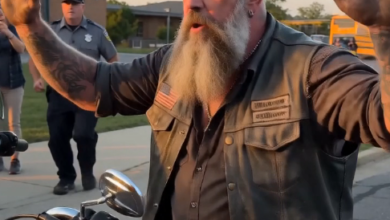
He had been sitting alone with coffee and a plate of eggs, waiting for two members of the Iron Guardians Motorcycle Club to meet him before a charity ride.
Stone first saw the wasp circling the sugar containers. He watched it land near Sophie’s straw, disappear beneath the lid, then begin moving frantically inside the cup.
He assumed the child would notice.
She did not.
When Sophie lifted the lemonade, Stone looked toward the counter and saw Laura’s back turned.
He had perhaps two seconds to decide whether to shout across the crowded room or remove the cup himself.
He chose the cup.
From every other angle, the action appeared cruel.
A giant biker had taken a child’s drink and dumped it onto the floor.
Only Stone had seen what was still moving inside.
PART 3
The first person to confront Stone was a forty-year-old father named Eric Dawson, seated two tables away with his family.
Eric had looked up after hearing Sophie gasp. He saw Stone holding the cup, lemonade spreading across the tile, and a frightened child staring at an intimidating stranger.
He stood immediately.
“Step away from her.”
Stone obeyed.
He placed the empty cup on the table and raised both hands where everyone could see them.
“I’m not trying to frighten anybody.”
“You just grabbed a child’s drink.”
“There was a wasp inside.”
Eric glanced toward the floor but could not see the insect beneath the table.
Several diners began speaking at once.
One accused Stone of inventing an excuse.
Another asked the manager to call police.
A younger customer continued recording.
Stone did not argue with them. He understood what the scene looked like.
Then Laura returned.
Her first instinct was not gratitude.
She moved between Stone and Sophie, placing one hand protectively across her daughter’s shoulders.
“What happened?”
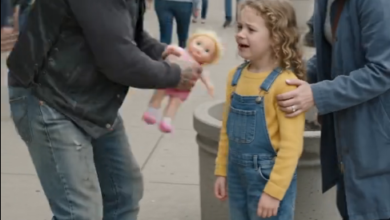
Sophie pointed toward the floor.
“He threw away my lemonade.”
Laura looked at Stone.
His size, tattoos, and leather vest did nothing to make his explanation easier to trust.
Stone pointed beneath the neighboring chair.
A server moved the chair carefully.
The wet wasp crawled into view, wings struggling against droplets of lemonade.
The room became quiet.
Laura’s gaze dropped to Sophie’s medical bracelet.
She understood the danger before Stone finished explaining.
“Did it sting you?”
Sophie shook her head.
“Did you feel anything in your mouth?”
Another shake.
Laura checked her daughter’s lips, face, neck, and breathing while reaching for the emergency injector in her bag.
Stone stepped farther away to give them room.
A diner employee trapped the weakened wasp beneath a glass and carried it outside.
Eric slowly sat down.
“I thought you were bullying her.”
Stone looked toward Sophie.
“So did she.”
The admission mattered.
Stone had prevented a possible sting, but Sophie had still experienced a frightening moment when a stranger suddenly took something from her hands.
He crouched several feet away, remaining below her eye level.
“I should have warned you,” he said. “I was afraid you would lift the straw before I finished.”
Sophie studied him carefully.
“You killed my lemonade.”
Stone nodded solemnly.
“I did.”
“It was raspberry.”
“That makes the loss worse.”
A small smile appeared despite her fear.
Stone continued.
“But drinks can be replaced. You can’t.”
PART 4
The diner manager brought Sophie another lemonade in a sealed bottle, though Laura decided water was enough until she felt completely certain her daughter had not been stung.
Stone offered to pay for the ruined drink.
The manager refused.
“You prevented an emergency inside my restaurant.”
Stone looked toward the spreading puddle.
“I also created a cleaning emergency.”
The server laughed while reaching for a mop.
The customer who had been recording approached Laura before posting anything. His name was Tyler Reed, a twenty-two-year-old college student who initially believed he had captured a biker behaving badly.
He showed her the video.
The recording began as Stone crossed the aisle. It clearly showed him removing the drink from Sophie’s hands and pouring it onto the floor.
Then the camera briefly caught the wasp moving beneath the lid before falling onto the tile.
Tyler asked whether Laura wanted the video deleted.
She watched it twice.
During the second viewing, she noticed something she had missed in the diner.
Stone looked directly at Sophie’s medical bracelet before taking the cup.
“He saw the bracelet,” Laura whispered.
Stone heard her.
“My niece wears one for the same allergy.”
That was why he understood how serious the situation could become.
Stone’s niece, Hannah, had experienced a severe reaction after being stung during a motorcycle-club picnic. Stone had been the adult closest to her when she collapsed.
He had watched Hannah’s mother administer emergency medication while another rider called for help. The child recovered, but the memory of her struggling to breathe remained sharper than Stone wanted to admit.
Afterward, every member of the club completed basic allergy-response training through a local health organization.
They learned not to give unprescribed medication, not to delay emergency services when severe symptoms appeared, and not to assume a person was safe merely because an earlier reaction had been mild.
Stone had also learned to notice medical bracelets.
When he saw the wasp inside Sophie’s cup, he did not know her specific history. The bracelet told him the risk might be greater than an ordinary sting.
Laura asked whether he wanted to sit with them.
Stone hesitated.
He did not want Sophie to feel forced to trust him because adults had decided his action was heroic.
He looked toward the girl.
“Your choice.”
Sophie considered him, then pointed toward the opposite side of the booth.
“You can sit there.”
Stone joined them.
For the next twenty minutes, Sophie asked questions about motorcycles, tattoos, and whether bikers were afraid of bugs.
Stone answered honestly.
“Everybody is afraid of something.”
“What are you afraid of?”
He looked toward her bracelet.
“Not noticing in time.”
PART 5
Tyler eventually posted the video with Laura’s permission after blurring Sophie’s face and removing the diner’s precise location.
He included the entire sequence rather than only the shocking first seconds.
His caption read:
I thought this biker was bullying a child. He had actually seen the danger inside her cup before anyone else did.
The clip spread quickly.
Many viewers praised Stone.
Others debated whether he should have warned Sophie instead of grabbing the drink.
Stone believed both reactions were understandable.
“From a distance, I looked like the problem,” he told a local reporter who contacted the diner. “I had enough time to protect her, but not enough time to make it look polite.”
He refused to describe himself as a hero.
He had not performed a medical procedure or defeated some dramatic threat. He had noticed an insect and removed a cup before a child used the straw.
The action was small.
The possible consequence was not.
Laura chose to speak publicly because she wanted other families to understand that insects could enter cans, cups, and bottles unnoticed during warm weather.
She emphasized practical habits rather than fear.
Check drinks before sipping.
Use covered containers outdoors.
Keep prescribed emergency medication accessible.
Teach children to tell an adult immediately after a sting or when symptoms begin.
Most importantly, follow the individual emergency plan provided by qualified medical professionals.
Laura did not claim every wasp near a drink required panic.
She simply acknowledged that her daughter’s medical history changed what an ordinary moment could mean.
The Iron Guardians invited Sophie and Laura to an upcoming family safety day held at their clubhouse.
The event already included bicycle checks, first-aid demonstrations, and helmet fittings. After the diner incident, organizers added a table where licensed medical educators discussed severe allergies and emergency preparedness.
Stone remained near the back.
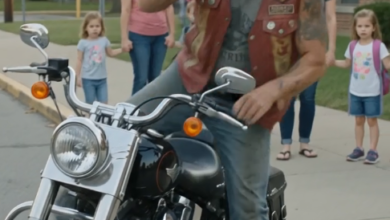
Sophie found him beside his Harley.
She had drawn a picture.
It showed a giant biker holding an enormous cup while a cartoon wasp flew away wearing an angry expression.
Across the top she had written:
THANK YOU FOR SAVING ME FROM THE MEAN LEMONADE BUG.
Stone studied it.
“You made me too tall.”
“You are too tall.”
“That’s fair.”
Sophie handed him a small gift bag.
Inside was a new travel cup with a locking lid.
A black motorcycle had been painted on one side.
“You need this,” she said.
“For what?”
“So bugs can’t get your drink either.”
Stone cleared his throat and looked toward his motorcycle until the emotion passed.
Then he promised to use it.
PART 6
One week after the incident, Sophie asked to return to Miller’s Diner.
Laura initially worried that the restaurant might remind her of fear, but Sophie said she needed to replace something.
They arrived shortly before lunch.
Stone was already there.
The manager had invited him back because several employees wanted to thank him. He sat in the same booth, drinking coffee from the motorcycle cup Sophie had given him.
When Sophie entered, Stone raised it carefully.
“Bug-proof.”
She inspected the lid.
“Good.”
The diner had replaced its open sugar containers with covered dispensers and installed a soft-closing screen near the patio entrance. Staff had also received a short safety briefing about allergy emergencies and unattended drinks.
The changes were not presented as proof the restaurant had been negligent.
Warm-weather insects entered buildings.
The goal was to reduce risk, not assign shame.
Sophie ordered raspberry lemonade again.
This time, the server brought it in a clear bottle so she could inspect the drink before opening it.
Stone remained at another table until Sophie waved him over.
She wanted him to watch the new routine Laura had taught her.
Sophie checked around the lid.
She examined the straw.
She looked inside before drinking.
“Safe,” she announced.
Stone nodded.
“Professional inspection.”
Sophie took one sip.
Then she moved the cup toward him.
“You want some?”
Stone shook his head.
“I saw what happened to the last person who touched your lemonade.”
Laura laughed.
After lunch, Sophie became serious.
“Did you think I was going to die?”
The question caught both adults unprepared.
Stone answered carefully.
“I thought you might be hurt, and I knew I could stop it before we found out how badly.”
“Were you scared?”
“Yes.”
“You didn’t look scared.”
Stone folded his hands on the table.
“Sometimes adults move first and feel scared afterward.”
Sophie considered this.
“Mom was angry at you.”
“She thought I was hurting you.”
“But you weren’t.”
“She couldn’t know that yet.”
Laura looked at him gratefully.
Stone never used her first reaction against her. He understood that protecting a child sometimes meant distrusting the stranger closest to them.
Laura had been wrong about what he was doing.
She had not been wrong to move toward her daughter.
Two people could act from protection while understanding different parts of the same moment.
That lesson mattered beyond the diner.
PART 7
The video faded from public attention within weeks, replaced by newer moments that seemed equally shocking for a few seconds.
The travel cup remained.
Stone carried it on every long ride.
The painted motorcycle gradually scratched, and the locking lid became stained by coffee, but he refused every replacement the club offered.
“It was issued by a professional safety inspector,” he told them.
Sophie continued attending the Iron Guardians’ family events with Laura. She learned that the intimidating men and women in leather vests included nurses, teachers, mechanics, veterans, and parents who could argue for twenty minutes about the safest way to cook hamburgers.
Stone taught Sophie how to check a bicycle before riding.
Sophie taught Stone that raspberry lemonade tasted better when he stopped pretending all flavored drinks were “children’s beverages.”
Their friendship grew within careful boundaries.
Laura remained present.
Stone never replaced Sophie’s father or treated one rescue as permission to enter every part of the family’s life.
He became Uncle Stone, the enormous biker who checked every outdoor cup twice and became visibly nervous whenever insects approached a picnic table.
Years later, Sophie joined a school health club and helped organize allergy-awareness training for teachers and students. She carried her prescribed emergency medication without embarrassment and taught friends how to follow her personal emergency plan.
During one presentation, a classmate asked whether she hated wasps.
“No,” Sophie answered. “They’re just doing wasp things. People have to do careful people things.”
Laura recognized Stone’s influence in the sentence.
On Sophie’s sixteenth birthday, the family returned to Miller’s Diner. The restaurant had changed owners, but the same corner booth remained.
Stone arrived wearing the leather vest now faded nearly gray.
Sophie ordered raspberry lemonade.
When the server placed it down, Stone leaned forward dramatically and inspected the lid.
Sophie covered the cup with one hand.
“Touch it and lose the beard.”
Stone sat back.
“You’ve become violent.”
“I learned from bikers.”
Laura shook her head while both laughed.
A framed copy of Sophie’s original drawing hung near the register. The caption beneath it did not call Stone a hero.
It read:
HE SAW WHAT THE REST OF US MISSED.
That was the part Stone valued.
Most people imagined rescue as an extraordinary act requiring strength, bravery, or sacrifice. Sometimes it required nothing more dramatic than paying attention to a small movement inside an ordinary cup.
The people in the diner had initially seen a large biker snatch a drink from a child and dump it onto the floor.
They reacted to the information available.
Then the wasp crawled into view.
The meaning changed.
Stone had frightened Sophie.
He had ruined her lemonade.
He had given every stranger in the room a reason to misunderstand him for several seconds.
Yet the drink was replaceable.
The moment was recoverable.
The risk of waiting was not something he was willing to test.
Laura later described it in the simplest words:
“He poured out my daughter’s drink. He may also have saved her life.”
Sometimes kindness looks gentle from the beginning.
Sometimes it arrives as an enormous tattooed hand taking away the thing you wanted, seconds before you discover what was hidden inside.
Follow this page for more unforgettable biker stories about misunderstood kindness, ordinary moments of courage, and the people who notice danger before the rest of the room understands why they moved.