Part 2: A Tattooed Biker Blocked a School Bus Full of Children and Refused to Move — Then a Former Mechanic Heard the Sound That Could Have Killed Thirty Kids
PART 2
Jonah Mercer did not like schools.
That surprised people because he had spent a large part of his adult life repairing school buses. He knew the smell of diesel mornings, vinyl seats, spilled juice, wet backpacks, old heaters, and the strange mix of chaos and trust that came with putting children inside a machine and sending them home.
He respected schools.
He simply did not like standing near them.
When Jonah was eleven, his father stopped picking him up after football practice. At first, Jonah waited beside the fence with confidence. Then embarrassment. Then anger. Finally, he learned to walk home before anyone could notice he was waiting for someone who would not arrive.
That old humiliation never fully left him.
Maybe that was why he liked machines. A loose belt, a worn bearing, or a bad wheel never lied about what was wrong. It made a sound. It gave warning. If someone listened, the problem could be fixed before it became tragedy.
Jonah had been a fleet mechanic for the Franklin County school district for seventeen years before opening his own small garage. He retired from district work after a maintenance-bay accident injured his right shoulder, but he never stopped hearing buses the way other people heard music.
That Monday, he had not planned to involve himself in anything.
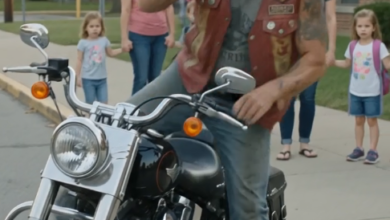
He was across the street from Brookside Elementary because Mrs. Alvarez from the apartment building behind the school had called him about her son’s motorcycle. Jonah finished the repair early, sat on his Harley, and watched the dismissal line move like it always did: children shouting, parents waving, teachers pointing, buses rumbling toward the road.
Then Bus 42 passed.
The sound was small.
A parent would not have noticed it. A teacher would not have noticed it. Even the driver might not have heard it from inside the cab over the engine, children, and radio chatter.
But Jonah did.
A heavy wheel has a language when it is no longer sitting true. It complains in uneven beats, like a bad tooth inside metal. Jonah heard a faint knock, then a wobble, then a second knock that did not belong to the road.
He looked at the left rear wheel and saw the tiniest side-to-side movement.
The bus was approaching the exit.
Beyond the exit was Maple Avenue, where traffic moved fast and the road curved downhill toward an intersection.
Jonah did not think about how he would look.
He thought about thirty children riding over that curve.
Then he moved.
PART 3
To Angela Morris, the biker appeared out of nowhere.
She had driven children for thirteen years without a single preventable accident. She checked mirrors. She counted heads. She knew which children cried on the first day of kindergarten and which fifth graders pretended they were too old to wave at their mothers.
When Jonah rolled his Harley into her path, her first thought was not gratitude.
It was threat.
A large biker had just blocked a bus full of children.
That was all any responsible driver needed to know.
She set the brake, opened the window, and ordered him to move. Her voice stayed professional, but her right hand hovered near the radio button.
Jonah did not approach the door.
He did not reach for the bus.
He stood several yards away with both hands raised, as if police were already there.
“Please keep the brake set,” he called. “Left rear wheel. You need maintenance here before this bus moves another block.”
Parents surged closer.
A father named Craig Dutton shouted that Jonah was trying to hijack the bus. Another parent stepped between the biker and the children, even though Jonah had not come near them.
The school security officer, Mr. Wesley Grant, arrived breathless. He was a fifty-year-old Black American man with dark skin, a shaved head, and the calm posture of someone trained to handle upset adults.
“Sir, step away from the bus.”
Jonah obeyed immediately, backing toward his motorcycle while keeping it parked across the driveway.
Grant noticed that detail.
A reckless man often argues with authority.
Jonah did not argue.
He only said, “Don’t let it roll onto Maple.”
Angela contacted dispatch and the transportation office. While everyone waited, the children pressed their faces toward the windows, trying to understand why the bus had stopped.
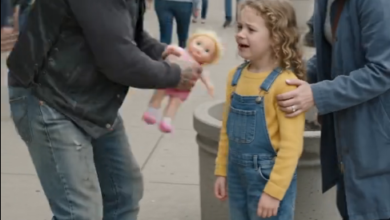
Inside the second row sat nine-year-old Sophie Miller, a small white American girl with pale skin, red hair in two braids, freckles, and a blue backpack covered in star patches.
She had seen adults angry before.
This felt different.
The biker did not look angry.
He looked scared.
When transportation supervisor Dennis Cole arrived in a white district pickup, he came ready to remove a trespasser. Dennis was a fifty-eight-year-old white American man with gray hair, a reflective vest, and thirty years of road-maintenance experience.
“What exactly do you think you heard?” Dennis demanded.
Jonah answered without pride.
“Loose wheel hardware. Left rear. Outer side. I’d bet my bike on it.”
Dennis knelt beside the tire with a flashlight.
His expression changed before he said a word.
That silence frightened Angela more than Jonah had.
PART 4
Dennis ordered every child off the bus.
That was when the parents stopped shouting.
Angela opened the doors, and teachers helped students step down carefully into a line near the school fence. The children did not understand why they were being moved, only that adults had gone very serious very fast.
Jonah remained across the driveway, away from the students, because he knew the same parents who had feared him minutes earlier did not need him standing close to their children while emotions were still raw.
Dennis continued inspecting the wheel area.
When he stood, his face had gone pale.
“Bus is out of service.”
Angela gripped the doorframe.
“How bad?”
“Bad enough that I’m glad it stopped here.”
The wheel was not lying loose on the axle, as some parents later exaggerated. It had not detached. The children had not been seconds from a movie-like disaster.
Reality was quieter and more frightening.
Several lug nuts had backed off. One was gone. The wheel had begun to move under load. If the bus had taken the downhill curve on Maple Avenue, the shifting could have worsened quickly, especially under the weight of thirty children and a full turn.
Maybe it would have held until the depot.
Maybe not.
No responsible mechanic would gamble children on maybe.
Dennis turned toward Jonah.
“You were district fleet, weren’t you?”
“Seventeen years.”
“What shop?”
“West yard.”
Dennis stared at him longer.
“Torque Mercer?”
Jonah gave a small, uncomfortable nod.
A few older drivers remembered the name then.
Torque Mercer was the mechanic who could diagnose a failing bearing from across a parking lot. The mechanic who used to stay late before snow days because buses did not care if children were cold. The mechanic who left after an injury but still sent coffee to the depot during winter inspections.
Angela stepped down from the bus slowly.
“I didn’t hear it.”
Jonah shook his head.
“You had engine noise, kids talking, radio, wind. It wasn’t your fault.”
One parent lowered his phone.
Another whispered, “He blocked the bus because he knew.”
Craig Dutton, the father who had shouted about a hijacking, looked ashamed but not ready to speak.
Sophie Miller stood near the fence, staring at Jonah.
She had watched the adults change their faces.
First fear.
Then anger.
Then something close to relief.
She raised one small hand in a shy wave.
Jonah saw it and nodded once.
That almost undid him.
PART 5
Police arrived because two parents had called 911 during the first minute.
Officer Dana Ruiz, a forty-one-year-old Latina American woman with tan skin, dark hair pulled into a tight bun, and a patient but direct voice, spoke first with Angela, then Grant, then Dennis, then Jonah.
The facts became clear quickly.
Jonah had blocked the driveway at low speed while the bus remained on school property. He had not threatened anyone, touched the bus, approached children, or refused police commands. His motorcycle had obstructed school transportation, but his stated concern had been immediately verified by a district supervisor.
Dana still asked him whether he understood how dangerous his action could have appeared.
Jonah nodded.
“I knew how it looked.”
“Then why not call the school office?”
“Because the bus was moving.”
“Why not wave harder?”
“I did.”
“Why use the motorcycle?”
Jonah looked toward the bus, now silent and empty.
“Because I needed something bigger than my voice.”
Dana wrote that down.
A replacement bus arrived. The children boarded under supervision, and Angela moved them safely home after the district reassigned her route. Before leaving, she walked to Jonah.
“I was angry.”
“You should have been.”
“I thought you were endangering my kids.”
“I know.”
She held out her hand.
“You probably saved them.”
Jonah shook her hand carefully.
“I stopped a bus. Your inspection protocols and maintenance people will find out why it needed stopping.”
That mattered to Angela.
He was not there to humiliate the driver.
He was not there to make himself the hero and everyone else incompetent.
He had heard a warning and refused to ignore it.
Later that evening, the district began reviewing maintenance records. The wheel had been serviced days earlier by an outside contractor during a tire replacement. An internal investigation would determine whether torque procedures were missed, recorded incorrectly, or compromised afterward.
Jonah did not speculate online.
He posted only one sentence after the story began spreading.
Do not blame the driver. Listen to machines, inspect what matters, and never put pride ahead of children.
The sentence spread faster than the video of him blocking the bus.
For once, Jonah was grateful.
PART 6
Sophie Miller could not stop thinking about the sound.
She had not heard it herself. All she remembered was the biker’s face through the windshield, the sudden stop, the adults shouting, and the strange moment when the transportation man looked under the bus and became quiet.
At dinner, she asked her father what would have happened if the bus had kept going.
Her father, Craig Dutton, put down his fork.
Craig had been the loudest parent outside the school. He had called Jonah dangerous. He had told another father to record everything. He had imagined himself protecting children from a biker, only to learn the biker had been protecting them from a wheel problem no parent had noticed.
He did not know how to explain that to his daughter without frightening her.
So he told the truth carefully.
“The bus had a problem. Mr. Mercer heard it before anyone else did.”
“Could the wheel fall off?”
“It might have become very dangerous.”
“Did he save us?”
Craig looked toward his wife.
“Yes.”
“Then why did you yell at him?”
The question hit harder because it was innocent.
Craig answered slowly.
“Because I saw what he looked like before I understood what he knew.”
Sophie considered that.
“That’s not fair.”
“No,” Craig said. “It wasn’t.”
The next morning, Craig returned to Brookside Elementary early and waited beside the front entrance until Jonah arrived to speak with the transportation office. The biker approached cautiously, as if expecting another argument.
Craig held out his hand.
“I owe you an apology.”
Jonah accepted it.
“You were scared.”
“I judged you.”
“That happens.”
“It shouldn’t have happened so fast.”
Jonah looked toward the buses.
“Most bad judgments happen fast. So do some good decisions. The trick is fixing the first kind when the truth catches up.”
Craig nodded.
“My daughter wants to draw you something.”
Jonah looked genuinely alarmed.
“I don’t need anything.”
“She does.”
That afternoon, Sophie gave Jonah a picture drawn in blue crayon. It showed a yellow bus, a motorcycle, and a giant wheel floating above them like a dark moon. Underneath, in careful letters, she had written:
THE MAN WHO HEARD THE BUS.
Jonah stared at the drawing.
No award from the district would have meant more.
Still, when the school asked whether they could share the picture, he insisted Sophie’s parents decide and that her face remain private.
He understood something many adults forgot.
A child’s gratitude was not content.
It was a gift.
PART 7
The investigation changed things.
The district tightened wheel-service verification rules, required secondary checks after tire work, updated driver reporting procedures for unusual sounds, and added short safety briefings about listening for new vibrations before leaving school property. None of the changes were dramatic enough for television, which meant they were exactly the kind that prevent future tragedies quietly.
Jonah returned to his garage.
For several days, people came by only to look at him.
Some thanked him. Some apologized. Some wanted selfies beside his Harley. Jonah accepted handshakes but refused to turn the school bus incident into a personal brand.
“I heard a noise,” he kept saying. “That’s all.”
But it was not all.
Hearing danger is not the same as acting on it.
Plenty of people notice something wrong and wait for someone else to confirm it. Jonah had spent his life learning that machines often whisper before they fail, and the cost of ignoring that whisper rises with every second.
At the next school board meeting, Angela Morris spoke first.
She stood in front of parents, mechanics, administrators, and drivers, wearing the same navy uniform from that day.
“I have transported children for thirteen years,” she said. “I am proud of my safety record. But pride cannot be louder than warning signs. Mr. Mercer stopped my bus because he heard something I could not hear from the driver’s seat. I am grateful he acted before we reached Maple Avenue.”
Dennis Cole followed.
He confirmed the wheel issue without exaggerating and without hiding the seriousness.
Then Jonah was asked to speak.
He hated microphones.
He looked at the crowd, then at Sophie sitting between her parents, clutching a folder of drawings.
“I blocked a bus,” he said. “I understand why that scared people. I would rather spend the rest of my life explaining why I blocked it than spend one minute wishing I had.”
The room became silent.
He continued.
“I know the sound of a wheel getting ready to leave. I heard it once on a truck when I was twenty-two and didn’t speak up because I was the youngest mechanic in the shop. That wheel came off two miles later. Nobody died, but a driver was hurt badly enough that I still remember his voice asking what happened.”
Jonah’s hands tightened around the microphone.
“After that, I promised myself I would never keep quiet because I was afraid of looking foolish.”
Craig looked down.
Angela wiped her eyes.
Sophie raised her drawing slightly, as if reminding him that he had not looked foolish to everyone.
Years later, Brookside children would still talk about the biker who stopped Bus 42. The story changed as children’s stories do. Sometimes the wheel was already falling. Sometimes Jonah lifted the bus with one hand. Sometimes the Harley had magical brakes.
The truth was simpler and better.
A man heard a sound.
He trusted what years of hard work had taught him.
He accepted being hated for several minutes.
And thirty children went home safely because he decided a driveway full of angry adults was less frightening than a bus full of children on a road with a failing wheel.
Sophie kept drawing buses for a while. In each picture, the wheels were enormous, round, and carefully attached.
In the corner of one drawing, she added a small motorcycle and a bearded man standing with one hand raised.
When her teacher asked what he was doing, Sophie answered:
“He’s listening.”
That was the legacy Jonah wanted.
Not fear.
Not praise.
Listening.
Because sometimes the thing that saves children is not a loud hero, a dramatic speech, or a perfect plan.
Sometimes it is one scarred old mechanic refusing to ignore a sound everyone else mistakes for nothing.
Follow this page for more unforgettable biker stories about misunderstood courage, ordinary skills used at exactly the right moment, and the people willing to be judged harshly so someone else can make it home safely.