Part 2: A Massive Biker Tore a Young Boy’s Shirt Apart in the Middle of a Crowded Park — Then Everyone Saw the Flames He Had Smothered Before They Reached the Child’s Skin
PART 2
Jordan’s family had arrived at the park shortly before noon to celebrate his younger sister’s seventh birthday.
Denise Ellis was a thirty-six-year-old Black American single mother who worked as a respiratory therapist at a local hospital. She spent most of her professional life around emergencies, but that afternoon she wanted nothing more complicated than cake, balloons, and several hours during which nobody required medical care.
Jordan wore the red jersey because it had belonged to his late father, Marcus.
Marcus Ellis had coached youth football before dying from a sudden heart condition two years earlier. The jersey was not valuable, but Jordan had begun wearing it to family gatherings whenever he missed him.
It was too large.
The loose fabric hung several inches below Jordan’s waist and moved easily in the wind.
Denise had asked him to change before leaving home because oversized synthetic clothing was not ideal around an active grill. Jordan refused.
“It was Dad’s.”
That ended the argument.
At the park, Denise kept Jordan away from the cooking area at first, but relatives arrived carrying food, children needed help with gifts, and her attention became divided across dozens of ordinary responsibilities.
Jordan eventually moved toward the grill to ask his uncle whether the hamburgers were ready.
The grill had a metal wind guard, but a sudden breeze passed through the shelter just as grease dripped onto the coals. A brief flare sent several glowing particles into the air.
Most cooled before touching the ground.
One landed against Jordan’s jersey.
Synthetic fabric does not always burn like paper or cotton. It may shrink, melt, and cling while producing a small flame that spreads rapidly once established.
Jordan stood with his back toward everyone at the grill.
His uncle watched the food.
Denise was helping her daughter open a package.
Stone happened to be facing the correct direction.
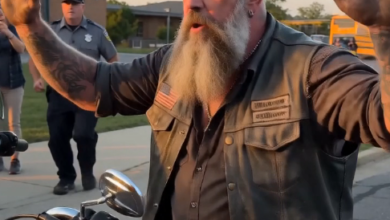
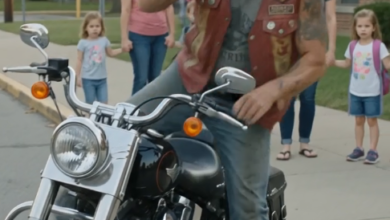
He had joined several Iron Guardians Motorcycle Club members at the park after completing a charity ride. Their picnic table stood nearly forty feet away, close enough for him to notice an unnatural flicker moving along Jordan’s back.
At first, Stone believed sunlight was reflecting from the red fabric.
Then he saw smoke curl upward near the boy’s shoulder.
He did not shout because Jordan might have turned toward the grill or begun running through the crowded picnic area. Moving air could have fed the flame, while nearby children might have entered his path.
Stone acted before anyone else understood there was a problem.
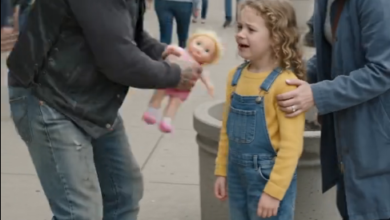
From Denise’s angle, his intervention looked nothing like rescue.
It looked like a stranger tearing apart the last shirt her son owned from his father.
PART 3
The first person to reach Stone was Jordan’s uncle, Terrence.
Terrence had been holding a metal spatula when he heard the boy scream. He turned and saw Stone gripping the jersey near Jordan’s shoulder while Denise shouted from several yards away.
Terrence dropped the spatula and charged forward.
Stone tore the side seam, pulled the melting fabric away from Jordan’s undershirt, then pushed the child gently toward the open grass.
“Keep him away from the grill!”
Terrence stopped only because he saw the flame.
For less than a second, the red jersey burned in Stone’s hands.
He threw it onto the pavement, removed his leather vest, and smothered the fabric beneath it while another biker moved the children farther away.
A man named Peter Lawson began recording after hearing Denise scream. His phone captured Stone tearing the final portion of the jersey from Jordan’s shoulder, but it missed the ember landing and the first flame appearing.
“Somebody call the police!” Peter shouted.
Another visitor accused the bikers of starting a fight.
Stone ignored them.
Once the flame disappeared, he moved his vest away carefully and told everyone not to touch the melted fabric.
Then he turned toward Jordan.
“Does anything hurt?”
Jordan was crying too hard to answer.
Denise reached him and immediately examined his face, arms, neck, and back. The white cotton undershirt carried a small brown mark but had not ignited.
A retired nurse attending another picnic brought the park’s first-aid kit while Terrence called emergency services. They did not apply ice, butter, or creams. They kept Jordan calm, checked for pain, and waited for trained responders to examine him properly.
Stone remained several steps away.
He understood that Jordan needed his mother, not the stranger who had just frightened him.
Police officers arrived before the ambulance because witnesses had reported an adult assaulting a child. Officer Lena Ortiz approached Stone with one hand near her radio and ordered him to keep his hands visible.
Stone complied.
He did not become offended or attempt to explain over Denise’s voice.
Peter showed the officer his video.
The recording initially appeared alarming.
Then Officer Ortiz watched the final seconds, where the burning jersey fell onto the pavement beneath Stone’s leather vest.
She looked toward the grill.
“What happened before you started recording?”
Peter lowered his phone.
“I don’t know.”
Stone answered quietly.
“That’s the part everybody missed.”
PART 4
Paramedics found no serious burns.
Jordan’s back showed mild redness where heat had begun transferring through the undershirt, but the skin was not blistered or broken. They cooled the affected area appropriately, monitored his breathing because of the smoke, and recommended further evaluation as a precaution.
Denise sat beside Jordan inside the ambulance while he held both arms around himself.
“My dad’s shirt is gone,” he whispered.
The sentence hurt her more than she expected.
The jersey was ruined. Most of the back had melted into a blackened mass, and one sleeve had been torn completely away.
Denise looked toward Stone standing beside the police officer.
For a terrible moment, grief and gratitude occupied the same space.
Stone had destroyed something connected to Marcus.
He had also prevented that same fabric from melting against Jordan’s skin.
Denise stepped from the ambulance.
“Why didn’t you shout first?”
Stone did not become defensive.
“I thought about it.”
“Then why didn’t you?”
“The flame was already moving. If he panicked and ran, the air could have fed it. If he turned toward the grill, somebody else could have been hurt.”
“You frightened him.”
“I know.”
“You frightened me.”
“I know that too.”
Stone looked toward the blackened jersey.
“I had enough time to stop the fire. I didn’t have enough time to make the rescue look gentle.”
Officer Ortiz confirmed that witnesses had seen the spark land and that no assault had occurred. Park cameras later supported Stone’s account.
Denise pressed one hand against her forehead.
“I called you a monster.”
“You saw a stranger tearing clothing from your child.”
“You could have been arrested.”
“That would have been easier to repair than a burn.”
Denise looked at Stone’s hands.
The fingertips of his left glove had melted slightly, and the skin along his wrist was reddened where the burning jersey had touched him before he threw it down.
“You were hurt.”
“Not badly.”
“You keep saying that like it doesn’t matter.”
Stone glanced toward Jordan.
“It mattered less.”
The answer did not sound heroic.
It sounded practiced.
Denise wondered how many times the biker had placed his own pain beneath someone else’s emergency.
Then Jordan called from the ambulance.
“Mom, there’s something inside his vest.”
Stone looked toward the leather garment lying beside the ruined jersey.
A small photograph had slipped from its inner pocket.
It showed a much younger Stone kneeling beside a boy whose left arm was covered in burn bandages.
PART 5
The boy in the photograph was Stone’s younger brother, Samuel.
Stone had been seventeen when a backyard barbecue changed both their lives.
Their parents were hosting a neighborhood cookout similar to the one at Riverside Park. Samuel, then nine, wore a loose nylon windbreaker because the evening had become cool.
A small flame from the grill caught the lower edge of the jacket.
Nobody saw it immediately.
Samuel felt heat and began running.
The movement fed the flame.
By the time an adult caught him and smothered the jacket, the melting material had caused serious burns across part of his back and arm.
Samuel survived, but he endured surgeries, physical therapy, and years of unwanted attention toward his scars.
Stone had been standing less than fifteen feet away.
He heard Samuel scream but did not understand what was happening until another adult acted.
That memory became part of every fire Stone saw afterward.
He joined a volunteer fire department at nineteen and later served as a municipal firefighter for twelve years before a knee injury ended his active duty. He eventually opened a motorcycle repair shop, but continued attending fire-safety training and carrying extinguishers in every vehicle he owned.
The photograph inside his vest had been taken during Samuel’s first day home from the hospital.
Jordan studied it after Stone explained.
“Is he okay now?”
“He’s alive, married, and complains more than any person I know.”
“Does his arm still hurt?”
“Sometimes.”
Jordan looked toward the ruined jersey.
“Would that have happened to me?”
Stone refused to frighten him with certainty.
“I don’t know how badly you would’ve been hurt. I knew waiting would make the answer worse.”
Denise stood beside them.
“Is that why you tore it instead of trying to pat the fire out?”
“The fabric was beginning to melt. I wanted it away from his skin.”
Jordan lowered his eyes.
“You ruined my dad’s shirt.”
Stone accepted the accusation.
“Yes.”
Jordan waited, perhaps expecting the biker to defend himself.
Stone did not.
“I’m sorry about the shirt,” he continued. “I would still make the same choice.”
Jordan looked toward his mother.
Denise understood that her son needed permission to feel both things.
“You’re allowed to be sad about Dad’s jersey,” she told him. “And we’re allowed to be thankful Mr. Mercer took it away.”
The two feelings did not cancel each other.
Jordan touched the scorched fabric with one gloved finger after firefighters declared it safe.
“Can anything be saved?”
Most of the jersey could not.
But the number from the front remained intact.
Stone examined it.
“Maybe enough for something that doesn’t have to be worn near a grill.”
PART 6
Stone took the surviving front panel to Denise only after asking permission.
His motorcycle club included a rider named Rebecca “Red” Morgan, a sixty-one-year-old white American woman who restored old clothing and created memory quilts for grieving families.
Red cleaned the unburned fabric carefully and removed Marcus’s football number from the damaged jersey. She stitched it onto a dark blue square, framed it beneath protective glass, and left one small scorched edge visible.
“We could hide the damage,” she told Stone.
“Don’t.”
“Why?”
“Because the reason it survived matters.”
One week after the picnic, Stone returned the frame to Jordan at the repair shop.
Jordan stared at his father’s number for a long time.
The burned edge remained at the bottom, surrounded by clean fabric.
“It looks different.”
“It is different.”
“It’s not a shirt anymore.”
“No.”
Jordan looked disappointed.
Stone did not ask him to feel grateful.
Then Jordan turned the frame over.
Red had attached a small handwritten card:
SOME THINGS CANNOT RETURN TO WHAT THEY WERE, BUT THEY CAN STILL CARRY THE PERSON WE LOVED FORWARD.
Jordan read the sentence twice.
He asked whether the frame could hang inside his bedroom.
Denise nodded.
The park video had already begun spreading online. Peter posted it only after speaking with Denise and including the full explanation, though Jordan’s face was blurred.
His caption read:
I thought this biker was attacking a child. He was tearing fire away before it reached the boy’s skin. The first five seconds were not the whole story.
Some viewers praised Stone.
Others criticized the parents for allowing a child near a grill.
Denise responded once.
“Jordan should not have stood that close, and we have changed our safety rules. Shame would not teach us more than responsibility already has.”
Stone declined interviews but agreed to help the fire department create a community barbecue-safety event.
The presentation covered safe distances around grills, supervision, clothing choices, handling flare-ups, keeping extinguishing equipment nearby, and calling emergency services after a fire-related injury.
Stone did not demonstrate tearing clothing from children.
He emphasized prevention.
“The best rescue is the one nobody has to perform,” he said.
Jordan attended wearing a cotton T-shirt with his father’s number printed across the front.
During the event, he helped younger children identify a marked safety boundary around a cold demonstration grill.
One child asked whether Stone was the biker who destroyed his shirt.
Jordan looked toward the frame displayed at the information table.
“He destroyed the part that was burning,” Jordan said. “He saved the part that was me.”
Stone turned away before anyone noticed his eyes filling.
Denise noticed.
She had learned his habit.
PART 7
The fire-safety event became an annual program supported by the parks department, local firefighters, neighborhood groups, and the Iron Guardians Motorcycle Club.
Stone insisted that the club never present itself as an emergency service. Its members helped set up barriers, distribute information, check extinguishers, and direct families toward licensed professionals.
Jordan returned every year.
At twelve, he handed out safety cards.
At fourteen, he completed a certified youth first-aid course.
At sixteen, he volunteered with a community fire-explorer program, though Denise reminded him repeatedly that joining emergency services was not something he owed Stone.
“I know,” Jordan said. “I just want to be the person who notices.”
The frame containing his father’s jersey number remained above his bedroom desk.
For several years, the scorched edge made him angry.
It represented the moment he lost one more physical connection to Marcus.
As he grew older, the meaning changed.
The frame contained loss.
It also contained interruption.
The fire had taken part of the jersey, but Stone had stopped it before it took skin, movement, confidence, or years of Jordan’s life.
Jordan eventually visited Samuel, Stone’s younger brother.
Samuel was now a middle-aged school counselor with visible scars along his left forearm. He greeted Jordan warmly and immediately accused Stone of exaggerating every story involving their childhood.
“He said you complain a lot,” Jordan replied.
“That part is accurate.”
Samuel showed him how synthetic fabric had melted during the accident and explained why he never attended a barbecue without checking where children were standing.
“Stone still blames himself,” Samuel said.
“He was seventeen.”
“He knows.”
“Then why?”
Samuel looked toward his scars.
“Knowing something wasn’t your fault and feeling free from it are different jobs.”
Jordan understood.
Stone had not acted at Riverside Park only because he possessed training.
He acted because some part of him had remained inside that old backyard, watching his little brother run while fire spread across his jacket.
Stopping Jordan did not erase Samuel’s pain.
It gave the memory somewhere useful to go.
Years later, Jordan became a fire-prevention educator rather than an active firefighter. He visited schools, parks, youth centers, and neighborhood events, teaching children how ordinary choices could prevent emergencies.
During presentations, he displayed two photographs.
One showed his father coaching football while wearing the original red jersey.
The second showed the framed number with the scorched edge.
Jordan told the story without making Stone larger than life.
“A man saw something my family missed,” he explained. “He acted quickly, frightened me, destroyed something I loved, and prevented the fire from reaching my skin.”
A student once asked whether Jordan had forgiven him for ruining the jersey.
Jordan smiled.
“I was never angry because he wanted to destroy it. I was angry because I didn’t understand why it had to be destroyed.”
“That’s different?”
“Very.”
When Stone turned seventy, Jordan organized a small barbecue at Riverside Park.
The grill stood behind a clearly marked safety boundary. Every child wore fitted clothing, and three fire extinguishers were positioned nearby because Stone believed one extinguisher represented optimism rather than planning.
Denise brought the framed jersey number.
Samuel attended too.
During the meal, Jordan presented Stone with a new leather vest. The old one had been permanently damaged while smothering the jersey and had required several repairs over the years.
Inside the new vest, Jordan had sewn a small red patch shaped like his father’s football number.
Stone touched it silently.
“You didn’t have to do this.”
“You didn’t have to save any part of the shirt.”
Stone looked toward him.
“I wasn’t saving the shirt.”
“I know.”
That was exactly why the patch mattered.
The viral version of the incident remained simple.
A frightening biker tore a child’s shirt apart in a public park, then everyone discovered it had been burning.
The fuller truth required more space.
Denise’s fear had been reasonable because she saw a stranger grabbing her child.
Jordan’s distress had been real because the shirt connected him to his dead father.
Stone’s action had been violent only toward the fabric, but it still frightened the people he intended to protect.
And rescue did not make every loss disappear.
The jersey was gone.
What remained was a number, a burned edge, and a boy who reached adulthood without scars across his back.
Stone had explained his choice in one sentence:
“I tore his shirt so the fire couldn’t spread. He didn’t understand—but he didn’t get burned.”
Sometimes protecting someone means speaking gently and asking permission.
Sometimes there is enough time for explanation.
Other times, fire is already moving.
In those moments, the person who sees it first may have to accept looking cruel for several seconds, because damaged fabric can be mourned, replaced, or transformed.
A child’s skin cannot.
Follow this page for more unforgettable biker stories about misunderstood courage, split-second compassion, and the people willing to destroy something replaceable before the danger reaches what truly matters.