Part 2: A Massive Biker Blocked a Biological Father From Entering His Sick Son’s Hospital Room — Until Police Found the Restriction Order the Hospital System Had Failed to Show
PART 2
Mason Sullivan had begun volunteering at Mercy Children’s Hospital three years earlier, though nobody would have guessed it from looking at him.
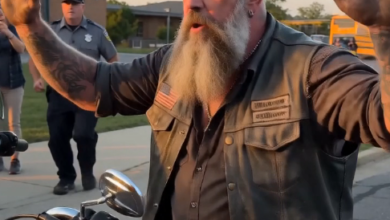
He belonged more naturally beside motorcycles, welding equipment, and roadside diners than painted hospital walls decorated with cartoon animals. His hands were large enough to hide most children’s books, and his gray beard made him look like a man younger patients might fear before they heard him speak.
The invitation came through his late wife.
Linda had worked as a pediatric nurse for twenty-two years. Before cancer took her, she told Mason that children often trusted people who did not pretend everything would be fine. They trusted adults willing to sit quietly inside fear instead of rushing to cover it with cheerful lies.
“Read to them,” she had said during one of their final conversations. “You’ve got the voice for dragons.”
Mason laughed then.
Six months after her funeral, he walked into Mercy Children’s carrying a box of donated books and almost walked straight back out.
He stayed.
Over time, children began asking for him by name. He read pirate stories badly, performed different voices for every animal, and never laughed when a child wanted the same chapter three nights in a row. He did not ask why parents were absent or why some children cried after phone calls. He understood that volunteers were not investigators, therapists, or replacement family.
Their job was to be present.
Oliver Hayes had arrived at the hospital nine days earlier with severe pneumonia complicated by an immune condition. His mother, Claire, stayed during the day but worked night shifts at a distribution center because missing too many hours could cost the family their apartment.
Oliver was quiet around most adults.
With Mason, he became talkative.
He liked stories about guarded castles, especially the doors.
“Why do castles need big doors?” he once asked.
“To keep bad things out,” Mason answered.
“What if the bad thing says it belongs inside?”
Mason had looked up from the book then.
Oliver immediately pretended to be interested in the illustration.
Mason did not press.
But he remembered the question.
So when Daniel Hayes appeared in the hallway and Oliver’s fingers locked around Mason’s vest, Mason understood something the hospital chart had not yet said aloud.
The child was not asking him to fight.
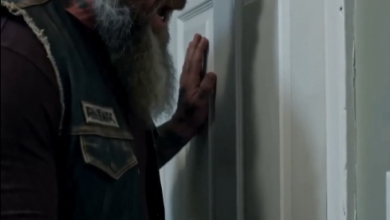
He was asking him to become a door.
PART 3
Daniel Hayes did not look like the kind of man hospital staff expected children to fear.
He wore clean clothes. He spoke clearly. His visitor badge had been printed at the front desk after he showed identification proving he was Oliver’s biological father. Nothing in the hospital’s electronic chart warned the nurse that he should not be there.
That was the problem.
The system recognized the relationship.
It did not recognize the danger.
Daniel stopped several feet from Mason.
“Move away from my son.”
Mason kept his voice calm.
“He asked me not to.”
“He’s eight. He’s sick and confused.”
Oliver’s fingers tightened around the vest.
Mason felt the movement but did not turn around. He worried that if he looked at the boy, Daniel might use the opening to move past him.
A nurse named Julia Bennett stepped closer. She was thirty-four, white American, with brown hair tied beneath a blue scrub cap and an expression caught between professional caution and rising concern.
“Mr. Hayes, please wait while we confirm visitation.”
“You already gave me the badge.”
“Yes, but Oliver appears distressed.”
Daniel looked beyond Mason.
“Oliver, tell them I can come in.”
The boy disappeared farther beneath the blanket.
Daniel took one step forward.
Mason shifted sideways, closing the doorway completely.
He did not raise his fists.
He did not widen his stance.
He simply occupied the space.
That restraint mattered later, though it looked like defiance in the moment.
Hospital security guard Paul Reynolds arrived first, a forty-six-year-old Black American man with close-cropped hair, a dark blazer, and both hands held visibly away from his body.
“Sir, you need to clear the doorway.”
Mason nodded toward Oliver.
“Ask the boy before you ask me.”
Paul looked past him.
Oliver could not speak.
Julia went to his bedside and found the folded paper beneath his shaking hand. She opened it slowly.
The sentence was written in uneven block letters.
My dad makes me scared. Please don’t tell him I said it.
Julia’s expression changed.
She quietly pressed the call button for additional assistance.
Daniel noticed.
“What did he write?”
Nobody answered.
His calm disappeared.
“Give me that paper.”
Mason remained between him and the room.
Daniel stepped closer again.
The child behind Mason stopped breathing normally.
And the biker did not move.
PART 4
Officer Renee Carter arrived with her partner four minutes later.
By then, the hallway held too many people and too little information. Daniel insisted a stranger was preventing lawful access to his son. Hospital security explained that Mason had refused repeated instructions. Mason said almost nothing because every raised voice made Oliver’s heart monitor climb faster.
Renee saw that first.
She asked everyone except one nurse to step back.
Then she approached Mason without reaching for him.
“Sir, I need you to move one step to your left.”
Mason looked through the doorway.
Oliver was sitting upright now, gripping the blanket with one hand and Mason’s vest with the other. He stared at Renee with the desperate calculation children learn when adults have failed them before.
Renee softened her voice.
“Oliver, my name is Officer Carter. Is Mr. Sullivan stopping someone you want to see?”
Oliver shook his head.
“Did you ask him to stand there?”
A tiny nod.
Daniel exhaled sharply.
“He is coaching the child.”
Renee turned toward him.
“Sir, do not speak to Oliver until I finish.”
Daniel’s jaw tightened, but he obeyed.
Renee read the note Julia handed her, then asked dispatch to search for active court orders connected to Daniel and Claire Hayes. The first search returned nothing. Daniel smiled as if the matter had ended.
“I told you.”
Renee did not answer.
She asked for a county-level records check rather than relying only on the hospital-linked database.
Minutes stretched.
Mason’s legs began aching, but he did not shift. Oliver’s hand still held the vest behind him.
Then Renee’s radio crackled.
There was an active temporary protective order issued nine days earlier after an emergency family-court hearing. Daniel was prohibited from contacting Oliver or entering any location where the child was receiving medical treatment.
The order had been sent to law enforcement.
It had not yet synchronized with the hospital’s visitor system.
The hallway changed instantly.
Daniel stepped back.
Officer Carter moved between him and the room.
“Mr. Hayes, place your hands where I can see them.”
Daniel began explaining.
Renee did not argue with him in front of Oliver. She instructed her partner to escort him away from the pediatric floor while she contacted the court and Claire.
Only after Daniel disappeared through the elevator doors did Mason feel Oliver’s fingers release the leather vest.
The child whispered, “Is he gone?”
Mason turned around.
“Yes, buddy.”
Oliver stared at the open doorway.
Then he began to cry.
PART 5
Mason moved away from the door as soon as Officer Carter confirmed that it was secure.
That mattered.
He did not linger as though the doorway belonged to him now. He did not claim authority over Oliver’s family or expect praise for refusing to move earlier. Once trained professionals understood the danger and took responsibility, Mason stepped aside immediately.
He returned to the chair beside Oliver’s bed.
The storybook still lay open on the floor.
Mason picked it up, but Oliver was no longer interested in dragons.
“Were you scared?” the child asked.
Mason considered lying.
Children deserve reassurance, but they also deserve truth shaped gently enough to carry.
“Yes,” he said.
Oliver looked surprised.
“You’re huge.”
“Being huge doesn’t stop fear.”
“Then why did you stay?”
Mason placed the closed book on his lap.
“Because you asked me.”
Oliver looked toward the doorway again.
Outside, Officer Carter was speaking with Julia and the hospital administrator. Security staff reviewed the visitor records while Claire raced toward the hospital from work, sobbing over the phone because the protective order she believed would safeguard her son had not appeared where it mattered.
Oliver’s breathing slowly settled.
Then he said something so quietly Mason almost missed it.
“You stood there like a door that knew how to love me.”
Mason lowered his head.
He had been called many things in his life. Criminal. Threat. Old fool. Road dog. Widow. Volunteer. None of them reached as deeply as that sentence.
He looked down at his tattooed hands.
“Doors don’t usually love people.”
“This one did.”
When Claire arrived, she entered the room wearing a warehouse vest over a gray sweatshirt, her dark hair loose from its tie and tears covering her face. She stopped when she saw Mason beside the bed.
For one tense second, he worried she would misunderstand him too.
Then Oliver told her, “He was my door.”
Claire crossed the room and wrapped both arms around her son.
She did not thank Mason immediately.
She was too busy proving to Oliver that he had been heard.
That was exactly how it should have been.
PART 6
The hospital opened an internal review before midnight.
The protective order had existed, but several systems had failed to share it quickly enough. Claire had provided a copy during Oliver’s admission, yet the document had been scanned into a general records folder rather than marked as an urgent visitation restriction. The front desk saw Daniel listed as the biological father and issued a badge without checking the buried attachment.
No one person had intended harm.
That did not make the failure harmless.
The hospital changed the record before Daniel reached the police station. A bright safety alert appeared on Oliver’s chart, access points were notified, and administrators began reviewing procedures for children connected to protective orders.
Officer Carter remained until Claire understood every next step.
Mason waited in the family lounge.
He did not want to occupy Oliver’s room once the boy’s mother arrived, and he did not want Claire to feel watched while speaking with police. He sat near a vending machine with the dragon book in his lap and a paper cup of coffee cooling between his hands.
Julia found him there.
“You did the right thing,” she said.
“I ignored hospital security.”
“You listened to the patient.”
“He’s eight.”
“That does not make his fear imaginary.”
Mason nodded.
Paul Reynolds, the security guard who had initially ordered him away, approached next. His expression carried no defensiveness.
“I thought you were interfering.”
“I was.”
Paul almost smiled.
“You know what I mean.”
Mason did.
From the hallway, Claire appeared with Officer Carter. She looked exhausted but steady.
“I need to thank you,” she said.
Mason stood.
“You don’t.”
“My son asked adults for help before.”
The sentence stopped him.
Claire pressed her hands together.
“Sometimes people thought he was exaggerating. Sometimes they told him his father loved him. Tonight, he asked one person who didn’t make him prove the fear first.”
Mason looked down.
“I saw his face.”
“You believed it.”
That distinction settled heavily between them.
Claire held out the folded note Oliver had written.
“I’m keeping the original,” she said, “but he asked me to show you what he added.”
Beneath the first sentence, Oliver had written another line.
Bear believed me before the computer did.
Mason turned away for a moment so nobody would see his eyes.
They saw anyway.
No one mentioned it.
PART 7
Oliver remained in the hospital for another eleven days.
During that time, Mason returned every Thursday as usual, although hospital administrators offered to excuse him from volunteering after the incident. He refused because Oliver still had five chapters left in the dragon book and because promises made beside hospital beds should not disappear when the hallway becomes uncomfortable.
The doorway changed after that night.
A new alert card appeared outside the room, using language designed to protect Oliver’s privacy while warning staff that all visitors required direct approval. Nurses checked identification twice. Security reviewed every name. Officer Carter called Claire with updates from the court.
But Oliver still watched the doorway whenever footsteps approached.
Fear does not leave merely because paperwork finally catches up.
Mason noticed.
So he adjusted his chair during reading time, placing himself where Oliver could see both him and the door without needing to turn his head. He did not block it anymore. He did not need to.
The system was finally standing there too.
Before Oliver was discharged, the nurses organized a small farewell in his room. No balloons, because of his respiratory sensitivity. No crowded visitors. Only Claire, Julia, Paul, Mason, and Officer Carter standing near the wall.
Oliver wore jeans, sneakers, and a green hoodie instead of the hospital gown. He looked stronger, though still small enough that the backpack on his shoulders seemed to carry him rather than the other way around.
He handed Mason a folded drawing.
It showed a hospital room with a large black door. The door had boots, a gray beard, tattooed arms, and a leather vest. Behind it stood a small boy holding a book.
Across the top, Oliver had written:
THE DOOR THAT LISTENED.
Mason studied it for a long time.
“Doors don’t have beards,” he finally said.
“Mine does.”
Everyone laughed softly.
Claire asked Mason whether he would continue reading to Oliver through video calls while the boy recovered at home. Mason agreed, though he warned that dragon voices sounded worse through a phone.
Months passed.
Oliver’s health improved slowly. The court made the protective order permanent while his father entered a supervised intervention program. The story did not end with simple forgiveness or miraculous change. Safety came through procedures, counseling, adults doing their jobs, and a child learning that saying “I am scared” could finally make someone stop.
The hospital also changed.
Protective orders received immediate red alerts. Staff received additional training on listening to children without forcing them to speak in front of the person they feared. A small sign appeared in the pediatric unit’s staff room:
A relationship does not automatically equal safe access.
Mason never asked for recognition.
He kept the drawing inside his vest, folded behind a photograph of Linda. Whenever a new volunteer became nervous about saying the wrong thing around sick children, Mason offered the same advice.
“Don’t promise you can fix everything.”
He would tap the inside pocket holding Oliver’s drawing.
“Just make sure they know someone is listening.”
Years later, Oliver would barely remember the argument in the hallway. He remembered the vest beneath his fingers, the book on the floor, and the enormous man who stood still while every adult demanded that he move.
Most of all, he remembered what happened afterward.
The biker stepped aside the moment real protection arrived.
Because Mason had never wanted to become the boy’s father, guardian, or hero.
He had only been asked to become a door.
And for one frightening night, that door knew exactly who needed to remain outside.