Part 2: A 56-Year-Old Biker Was Caught Digging Through Trash Behind an Expensive Restaurant — Until Police Opened the Dirty Paper Bag He Refused to Let Go
PART 2
Daniel Sullivan had not been invited to the birthday party.
He had come to Bellamy’s Steakhouse because his sister worked in the kitchen and had asked him to repair the loose rear light on her car before her shift ended. It was the kind of small job family members gave Daniel because they knew he would arrive with tools, fix the problem, refuse payment, and complain only about the restaurant’s parking design.
He finished the repair shortly before eight o’clock.
While packing his tools into his motorcycle’s side case, he noticed a boy walking alone along the back wall of the restaurant.
Noah Ellis looked too young to be outside without an adult, especially in the cold. He wore a blue blazer slightly too large through the shoulders, black dress pants, and polished shoes already marked by wet gravel. One hand stayed pressed over his right ear.
Daniel did not approach immediately.
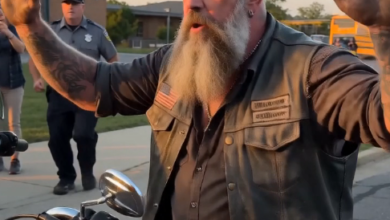
Children had been taught to fear strange men for good reasons, and Daniel knew his leather vest, tattoos, and size would not make reassurance easier. So he watched from near his motorcycle while Noah checked beneath a delivery van, behind a stack of milk crates, and along the edge of the loading area.
The boy’s movements became faster.
More desperate.
Daniel finally spoke from several yards away.
“You lose something?”
Noah froze.
Then he shook his head.
Daniel noticed the faint outline of a hearing device behind the boy’s left ear, while the right side was empty.
“You looking for the other one?”
Noah’s face changed.
His lower lip trembled, but he turned away.
“My mom can’t buy another one.”
That was not an answer to the question.
It was the reason he had said nothing.
Daniel lowered himself slightly, not close enough to crowd him.
“What happened?”
Noah stared toward the restaurant’s back door.
Two boys from the party had taken the hearing aid while everyone sang happy birthday. They wrapped it in a napkin and passed it beneath the table until one of them carried it toward the kitchen hallway.
Noah had followed far enough to see the napkin tossed into a trash cart.
He had been searching since.
“Did you tell your mother?”
Noah shook his head again.
“She saved for months so I could come here.”
Daniel looked at the overflowing dumpster.
Then at the boy holding one hand over the silence where half his world had been.
“Go back inside,” Daniel said.
Noah’s eyes widened.
“Are you going to tell?”
“No.”
Daniel pulled on his work gloves.
“I’m going to find it.”
PART 3
The first trash bag held table scraps.
The second held broken wine glasses wrapped in cardboard.
The third burst open when Daniel lifted it, spilling wet napkins, coffee grounds, steak bones, and pieces of birthday cake across the pavement.
He kept searching.
The restaurant’s rear camera caught only fragments: a large biker cutting open garbage bags, pushing food aside, and kneeling behind a dumpster after closing hours. From a security screen, it looked exactly like vandalism.
Inside, the birthday party continued.
Noah returned to the table beside his mother, Evelyn Ellis, a thirty-four-year-old Black American single mother with tired eyes, dark braids, and a simple green dress she had bought secondhand for the occasion. She noticed his hand over his ear but assumed the crowded restaurant had become too loud.
“Everything okay?” she asked.
Noah nodded.
He could hear her only faintly through the remaining device.
Across the table, the two boys who had taken his hearing aid avoided looking at him. One whispered to the other. Both tried not to laugh.
Noah lowered his eyes.
Behind the restaurant, Daniel found the napkin in the fourth bag.
It was crushed beneath a paper plate soaked with gravy. When he unfolded it, a small beige hearing aid dropped into his palm, smeared with frosting and moisture.
Daniel’s chest tightened.
He removed his leather vest, wiped his hands on his shirt, and wrapped the device carefully in the cleanest paper bag he could find. He held the bag against his chest to protect it from the cold drizzle and started toward the rear entrance.
That was when Charles Whitmore opened the door.
The manager saw the torn bags.
The scattered garbage.
The biker covered in grease.
He did not see the small device inside the paper bag.
“What have you done?” Charles shouted.
Daniel tried to explain, but Charles talked over him and called police before the first full sentence was finished.
When Officer Grant arrived, Daniel remained beside the dumpster because leaving would make him look guilty and because the hearing aid still needed to reach Noah.
“Put the bag down,” she ordered.
Daniel looked at the dirty pavement.
“No, ma’am.”
Officer Grant studied him.
“Why?”
“Because something inside costs more than money to the kid waiting for it.”
PART 4
Officer Grant did not grab the bag.
That decision changed the evening.
She had spent twelve years in uniform and understood that people protecting stolen property usually held it differently. Daniel was not hiding the bag behind his body. He was shielding it from the wet ground, cold rain, and the restaurant manager’s impatient hands.
“What’s inside?” she asked.
“A hearing aid.”
Charles Whitmore stared at him.
“From our trash?”
Daniel nodded.
“A boy’s.”
Officer Grant looked toward the restaurant.
“Which boy?”
“I don’t know his last name. Noah. Blue blazer. About ten.”
Charles’s expression shifted, though not enough.
“There is a birthday party inside.”
“I know.”
Daniel explained what he had seen, how Noah had searched the parking lot alone, and why the boy had been too ashamed to ask for help. The officer listened without interrupting. Then she asked Daniel to open the bag slowly.
He did.
Inside lay the hearing aid, small enough to disappear beneath two fingers, wrapped in a damp napkin stained with blue frosting.
Charles stepped back.
Officer Grant’s partner turned toward the restaurant door.
“Let’s find the child.”
Daniel picked up the paper bag again.
Charles stopped him.
“You cannot enter the dining room looking like that.”
Daniel looked down at himself. His shirt was streaked with grease, cake, and coffee grounds. His gloves were ruined. The knees of his jeans were wet from the alley.
“I don’t need to go inside,” he said.
“Good.”
Officer Grant looked sharply at the manager.
“He found the child’s medical device in your garbage.”
“He also destroyed several trash bags.”
Daniel glanced toward Noah’s empty search path beneath the parked cars.
“I’ll clean it up.”
The officer studied Charles.
“You are worried about the alley?”
“I am responsible for this property.”
Officer Grant held the bag carefully.
“And who was responsible for the child inside?”
Charles had no answer.
They entered through the rear hallway together. Daniel remained outside because he did not want Noah to become the center of another scene.
But as the door closed, he heard Officer Grant ask Charles one quiet question.
“Before we decide who damaged your restaurant, perhaps we should ask who damaged that boy’s birthday.”
PART 5
The party stopped when the police officer entered the private dining room.
Parents lowered their glasses. Children stopped talking. A waiter carrying dessert paused near the doorway as Officer Grant approached Evelyn and quietly asked whether Noah used two hearing aids.
Evelyn’s face drained of color.
She turned toward her son.
“Noah?”
The boy kept his hand over his right ear.
His mother knelt beside him and gently moved it away. When she saw the empty space, fear and understanding arrived together.
“Where is it?”
Noah looked toward the two boys across the table.
Nobody moved.
Officer Grant placed the paper bag on the table and opened it carefully. When Evelyn saw the hearing aid inside the stained napkin, she pressed both hands over her mouth.
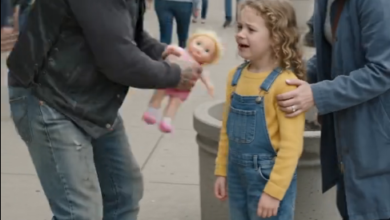
Noah began crying.
Not loudly.
He folded inward as if the shame he had carried alone had finally become too heavy. Evelyn pulled him against her, but he kept reaching toward the device.
The hearing aid was damp, yet the protective casing had held. After wiping it carefully and checking the battery compartment, Evelyn placed it behind Noah’s right ear.
For several seconds, nothing happened.
Then the device clicked on.
Noah’s eyes widened.
The hum of the dining room returned.
Dishes.
Music.
His mother’s breathing.
The rustle of police fabric.
He touched both ears and began crying harder.
“The world has sound again,” he whispered.
At the far end of the table, one of the boys who had taken it looked down.
His father demanded an explanation.
The truth came out unevenly. The boys claimed it had been a joke. They said they intended to retrieve it later. They said they did not know it was expensive.
Officer Grant’s expression remained calm.
“You knew he needed it to hear.”
Neither boy answered.
“That should have been enough.”
Evelyn asked who found it.
Officer Grant pointed toward the rear hallway.
“A man who saw your son searching when everyone else was celebrating.”
Noah stood before his mother could stop him.
He walked toward the kitchen door, unsteady with emotion, determined to find the stranger who had gone into the garbage because he had been too afraid to ask anyone else.
PART 6
Daniel was cleaning the alley when Noah found him.
The police had not ordered him to do it. Charles had not asked. Daniel simply could not leave torn bags and spilled food behind for the kitchen staff to handle. He had found a broom near the loading door and was sweeping cake, napkins, and broken cardboard into a new trash liner.
Noah stopped beneath the awning.
Daniel looked up.
The boy was still wearing the oversized blue blazer, but now both hearing aids sat behind his ears. His mother stood a few steps behind him, one hand pressed over her heart.
“You found it,” Noah said.
Daniel leaned the broom against the wall.
“Yes.”
“Why?”
The question sounded simple, but Daniel understood what the boy was asking.
Why did a stranger notice?
Why did he believe the search mattered?
Why would someone put their hands into garbage for something everyone else had treated like a joke?
Daniel removed his dirty gloves.
“Because you were looking like the world had gone quiet, and nobody should have to search for sound alone.”
Noah crossed the distance before Daniel expected it and wrapped both arms around his waist.
Daniel froze.
Then he placed one careful hand between the boy’s shoulders.
Evelyn began crying.
She apologized for the mess, for the police, for not noticing sooner. Daniel shook his head.
“You were giving him a good night. None of this belongs to you.”
Charles Whitmore stood near the door, watching.
Officer Grant looked at the manager.
“Do you still want to file a vandalism complaint?”
Charles stared at the cleaned pavement, then at Noah holding the biker whose clothes were still covered with the restaurant’s trash.
“No.”
Officer Grant nodded.
“Good.”
Then she looked through the dining room window toward the two boys and the adults gathered around them.
“Because the person who tore open garbage bags was trying to repair something.”
She paused.
“The people who threw away a child’s hearing are the ones who damaged this place tonight.”
Daniel did not smile.
Noah did.
He could hear every word.
PART 7
Bellamy’s changed after that night.
Not dramatically at first.
Charles Whitmore reviewed the security footage and saw details he had missed while standing inside the story. He saw Noah leave the restaurant alone, one hand over his ear. He saw the biker keep his distance until the boy answered. He saw Daniel search bag after bag while the child’s classmates continued eating cake twenty yards away.
The restaurant paid to inspect and professionally clean the hearing aid. It also refunded Evelyn for the birthday dinner, though she had not organized the party and had spent very little. Charles sent the money directly to a local program helping families afford hearing devices for children.
The two boys received consequences from their school and families. More importantly, their parents made them sit with an audiologist who explained what silence felt like when it was not chosen. Neither child transformed overnight, but both stopped calling the incident a joke.
Noah returned to Bellamy’s three months later.
This time, he came with Evelyn and Daniel.
Daniel wore a clean black shirt beneath his vest, though Charles had told him the jacket requirement could be ignored. Noah wore the same blue blazer, now altered to fit properly. The restaurant seated them near the front window instead of the private room where the device had been stolen.
Noah spent most of dinner asking Daniel about motorcycles.
“Are Harleys loud?”
“Some are.”
“Could I hear one with these?”
Daniel pointed toward the hearing aids.
“Only if your audiologist and your mother say yes.”
Evelyn gave him an approving look.
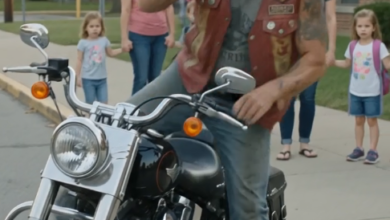
Weeks later, with permission and protective settings adjusted, Daniel brought his Harley to a community center parking lot. He did not rev it. He started the engine at a safe distance and allowed it to settle into a low rhythm.
Noah listened.
Not just with the devices.
With his whole face.
He felt the vibration through his shoes and grinned.
“It sounds like thunder with a heartbeat.”
Daniel remembered that sentence.
Years later, a small blue sticker appeared inside the lid of his motorcycle’s side case. Noah had made it for him. It showed a rough drawing of an ear beside a motorcycle, with four words written beneath it.
Thank you for finding sound.
Daniel never removed it.
Whenever someone asked why a gray-bearded biker had once climbed into a restaurant dumpster wearing expensive leather, he gave the simplest answer.
“A kid lost something important.”
But Noah knew the fuller truth.
He had not only lost a hearing aid that night.
For twenty silent minutes, he had lost the courage to believe anyone would help him look.
Then a frightening stranger knelt in the garbage, reached beneath everyone else’s carelessness, and handed the world back to him with sound.