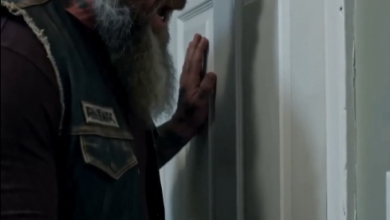
Part 2: A Face-Tattooed Biker Read Fairy Tales to First Graders Every Saturday — Until One Suspicious Parent Googled His Name and Exposed the Life He Had Never Mentioned
PART 2
Elijah Mercer had never told the children that he was a chief executive because six-year-olds did not care about job titles.
They cared whether he remembered where the story had stopped the week before.
They cared whether the wicked queen sounded sufficiently wicked, whether the little bear found his way home, and whether Rook allowed them to sit on the carpet when their legs became restless.
To the children, he was not a wealthy businessman or an intimidating biker.
He was the man who never laughed when they struggled with a word.
Rook had joined the Saturday Story Club through a city literacy organization that required background checks, references, fingerprinting, and volunteer training. Principal Karen Walsh knew his legal name and that the screening had cleared him, but she had never searched his business history.
On the occupation line of his volunteer form, Rook had written only:
Construction.
That was accurate.
Mercer Ridge Construction had begun twenty-four years earlier with one borrowed truck, two employees, and a toolbox Rook still kept in his office. The company now built schools, medical clinics, apartment complexes, and public libraries across three states.
Rook still rode his Harley to work whenever the weather allowed.
He still wore boots on construction sites.
He still preferred eating lunch with carpenters and electricians rather than investors who spent meetings describing people as numbers.
The face tattoos came later, after the death of his younger brother, Daniel. Each section incorporated small symbols from their childhood: a paper crown, a broken compass, an open book, and a blackbird that Daniel used to draw in the margins of school notebooks.
Strangers usually saw only the ink.
Children asked what the pictures meant.
Rook answered only what was appropriate.
“This one means somebody helped me find my way.”
“Who?”
“A teacher.”
That was the part he had not told the parents.
Elijah Mercer had reached fifth grade barely able to read.
He memorized classroom instructions, copied the children beside him, and started fights whenever teachers asked him to read aloud. Anger became easier than humiliation because classmates feared angry boys but laughed at boys who could not pronounce simple words.
Then Mrs. Evelyn Parker noticed.
She did not call him lazy.
She did not make him read in front of the class.
She stayed every Saturday morning and began with fairy tales.
PART 3
Mrs. Parker taught Elijah that a story was not a test he could fail.
It was a door.
Some doors took longer to open.
That did not mean the child standing outside was stupid.
Elijah had undiagnosed dyslexia, but in the working-class neighborhood where he grew up, there was little testing and even less understanding. His father believed reading difficulties could be corrected with discipline. His classmates believed slow reading meant a slow mind.
Mrs. Parker believed neither.
She used colored cards to cover parts of each page. She allowed Elijah to trace sentences with his finger. When letters seemed to move, she told him to stop, breathe, and return when the page became still.
Every Saturday, she read one paragraph.
Then he read one sentence.
When he stumbled, she waited.
When he became angry, she waited longer.
The first book Elijah completed was a worn collection of fairy tales with a green cloth cover. Mrs. Parker gave it to him and wrote a sentence inside:
A boy who struggles to enter a story may someday build doors for others.
Elijah kept that book through high school, trade school, homelessness, his first construction job, his first business loan, and every office the growing company eventually occupied.
It remained inside the desk of a man who signed contracts worth millions but still sometimes reread important documents three times before the words settled correctly.
Mrs. Parker died before Mercer Ridge became successful.
Rook quietly paid to renovate the reading room at Lincoln Elementary because she had taught there during the final decade of her career. He requested that the donor plaque display only her name.
Then he began volunteering.
He did not want speeches.
He did not want business photographs beside smiling children.
He wanted one hour in which a struggling reader could watch an adult pause over a difficult word and continue without shame.
The first grader who affected him most was Noah Crane.
Noah was bright, curious, and becoming skilled at hiding.
Whenever the class read together, he moved his mouth half a second behind everyone else. When asked an individual question, he created jokes or asked to use the bathroom.
Rook recognized the technique immediately.
One Saturday, he placed the fairy-tale book between them and whispered, “You do not need to fool me. I invented most of those tricks.”
Noah stared at the tattoos along his cheek.
“You read badly too?”
“Sometimes I still do.”
“But you’re old.”
Rook nodded.
“Tragic, isn’t it?”
Noah laughed.
Then he read one sentence.
PART 4
Melissa Crane’s post changed the way adults looked at Rook, though nothing about him had changed.
Some parents were impressed.
Others became more suspicious.
Why would the CEO of a major construction company spend Saturday mornings in a first-grade classroom without telling anyone?
Was it a publicity campaign?
Was his company seeking a school contract?
Were photographers coming?
One parent wrote that the school should be grateful.
Another wrote that wealth did not automatically make someone safe.
A third zoomed in on Rook’s face tattoos and asked whether the school had reviewed their meaning.
By Friday evening, the private post had been copied outside the group. A local reporter contacted Mercer Ridge. Someone found an old business-magazine profile listing Rook’s estimated wealth. Another person posted photographs of his motorcycle club arriving at a charity project.
The mystery became content.
Rook learned about the attention when his assistant called.
“There may be reporters outside the school tomorrow.”
“Why?”
“Because somebody discovered you read books.”
“That sounds criminal.”
“Elijah, I’m serious.”
So was he.
The children had not agreed to become background scenery in a story about a tattooed CEO. Their parents had not approved media exposure. The school’s literacy program could be overwhelmed by people who cared more about an unusual photograph than reading.
Rook considered staying home.
He stood in his garage early Saturday morning wearing his leather vest and holding Mrs. Parker’s old green book. His Harley waited beside him, but he could not make himself start the engine.
Then his phone vibrated.
The message came from Noah through Melissa’s number.
Mr. Rook, are we finishing the dragon book today? I practiced my page.
Rook looked at the green cover in his hand.
He rode to school.
Two reporters stood near the entrance. Several parents waited beside the sidewalk. Phones turned toward him as soon as he removed his helmet.
Rook said nothing to the cameras.
He walked directly to Principal Walsh.
“No media inside the classroom.”
She nodded.
“No photographs of the children.”
“Agreed.”
“And if the parents want me gone?”
Karen looked toward the group outside.
“They can speak with me after Story Club. The children are waiting.”
Rook entered the classroom.
Noah had saved the tiny blue chair for him.
PART 5
The atmosphere inside the classroom felt different.
Children noticed adult tension even when nobody explained it. Several kept glancing toward the door where parents stood behind the narrow window. One little girl asked whether Rook was famous.
“No,” he replied. “Your parents discovered I own too many meetings.”
“Are you rich?”
“I have three staplers in my office.”
The children gasped theatrically.
The room relaxed.
Rook opened the dragon book.
Halfway through the session, he reached Noah’s page. The boy’s shoulders rose. His fingers tightened around the paper. Behind the glass, Melissa watched him prepare the same escape he used whenever reading became dangerous.
Rook placed one colored card beneath the first sentence.
“Take your time.”
Noah began.
The first three words came smoothly.
He reversed two letters in the fourth word, stopped, and looked toward the parents.
Someone’s phone was raised.
Rook closed the book gently.
“Phones down, please.”
The parent lowered it.
Rook turned back to Noah.
“This room waits for readers.”
Noah tried again.
He completed the sentence, then another.
When he finished the entire paragraph, the children applauded because first graders will celebrate almost anything when an adult teaches them it matters.
Melissa covered her mouth.
She had spent weeks believing Noah disliked books. She had paid for reading applications, reward charts, and stacks of beginner readers. He had never told her that letters moved or that reading aloud made his chest hurt.
After the session, parents gathered in the hallway.
Melissa approached Rook first.
“I owe you an apology.”
Rook placed the books inside their storage box.
“You checked who was around your child. That part does not require an apology.”
“I posted your name without speaking to you.”
“That part was less helpful.”
She accepted the correction.
“Why didn’t you tell us who you were?”
Rook looked through the doorway at Noah arranging colored cards on the desk.
“I did. I said I was Rook, the Saturday reader.”
“That isn’t what I meant.”
“I know.”
He removed the green fairy-tale book from his bag and showed her Mrs. Parker’s handwritten sentence.
“This is the part that matters in this classroom.”
Melissa read it.
Her eyes filled.
Behind her, the other parents became quiet.
PART 6
Rook agreed to answer questions, but only after the children had left and the classroom door was closed.
He explained the background screening, his dyslexia, Mrs. Parker, and why the company had renovated the school reading room anonymously.
One father asked whether Mercer Ridge planned to bid on future school construction projects.
“No,” Rook answered. “I asked our legal department to exclude this district while I volunteer here.”
A mother asked why he wore the leather vest around children.
“Because this is how I dress on Saturdays.”
“Some children may find the tattoos frightening.”
Rook nodded.
“Some do for the first five minutes. Then they usually ask whether the bird on my face can fly.”
Principal Walsh reminded the group that children were allowed to select another reading volunteer at any time. None had requested one.
Melissa admitted that her post had created the media attention. She offered to delete it, but screenshots had already spread beyond her control.
Rook did not embarrass her.
Instead, he asked everyone to consider what the post had taught their children.
That a man’s title could make tattoos respectable?
That wealth transformed a suspicious stranger into a trustworthy volunteer?
Or that the first judgment had been incomplete from the beginning?
“I was safe before you knew my job,” he said. “The background check proved that. My behavior proved it again every Saturday. The company did not change either fact.”
Nobody argued.
The following Monday, Rook released one short statement through Mercer Ridge:
The Saturday Story Club is about children learning to read, not about me. Please support local literacy programs and protect the privacy of participating families.
He refused interviews.
The company’s public-relations team nearly mourned the missed opportunity.
Donations still arrived at Lincoln Elementary. Rook asked the school to divide them among several neighborhood literacy programs rather than naming anything after him.
Melissa took a different action.
She contacted parents individually and acknowledged that she had posted before asking questions. Then she organized volunteers to provide breakfast for the Saturday students, but she made one rule clear.
No cameras.
No promotional posts.
No turning children’s difficult mornings into evidence of adult generosity.
Rook approved.
Not publicly.
He simply arrived the next Saturday carrying books, found coffee waiting beside his tiny blue chair, and began reading.
PART 7
The online attention faded within several weeks.
The internet found another mystery, another stranger, and another photograph to judge before lunch.
Rook kept coming.
He arrived during rain, construction deadlines, company crises, and one Saturday morning after spending most of the night negotiating with a bank. The children never knew which weeks had been difficult.
They only knew he remembered every story.
Noah’s reading improved slowly.
There was no miraculous transformation in which struggling disappeared after one kind conversation. He still reversed letters. Long pages exhausted him. Some mornings he read confidently, while on others the first sentence felt impossible.
Rook taught him not to measure progress by perfect days.
By the end of first grade, Noah completed the green fairy-tale collection Mrs. Parker had once given Elijah. Rook brought the original copy only after washing his hands twice and warning the entire class that anyone spilling juice near it would be assigned to fight a dragon alone.
Noah read the inscription inside.
“A boy who struggles to enter a story may someday build doors for others.”
He looked up.
“Did you build doors?”
“Thousands.”
“I mean like this.”
Rook glanced around the classroom.
“I’m trying.”
At the end-of-year reading celebration, the children created their own books. Noah’s story featured a giant with drawings covering his face. Villagers believed the giant had come to destroy their library, but he had actually arrived to repair its broken roof.
On the final page, the giant sat in a tiny chair reading to dragons who were afraid of people.
Melissa cried when Noah read it aloud.
This time, she kept her phone inside her purse.
Years later, many children from that first Saturday group would forget the online controversy. They would forget the reporters and the surprise surrounding Rook’s company.
They remembered his voices.
They remembered that he never completed a difficult word for them too quickly.
They remembered how his tattooed finger moved patiently beneath each sentence and how the largest man in the room never made a child feel small.
Rook eventually retired as CEO, though he remained chairman of the company and continued riding his motorcycle to Lincoln Elementary. His beard grew whiter. The tiny blue chair became harder on his knees. The fairy tales did not change much.
One Saturday, a new first grader stared openly at the ink covering his face.
“Are you scary?” the boy asked.
Rook placed a book between them.
“Sometimes.”
The child leaned closer.
“When?”
“When someone bends the pages.”
The boy immediately protected the book with both hands.
Rook smiled and began the story.
Because the most important truth about Elijah Mercer had never been hidden in a corporate profile or discovered through an online search.
It was visible every Saturday morning.
A man who had once believed books were doors locked against him kept returning to hold those doors open for children who were still searching for the handle.
Follow this page for more unforgettable biker stories about hidden kindness, misunderstood appearances, and ordinary moments that reveal who someone truly is.