Part 2: A 60-Year-Old Biker Was Filmed Holding a Screaming Elderly Woman Inside a Supermarket — Until Police Saw the Broken Glass Door She Had Been Running Toward
PART 2
Frank Morgan had entered Miller’s Market for three things: coffee, motor oil, and the cinnamon candy his late wife once kept in every coat pocket she owned.
He had been standing near the produce section when the metal rack fell.
Most shoppers heard an ordinary crash and turned their heads. Eleanor heard something that had happened sixty-five years earlier, when a fire tore through the apartment building where she lived as a teenager.
She had escaped.
Her younger sister had not.
The memory had faded into something Eleanor’s family rarely mentioned, but dementia had begun loosening the walls between past and present. Some mornings, Eleanor recognized her son immediately. Other mornings, she asked when her husband would return from work, though George Hayes had been dead for six years.
David Hayes had learned to answer without correcting her too harshly.
“He’ll be home later, Mom.”
“Tell me about him.”
“What did he sing to you?”
Music still reached places dates and names could not.
That afternoon, David brought Eleanor to the supermarket because she had been restless inside her assisted-living apartment. She enjoyed choosing fruit, reading the labels on cereal boxes, and complaining that everything cost too much now.
He left her near the apples for less than four minutes while collecting a prescription.
That was when the display rack fell.
The metallic crash echoed through the high ceiling, followed by the grinding noise of the malfunctioning entrance door.
Eleanor’s face changed before her body moved.
Frank recognized the empty distance in her eyes because he had seen it in his wife, Margaret, during the final years of her life.
Margaret had not remembered every room.
She remembered fear.
Sometimes she woke believing strangers had entered the house. Sometimes she fought Frank’s hands because she could no longer connect his face with the man who had loved her for thirty-four years.
Frank learned that frightened people did not need stronger hands.
They needed slower ones.
He watched Eleanor drop the basket and begin running toward the entrance.
The manager moved to intercept her, but shouted her name from across the store.
The sound only frightened her more.
Frank saw the broken door jerking along its track.
He also saw that Eleanor was not going to stop.
So he stepped between the woman and the glass.
PART 3
At first, Frank held out both palms and tried to guide Eleanor away without touching her.
“There’s no fire,” a cashier shouted.
That was the wrong sentence.
To Eleanor, the fire was real.
She could smell smoke that was not there. She could hear windows breaking decades earlier. The fluorescent supermarket lights became flames reflected against the ceiling, and every stranger reaching toward her became another obstacle between her and escape.
She pushed Frank’s arm aside.
For an eighty-two-year-old woman, she moved with surprising force.
“Let me out!” she screamed. “My sister is still upstairs!”
The words stopped Frank for half a second.
Then the automatic door jerked open again, exposing the narrow gap between two heavy glass panels before slamming partially closed.
Eleanor ran toward it.
Frank moved behind her.
He wrapped his arms lightly across her upper torso, leaving her hands free, and turned his own body so that if either of them fell, she would land against him instead of the floor.
She fought harder.
From twenty feet away, it looked terrible.
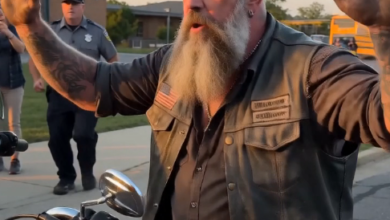
A huge tattooed man holding an elderly woman who was crying for release.
A customer began filming.
Another shouted, “Get your hands off her!”
The manager called police.
Frank did not answer anyone.
Every word from another direction added noise Eleanor could not process. Instead, he listened to what she was saying beneath the panic.
She was singing.
The words were wrong and scattered, but the melody was familiar.
“You Are My Sunshine,” Frank said quietly.
Eleanor stopped shouting for one breath.
Frank repeated the title.
“That’s your song. Stay with it.”
Her knees weakened.
Frank slowly lowered himself behind her, guiding them both onto the floor beside a padded bench. He did not trap her wrists or force her arms down. He simply kept his body between Eleanor and the damaged entrance.
The manager approached with two employees.
“Release her now.”
Frank shook his head and pointed toward the door.
Nobody understood.
Then Officer Lena Brooks entered through the side exit as David came running from the pharmacy counter.
Eleanor heard her son’s voice but did not recognize it.
She recognized the song.
And David recognized why Frank had chosen it.
PART 4
Officer Lena Brooks saw three separate emergencies when she reached the entrance.
An elderly woman in visible distress.
A large biker holding her from behind.
A malfunctioning glass door still attempting to move along a damaged track.
She did not begin by shouting.
“Sir, can you loosen your arms without letting her move toward that door?”
Frank nodded.
That response mattered.
He shifted his hands outward, making the space around Eleanor larger while keeping one forearm between her and the entrance. Lena moved into Eleanor’s line of sight and lowered herself until their eyes were level.
“My name is Lena,” she said. “You’re inside Miller’s Market. Your son is here.”
Eleanor looked past her.
David stood several feet away, crying but afraid to move too quickly.
“Mom,” he said softly.
Eleanor shook her head.
“My sister is upstairs.”
David’s face broke.
He knew exactly where his mother believed she was.
He also knew arguing would not bring her back.
Frank repeated the song title again.
David joined him.
“You Are My Sunshine, Mom. Dad’s song.”
Eleanor’s shoulders dropped slightly.
“My George?”
“Yes.”
“He knows where I am?”
David swallowed.
“He always knew.”
The panic began loosening its grip, one breath at a time. Eleanor stopped pulling against Frank’s arms. When she leaned backward, he supported her weight without squeezing.
Only then did Lena ask him to release her completely.
Frank did.
Immediately.
He slid several feet away and placed both hands on the floor where everyone could see them.
David knelt beside his mother.
The automatic door jerked again behind them, and one of the glass panels shifted violently against its frame.
Every person who had accused Frank turned toward the sound.
The manager’s face lost its color.
A store employee hurried to disconnect the power.
Officer Brooks looked at the distance between Eleanor and the doorway.
Three steps.
That was all Frank had prevented.
Three steps into a narrow moving gap of heavy glass and metal.
Lena glanced at the phones still pointed toward them.
“Stop recording,” she said. “Give this family some room.”
For the first time since the panic began, the crowd obeyed.
PART 5
Eleanor remained on the floor until her breathing became steady enough for David to help her onto the bench.
The store’s first-aid employee checked her for injuries. There were no bruises from Frank’s arms, no marks on her wrists, and no evidence that he had used more force than necessary.
Eleanor’s cardigan had twisted around one shoulder.
Frank noticed but did not approach.
He waited for David to straighten it.
That small restraint told Officer Brooks almost as much as the security footage later would.
David looked across the entrance at the biker sitting alone on the tile.
“How did you know the song?”
Frank rubbed one tattooed thumb across his palm.
“My wife used to sing it,” he said. “Near the end, when she couldn’t remember my name, sometimes she remembered that.”
“Dementia?”
Frank nodded.
“Seven years.”
David looked toward his mother.
“I’m sorry.”
“So am I.”
It was the kind of exchange that asked for no details.
Two men standing on different sides of the same long loss understood enough.
Eleanor looked at Frank then.
Her eyes were clearer but tired, the way a room looks after a storm has moved through it. She studied his beard, his vest, and the hands resting openly on his knees.
“You held me,” she said.
Frank’s expression tightened.
“I’m sorry I frightened you.”
She reached toward him.
David watched carefully but did not stop her.
Frank moved closer and offered one hand rather than taking hers.
Eleanor placed both palms around it.
His fingers were scarred from years of mechanical work, and his knuckles carried faded ink. Yet the hand remained perfectly still beneath hers.
She turned it over, studying the lines as though they might tell her something his face could not.
Then she gently patted the back of his hand.
“You have the hands of someone who knows loss,” she said.
Frank looked down.
The waiting customers became quiet again, but this silence felt different from the first.
It no longer contained suspicion.
It contained the uncomfortable realization that kindness had been present before anyone recognized it.
PART 6
The store’s security footage clarified everything.
It showed Eleanor running toward the malfunctioning entrance while employees remained too far away to reach her. It showed Frank trying to stop her without contact, then moving behind her only when she pushed past him.
Most importantly, the footage showed the door.
The glass panels opened unevenly, paused, then jolted toward each other as Eleanor approached. Had she entered the gap, she could have fallen against the track or been struck when the mechanism shifted.
The store manager apologized to Frank.
He did not make the apology easy for her by pretending nothing had happened.
“You saw a big man holding a small woman,” he said. “I understand why you called.”
The manager nodded, relieved.
Frank continued.
“But everyone started filming before anyone looked where she was running.”
Her relief disappeared.
That was fair too.
Officer Brooks documented the incident but filed no charges. She thanked Frank for cooperating and reminded him that physical intervention always carried risk, even when the intention was protective.
Frank agreed.
“I didn’t have a perfect choice.”
“No,” Lena said. “You had about three seconds.”
The store closed the entrance until technicians replaced the damaged mechanism. Management also reviewed emergency procedures for customers experiencing confusion or distress. Employees were instructed to lower noise, remove hazards, create space, and avoid surrounding someone who appeared disoriented.
David did not ask the supermarket to punish anyone.
He asked them to learn.
Before leaving, he returned to Frank with a folded receipt. A phone number was written across the back.
“My mother lives at Cedar Grove Assisted Living,” he said. “They have music afternoons on Fridays.”
Frank looked at the number but did not take it immediately.
“You don’t owe me anything.”
“I know.”
“Then why?”
David glanced toward Eleanor, who was resting in a wheelchair brought from the customer-service desk.
“She has already forgotten parts of what happened.”
Frank’s eyes softened.
“But she remembers your hands.”
Frank accepted the number.
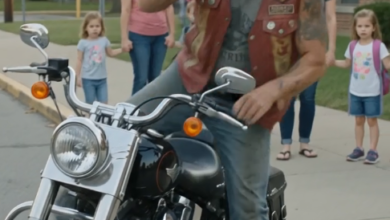
The following Friday, he rode to Cedar Grove with a small speaker strapped inside his saddlebag and a bag of cinnamon candy tucked into his vest.
PART 7
Eleanor did not recognize Frank when he entered the activity room.
She looked at his leather vest, then at David, and whispered loudly enough for everyone to hear, “That man has too many tattoos.”
Frank smiled.
“You said the same thing last week.”
“I did not.”
David laughed for the first time in several difficult days.
The music coordinator began playing familiar songs from Eleanor’s youth. Some residents hummed. Others watched the windows. One woman slept through almost everything until a waltz began, then lifted her hand as though waiting for a dance partner.
When “You Are My Sunshine” started, Eleanor looked toward Frank.
Not with recognition exactly.
With something gentler.
A feeling without a name.
Frank sat several chairs away and tapped the rhythm against his knee. Eleanor sang parts correctly and invented the rest. Nobody corrected her.
Afterward, she held out her hand.
Frank crossed the room and offered his.
She studied it again.
“Have we met?”
“Yes, ma’am.”
“Were you kind?”
Frank thought about the shouting, the police, the accusations, and the fear on Eleanor’s face while he held her away from the glass.
“I tried to be.”
Eleanor nodded as if that answer was enough.
Over the following months, Frank visited whenever he could. He never presented himself as family or expected Eleanor to remember him. Some Fridays she called him George. Other Fridays she asked whether he repaired bicycles. Once she accused him of stealing her chair, though he had been sitting across the room.
Frank stayed.
David eventually asked why.
Frank looked at Eleanor singing toward an empty seat beside her.
“Because my wife forgot me before she left,” he said. “I wish more people had stayed after she did.”
David did not respond immediately.
He moved his chair closer to Frank’s.
The supermarket video never became public. Officer Brooks persuaded those who had recorded the incident to delete the clips rather than upload a frightening woman’s confusion for strangers to judge.
One customer kept a different memory.
She remembered how quickly the room decided what the biker’s arms meant.
She also remembered how gently those arms opened when real help arrived.
Years later, David would still tell the story whenever someone mistook dementia-related fear for stubbornness or aggression. He never described Frank as a hero who controlled his mother.
He described him as a stranger who understood that the person fighting him was not his enemy.
She was frightened.
She was somewhere else.
And for three dangerous steps, his body became the safest place available.
Eleanor eventually forgot the supermarket, the broken door, and the biker’s name.
But whenever Frank visited, she often reached for his hands.
Perhaps she remembered nothing.
Perhaps the body sometimes keeps what the mind cannot.
Either way, Frank always let her decide whether to hold on.
Follow this page for more unforgettable biker stories about misunderstood courage, quiet compassion, and the people who remain gentle when fear makes kindness difficult to recognize.