Part 2: A 52-Year-Old Biker Smashed a Woman’s Phone in a Crowded Hospital Waiting Room — Until Security Discovered Whose Terrified Face She Had Been Broadcasting Live
PART 2
Thomas Maddox did not dislike phones.
He disliked what people sometimes became when they placed a camera between themselves and another human being.
Years earlier, after his wife died during an emergency surgery, someone in the hospital parking lot had filmed Thomas sitting beside his motorcycle with his face buried in both hands. The clip appeared online before he had even called his wife’s sister.
Hundreds of strangers commented on his grief.
Some called it powerful.
Some called it staged.
One person added sad music and turned the worst hour of his life into a short video that received more views than Thomas could understand.
He never found out who filmed it.
He never forgot the feeling of strangers owning a moment he had barely survived.
That was why he noticed Vanessa’s phone.
At first, Thomas assumed she was calling someone. Nearly everyone in the waiting room was staring at a screen, scrolling through bad news or searching for distractions. Then he saw the angle.
The camera faced Lily.
The woman’s expression did not match the room. While the little girl cried, Vanessa smiled slightly and watched the reactions appearing on her screen.
Thomas could not hear every word, but he heard enough.
“Guys, I don’t know where this child’s family is…”
“This is absolutely heartbreaking…”
“Share this so somebody recognizes her…”
None of that was true.
The triage nurse knew Lily’s name. The neighbor had completed the paperwork. Lily’s mother was driving from her evening shift and speaking with hospital staff by phone.
Vanessa had not asked anyone.
Truth would have slowed the content.
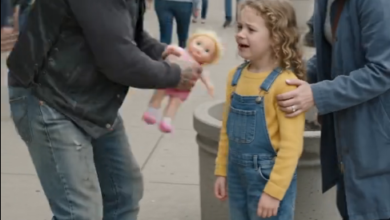
Lily noticed the camera after several seconds. She turned her bandaged arm inward and lowered her face.
Vanessa shifted sideways to capture it again.
Thomas stood.
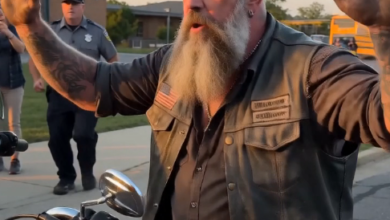
He approached slowly because Lily already looked frightened and a large tattooed man moving quickly would not help. He stopped between them and kept his hands at his sides.
“Ma’am,” he said, “put the phone down.”
Vanessa looked around his shoulder.
“I’m documenting what’s happening.”
“You’re filming a child who doesn’t want to be filmed.”
“You don’t know that.”
Thomas looked back at Lily.
The girl shook her head.
Vanessa saw it too.
She continued recording.
That was when Thomas understood she had already chosen the audience over the child.
PART 3
The first time Thomas blocked the camera, Vanessa stepped to the left.
He moved with her.
The second time, she raised the phone higher and told her viewers that an aggressive biker was interfering with her attempt to help an abandoned child.
That changed the room.
People who had not noticed Lily’s tears now noticed Thomas’s leather vest. A man near the coffee machine stood up. An elderly woman pulled her purse closer. Two teenagers began filming Thomas from another angle.
Suddenly, everyone had a camera.
Almost nobody had a question.
Vanessa moved close enough that the phone was less than three feet from Lily’s face.
The child pressed herself against the wall.
“Please stop,” Lily whispered.
Vanessa either did not hear her or decided the livestream mattered more.
Thomas reached toward the phone.
He did not grab Vanessa.
He did not shove her.
He struck the bottom edge of the device with an open hand, knocking it onto the padded chair beside her. The phone bounced once and fell onto the carpet without shattering.
Vanessa screamed as though he had struck her.
“He attacked me!”
Two hospital security officers crossed the room immediately. Marcus Bell, a forty-four-year-old Black American man with a shaved head and navy security uniform, caught Thomas’s right arm while his partner secured the left.
Thomas let them.
“Hands behind your back,” Marcus ordered.
Thomas obeyed.
“Turn off her phone,” he said.
“Sir, stay calm.”
“The child asked her to stop.”
Vanessa snatched the phone from the carpet. The livestream was still running. Comments moved rapidly across the screen, asking whether the biker was dangerous and urging someone to call police.
Vanessa turned the camera toward Thomas.
“There he is,” she said breathlessly. “The man who just attacked me.”
Thomas looked past her.
Lily had pulled her knees toward her chest. Her bandaged arm shook as she tried to cover her face with the sleeve of her sweatshirt.
A nurse hurried over and placed herself in front of the girl.
Only then did someone finally create the privacy Thomas had been trying to give her.
Hospital Police Officer Dana Mitchell arrived moments later, a forty-one-year-old Black American woman with steady brown eyes, close-cropped hair, and a dark uniform.
She looked at Thomas, Vanessa, and the terrified child.
Then she asked the question nobody online had bothered to ask.
“What happened before the phone fell?”
PART 4
Vanessa answered first.
People protecting a performance often do.
“He came at me for no reason,” she said. “I was trying to help that little girl because she was alone, and he became violent.”
Thomas remained beside the wall with Marcus holding one arm. He did not interrupt.
Officer Mitchell looked toward Lily.
The nurse beside her shook her head slightly, signaling that the child was too distressed to answer immediately.
“Is the child alone?” Dana asked.
A triage nurse stepped forward.
“No. Her neighbor brought her in after a minor burn. Her mother is on the way and has been in contact with us.”
Vanessa’s confidence flickered.
“She looked abandoned.”
“She was waiting.”
“I was raising awareness.”
“You were broadcasting from inside a medical facility,” Dana replied. “Did you receive consent from the child, her mother, or hospital staff?”
Vanessa looked at the phone.
The livestream continued.
Dana held out one hand.
“End it now.”
Vanessa hesitated.
That pause told the room more than her explanation had.
“Officer, people are watching because they care.”
Thomas finally spoke.
“People caring would have stopped when she said please.”
Dana turned toward him.
“Did you touch Ms. Cole?”
“No.”
“Did you knock the phone down?”
“Yes.”
“Why?”
“She kept moving it around me to film the girl’s face.”
Vanessa protested.
“He destroyed my property.”
The phone had a small scratch along its protective case but remained functional. Dana noted it without commenting, then requested security footage from the waiting room.
The video showed everything.
Vanessa approaching Lily.
The camera rising.
Lily turning away.
Thomas placing himself between them.
Vanessa moving around him twice.
Lily whispering.
The phone falling onto the padded chair.
No strike against Vanessa.
No threat.
Only one impulsive action directed at the device after repeated warnings.
Dana asked Marcus to release Thomas’s arm.
Then she faced the waiting room.
“Who is the child’s legal guardian right now?”
Nobody answered.
The neighbor had not yet returned. Lily’s mother was still driving. Staff were overwhelmed. Everyone else had simply watched.
Thomas pointed toward the shaking girl.
“Then until her mother gets here, every adult in this room has a responsibility not to make her fear worse.”
The silence afterward felt heavier than the shouting.
PART 5
Lily’s mother arrived nine minutes later.
Monique Carter was a thirty-five-year-old Black American woman with dark braids pulled beneath a rain-soaked hood, hospital scrubs under her coat, and terror visible before she even reached the check-in desk.
She had left work the moment the neighbor called, but traffic and heavy rain turned a twelve-minute drive into thirty.
When she saw Lily behind the privacy screen, she ran.
The child stood and buried her face against her mother’s chest.
Monique held her carefully, avoiding the bandaged arm, and repeated the same words until Lily’s breathing slowed.
“I’m here. I’m here. I’m here.”
Nobody filmed them now.
Officer Mitchell had ordered every visible camera lowered.
Vanessa sat several rows away with her phone in her lap, angry and embarrassed. The livestream had ended, but clips had already been saved and shared.
Dana explained the situation privately to Monique. She did not exaggerate Thomas’s role or excuse the damaged phone. She said he had intervened after Vanessa ignored the child’s request to stop, and that the hospital was documenting the privacy breach.
Monique looked across the room.
Thomas stood near the vending machines again, hands clasped in front of him, appearing unsure whether approaching would help or frighten the child further.
Lily noticed him.
She whispered something to her mother.
Monique nodded.
They crossed the room together.
Thomas lowered himself onto one knee, not close enough to touch her.
“I’m sorry it got loud,” he said.
Lily looked at his vest.
“You made the camera go away.”
“For a minute.”
“It was watching me cry.”
“I know.”
“Why did she want people to see?”
Thomas struggled with that question.
“Sometimes adults forget that a person is more important than the attention they can get from that person.”
Lily considered this.
Then she looked toward Vanessa.
“Is she bad?”
Thomas shook his head.
“I don’t know her well enough to say that. But what she did was wrong.”
Monique’s eyes filled.
“Thank you for seeing my daughter before you saw a story.”
Thomas looked away because the sentence landed too close to an old memory.
“I only blocked a phone.”
“No,” Monique said. “You gave her face back to her.”
PART 6
The hospital did not simply allow everyone to leave.
Vanessa filed a complaint over the damage to her phone. Thomas accepted responsibility for knocking it away and offered to pay for the scratched case, though he refused to apologize for stopping the recording.
Hospital administration reviewed both the security video and Vanessa’s livestream. Her footage had captured Lily’s face, injury, location, and emotional distress without consent. Staff requested that she remove the recording and every repost under her control.
She resisted at first.
“It was public interest,” she said.
Officer Mitchell answered quietly.
“A frightened child in a waiting room is not public property.”
That sentence ended the argument more effectively than shouting would have.
The hospital issued Vanessa a trespass warning after confirming she had no patient or family member receiving care and had entered the emergency department only after noticing activity through the glass entrance.
Thomas received a formal warning for damaging property.
He accepted it.
Dana looked surprised.
“You are not going to argue?”
“I did what I did.”
“You could have asked security.”
“I did not see security until after the camera fell.”
“That does not make breaking things legal.”
“No, ma’am.”
Dana studied him for several seconds.
“You understand I cannot tell people to start smashing phones whenever someone films something inappropriate.”
“I understand.”
“Would you do it differently?”
Thomas looked toward Lily, now sitting against her mother with a warm blanket around her shoulders.
“I’d put the phone on the chair more gently.”
Dana almost smiled.
Almost.
The hospital arranged for a child advocate to speak with Monique and Lily because the livestream had spread briefly before removal. A social worker helped document the incident and explained how to report unauthorized reposts.
Thomas’s injured club brother was discharged shortly afterward with bruised ribs and a heavily bandaged hand. He listened to the story, looked at Thomas, and shook his head.
“You got detained while I was getting X-rays?”
Thomas picked up the man’s helmet.
“You took too long.”
Before leaving, Thomas stopped near Lily.
She held up her uninjured hand.
He expected a wave.
Instead, she placed it in front of her face like a shield.
Thomas understood.
He raised his tattooed palm the same way.
Two small walls.
No cameras between them.
PART 7
The incident might have disappeared like most waiting-room arguments if one of the teenagers filming Thomas had not uploaded a short clip that ended before the truth became clear.
The first version showed a large biker knocking down a woman’s phone while security rushed toward him. It spread quickly with a caption calling him violent.
Then the hospital footage was reviewed.
Monique did not release Lily’s image, but she gave a written statement explaining that the woman had livestreamed her injured child without permission and continued after Lily asked her to stop.
Officer Mitchell could not discuss the full case publicly, but the hospital released a reminder that patient privacy applied in waiting areas and that photographing or broadcasting children without consent could cause serious harm.
The conversation changed.
People who initially condemned Thomas began calling him a hero.
He disliked that almost as much as being called violent.
He had not handled everything perfectly. He knew that. A better version of the moment might have ended without a damaged phone, security restraints, or a room full of shouting.
But a perfect adult had not stood up.
He had.
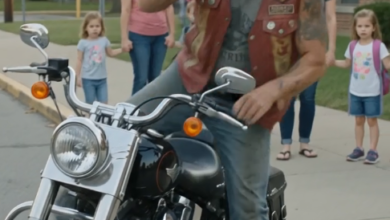
Several weeks later, Monique brought Lily to a community motorcycle fundraiser for pediatric burn care. Lily’s arm had healed, leaving only a small pink patch near her wrist.
Thomas was helping arrange folding tables when he saw them.
Lily carried a homemade sign turned inward against her chest so nobody could photograph it before she was ready.
When she reached Thomas, she flipped it around.
The sign showed a large biker standing in front of a tiny girl while dozens of floating phones bounced harmlessly against his back.
Beneath the drawing, Lily had written:
THANK YOU FOR MAKING MY CRYING MINE AGAIN.
Thomas read it twice.
Then he asked permission before taking a photograph of the drawing.
Not Lily.
Only the drawing.
She grinned.
“You asked first.”
“I’m learning.”
Monique laughed softly.
The hospital changed too. New signs appeared in the emergency waiting room reminding visitors not to record patients or children. Security staff received guidance on responding quickly when vulnerable people were filmed without consent. Nurses began keeping small privacy screens closer to triage.
None of those changes depended on people smashing phones.
They depended on people noticing sooner.
Vanessa eventually posted an apology. It was imperfect and defensive in places, but she admitted that she had focused on the reaction of strangers online rather than the child in front of her. She removed the clips and volunteered to complete a digital privacy course as part of the hospital’s agreement not to pursue further restrictions.
Thomas never followed her account.
He returned to his repair shop, his club, and ordinary life.
But he kept Lily’s drawing above his workbench.
Whenever someone called him the biker who smashed a phone, he corrected them.
“I knocked it onto a chair.”
Then he would look at the drawing and add something quieter.
“The important part wasn’t the phone. The important part was that a little girl said stop, and the room needed to remember that she was allowed to mean it.”
Because protecting a child does not always require becoming her family.
Sometimes it begins when one adult refuses to let her fear become entertainment.
And sometimes the simplest responsibility in a crowded room is to look away when someone’s pain does not belong to you.
Follow this page for more unforgettable biker stories about misunderstood courage, quiet protection, and ordinary people who choose compassion when everyone else chooses to watch.