Part 2: A 49-Year-Old Biker Rushed Into a Bridal Boutique and Carried a Crying Young Bride Outside — Until Police Read the Message She Had Sent Him Before Saying “I Do”
PART 2
Marcus had once been Claire’s foster father.
Not officially for very long.
Only fourteen months.
Claire had been thirteen when she arrived at the Sullivan home carrying two grocery bags of clothes, a library book six weeks overdue, and a habit of apologizing whenever she opened the refrigerator. Marcus and his wife, Helen, had already fostered three teenagers by then, but Claire was the quietest child who had ever entered their house.
She asked permission to sit on the couch.
She folded used wrapping paper after Christmas.
She hid granola bars beneath her mattress because part of her still believed food could disappear overnight.
Marcus never forced closeness.
He repaired the broken zipper on her backpack, taught her how to change a tire, and left the porch light on whenever she worked late at the school library. Helen handled the softer conversations. Marcus handled the things that could be fixed with tools, patience, and silence.
Claire eventually began calling Helen “Mom.”
She called Marcus nothing for nearly a year.
Then one rainy night, he picked her up after a school dance where the other girls’ fathers had posed for pictures. Claire climbed into the truck, shut the door, and quietly said, “Thanks, Dad.”
Marcus had to pretend the windshield needed his full attention for the next five miles.
When Claire turned fifteen, a distant aunt gained custody. The move was considered a family reunification success. Claire promised to call. For a while, she did.
Then life pulled them apart.
Helen died seven years later after a fast-moving illness. Claire attended the funeral, stood beside Marcus beneath a black umbrella, and held his hand without saying anything. Afterward, they exchanged occasional holiday messages and birthday calls.
Then Claire met Jonathan Reed.
At first, Jonathan seemed thoughtful. He remembered details, opened doors, sent flowers, and told Claire he wanted to protect her from a world that had never protected her enough.
Marcus disliked him almost immediately.
Not because Jonathan was rude.
Because he was too interested in deciding who Claire could trust.
Within two years, Claire stopped visiting old friends. She changed jobs at Jonathan’s suggestion. Her social media vanished. Calls to Marcus became shorter, then rare.
The morning of the wedding, Marcus had not heard her voice in eleven months.
Then his phone lit up with one sentence.
If you still think of me as your daughter, come before I say yes.
Marcus grabbed his keys before he finished reading it twice.
PART 3
Claire had not planned to send the message.
For three weeks, she had written and deleted versions of it.
Help me.
I made a mistake.
I do not think I can marry him.
Every version felt too dramatic after she read it back. Jonathan had never locked her inside a room. He had never needed to. He controlled smaller things that were easier to explain away.
He chose which friends were “bad influences.”
He monitored their shared bank account.
He insisted on reading her messages because engaged couples should have no secrets.
He called her selfish when she wanted time alone, unstable when she cried, and ungrateful whenever she mentioned Marcus or Helen.
After the engagement, he began reminding Claire that nobody else had stayed.
Her biological parents had not.
Her aunt had struggled.
Helen was dead.
Marcus had “moved on.”
Jonathan repeated that story until isolation began sounding like evidence of love.
On the wedding morning, Claire stood inside Everly Bridal House while Jonathan’s mother, Patricia Reed, supervised every detail. The dress had been selected after Jonathan rejected Claire’s first choice as childish. The church had been chosen by his family. Even Claire’s bridesmaids were mostly Jonathan’s cousins because her old friends had gradually disappeared from the guest list.
Her phone remained inside a satin handbag near the fitting platform.
Patricia answered it twice.
“Jonathan is worried,” she said. “You are making him look foolish.”
Claire stared at herself in the mirror.
The woman inside wore an expensive gown, diamond earrings, and the expression of someone waiting for a sentence.
Then a seamstress asked whether she needed water.
The question was ordinary.
But Claire nearly cried because it was the first thing anyone had asked her that morning without already deciding the answer.
She stepped into the dressing room, retrieved her phone, and found Marcus’s old number.
Her thumb hovered over the screen.
She knew what might happen if he came. She knew Jonathan would call it humiliation, betrayal, another example of her being unable to make adult decisions.
Then she remembered something Marcus had told her at fourteen, after she apologized for waking him during a nightmare.
You never have to earn the right to ask for a door.
Claire typed one sentence.
Then she sent it.
PART 4
Marcus reached the boutique twenty minutes later.
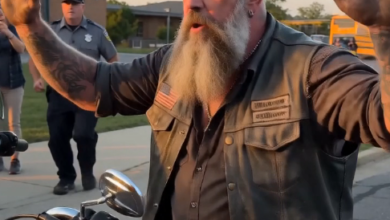
He did not bring his club.
He did not bring a weapon.
He did not arrive with a plan beyond finding Claire and asking whether the message still meant what it said.
The receptionist tried to stop him near the entrance.
“Sir, there is a private bridal event.”
“I’m here for Claire Bennett.”
Patricia appeared first.
She recognized Marcus from the funeral years earlier and immediately stepped between him and the fitting area.
“You have no business here.”
Marcus kept his hands visible.
“She contacted me.”
“She is emotional.”
“Then let her tell me to leave.”
Patricia lowered her voice.
“You will not destroy this wedding because Claire is having a childish panic.”
Marcus looked past her.
Claire stood near the mirror, surrounded by fabric, flowers, and women speaking for her.
Their eyes met.
He saw the frightened thirteen-year-old with grocery bags before he saw the bride.
Marcus approached slowly.
Jonathan was already shouting through a video call held by his sister. His voice filled the boutique.
“Claire, tell him to get out. Right now.”
Claire flinched.
Marcus stopped several feet away.
“Do you want me to leave?”
Claire’s mouth opened.
No sound came.
Patricia gripped her elbow.
“She wants to go to the church.”
Marcus looked only at Claire.
“Do you want me to take you somewhere safe?”
That was when she whispered, “Please.”
Marcus stepped forward.
Patricia pulled Claire backward.
Another relative reached for her veil. Claire cried out as the pins tightened against her scalp. Marcus separated the hands from the dress without striking or shoving anyone, then lifted Claire because the narrow gown prevented her from moving quickly.
To everyone filming, it looked like an abduction.
Claire kicked once as someone grabbed her ankle.
She shouted, but the room heard only panic, not words.
Marcus carried her through the doors.
Outside, police cruisers were already pulling toward the curb.
Officer Elena Ruiz, a forty-one-year-old Latina American woman with dark hair beneath her cap and a steady voice, drew close with one hand raised.
“Put her down now.”
Marcus stopped instantly.
He placed Claire carefully on her feet.
Then he stepped away.
That was the first detail Elena noticed.
A kidnapper does not usually create distance the moment the supposed victim can speak.
PART 5
Claire nearly fell when her shoes touched the sidewalk.
Officer Ruiz steadied her while another officer positioned himself between Marcus and the boutique entrance. Guests crowded behind the glass, filming and shouting contradictory explanations.
“He grabbed her.”
“She was fighting.”
“That man is not family.”
Marcus said nothing.
He kept both hands open and allowed the officers to search him. He did not argue when they moved him several yards away. Claire needed to be heard without his presence shaping the answer.
Officer Ruiz removed her jacket and placed it around Claire’s bare shoulders.
“Are you hurt?”
Claire shook her head.
“Did that man take you against your will?”
“No.”
“You were crying and struggling.”
“They were pulling me back.”
Elena glanced toward the boutique.
“Who is he?”
Claire looked at Marcus.
“My foster dad.”
“Did you ask him to come?”
Claire reached into the concealed pocket sewn into the skirt of her gown and removed her phone. Her fingers shook so badly that Elena had to help unlock it.
The message was still open.
If you still think of me as your daughter, come before I say yes.
Below it was Marcus’s reply.
I still do. I’m coming. You decide what happens when I arrive.
Elena read both messages twice.
Then she asked Claire the question Marcus had asked before lifting her.
“Do you want to leave with him?”
Claire looked at the limousine, the boutique, the relatives behind the glass, and the church program protruding from Patricia’s purse.
Then she nodded.
“Yes.”
Jonathan arrived before the officers finished taking statements. He stepped from a black SUV wearing his wedding suit, face red with rage, and immediately began ordering Claire into the vehicle.
“You are embarrassed and confused. We are going to the church.”
Claire’s body folded inward.
Officer Ruiz stepped between them.
“She has said she does not want to go.”
Jonathan pointed toward Marcus.
“He manipulated her.”
Elena held up Claire’s phone.
“She contacted him.”
Jonathan turned to Claire.
“After everything I’ve done for you?”
The old guilt moved across her face.
Marcus saw it from a distance, but he did not approach.
This time, Claire answered for herself.
“You taught me that love meant I could never leave.”
Her voice shook.
Then it strengthened.
“He was the first person who asked whether I wanted to be saved.”
PART 6
The wedding did not happen.
That did not mean the danger disappeared when the dress came off.
Officer Ruiz understood that leaving a controlling relationship can become the most dangerous moment, especially when the controlling person realizes private authority has become public refusal. She did not simply allow Claire to ride away with Marcus and hope the afternoon ended kindly.
She asked what Claire wanted next.
Not where Jonathan wanted her to go.
Not what Patricia believed was best.
Not what Marcus thought she should do.
Claire asked for somewhere Jonathan could not immediately find her.
Elena contacted a victim advocate named Denise Carter, a forty-seven-year-old Black American woman who worked with a local domestic violence support service. Denise arranged a confidential room, transportation, and help documenting the controlling behavior Claire had normalized for years.
Marcus waited beside his motorcycle.
He did not demand that Claire come home with him. The old Sullivan house carried memories, but it might not feel safe to her yet. He simply told Elena that he would remain available if Claire requested him.
When Claire finally emerged from the boutique, she was no longer wearing the gown.
A seamstress had given her jeans, a sweatshirt, and white sneakers left from an emergency clothing bag. The dress remained hanging inside the store, beautiful, expensive, and suddenly irrelevant.
Claire walked toward Marcus.
He removed his vest and offered it without stepping closer.
She put it around her shoulders.
It hung nearly to her knees.
“I’m sorry,” she said.
“For what?”
“For disappearing. For calling only when everything was already ruined.”
Marcus’s face tightened.
“You called before you said yes.”
She began crying again.
“That was very late.”
“It was still before.”
Claire looked down at the old patches on his vest.
“Do you hate him?”
Marcus considered the question.
“No.”
She looked surprised.
“I hate what happened to your voice around him.”
That answer stayed with her.
Denise arrived soon afterward. Before Claire entered the advocate’s car, she turned back and asked Marcus whether he would follow.
“Only if you want me to.”
“I do.”
So Marcus rode several car lengths behind them through Nashville traffic.
Not as an owner.
Not as a rescuer expecting gratitude.
Only as a father who had been asked to come before one word changed the rest of his daughter’s life.
PART 7
Claire spent the next nine months rebuilding choices.
Small ones came first.
Which coffee to order.
Which number to block.
Whether to cut her hair.
Who could know her temporary address.
Whether she wanted Marcus present during meetings with lawyers and advocates.
Sometimes the answer was yes.
Sometimes it was no.
Marcus treated both answers with equal respect.
That was how trust returned.
Jonathan never accepted responsibility easily. He sent apologies that became accusations by the final paragraph. He told mutual acquaintances Claire had suffered a breakdown. Patricia demanded reimbursement for wedding expenses, as though an unused ballroom mattered more than the reason the bride had fled.
Claire stopped responding.
With Denise’s help, she documented threatening messages, separated finances, regained personal identification Jonathan had kept “for safekeeping,” and reconnected with two old friends she had been convinced no longer cared.
Officer Ruiz checked in twice.
The second time, Claire asked why she had believed her so quickly outside the boutique.
“I didn’t decide who was good,” Elena explained. “I created enough distance for you to answer.”
Claire remembered that.
So did Marcus.
A year after the wedding that never happened, Claire invited Marcus to the small house she rented near a community garden. There were no lace decorations, no formal meal, and no relatives supervising the afternoon.
Only sandwiches, lemonade, Denise, two friends, and a photograph of Helen on the mantel.
Claire handed Marcus a framed screenshot of the message she had sent.
Beneath it, she had added one line:
He came, but he still let me choose.
Marcus stared at it until his eyes blurred.
“I carried you out of the store,” he said.
“You asked first.”
“That mattered?”
“It was everything.”
Claire later began volunteering with a support group for young women leaving controlling relationships. She never called herself a survivor in every room because labels were another choice she wanted to own. But she told them one thing consistently:
Help should not replace one controlling person with another.
Help should open a door and allow you to decide whether to walk through.
Years later, Marcus kept the framed message above his workbench. New riders assumed it marked the day he rescued his daughter from a forced wedding.
Marcus always corrected them.
“She rescued herself,” he said. “I was transportation.”
Claire disagreed slightly.
To her, Marcus had been more than transportation.
He had been proof that being separated from someone did not mean they had stopped loving her. He had arrived wearing old leather, carrying no perfect plan, and willing to be mistaken for a criminal until she could explain the truth.
Most importantly, he had asked the question Jonathan never had.
What do you want?
And when Claire finally answered, Marcus did not argue, negotiate, or ask her to earn his help.
He simply came before she said yes.