Part 2: A 44-Year-Old Biker Was Found Sleeping in a Truck Outside a Seven-Year-Old Girl’s Home for Three Nights — Until Police Learned Who Her Mother Was and Why He Refused to Leave
PART 2
Six months earlier, Lucas Mercer had been dying beneath an overturned motorcycle beside Interstate 40.
Rain mixed with gasoline on the pavement while traffic slowed just long enough for strangers to record the wreck before continuing home. Lucas remembered headlights, the taste of blood, and the strange calm that arrived when he realized he could no longer feel his left hand.
Claire Reed was driving home from a night shift.
She had already worked thirteen hours, her shoes hurt, and Sophie had called twice asking whether she would be awake in time to make pancakes. Claire could have assumed the ambulance was coming.
Instead, she stopped.
She pulled her car onto the shoulder, called emergency services, and crawled beneath the bent guardrail where Lucas had landed. His leather vest was soaked, his breathing shallow, and a torn artery near his leg was bleeding faster than she could safely control with her hands alone.
Claire removed her belt.
She used it as a temporary tourniquet, kept pressure on the injury, and spoke to him until paramedics arrived.
Lucas remembered only pieces of her voice.
“Stay with me.”
“Tell me your name.”
“You do not get to close your eyes yet.”
At the hospital, surgeons told him the minutes between Claire stopping and the ambulance arriving had likely decided whether he lived.
Lucas tried to thank her later.
Claire refused money, flowers, and the expensive leather jacket his club offered to buy her.
“You survived,” she said. “That is the thank-you.”
They did not become close friends immediately. Lucas occasionally brought coffee to the emergency department, and Claire sometimes sent photographs of Sophie wearing the toy motorcycle helmet his club had given her.
Their connection remained simple.
She had seen him when others drove past.
He remembered.
Months later, during a follow-up examination, Claire looked more exhausted than usual. Lucas noticed a fresh scratch near her wrist and asked whether everything was all right.
Claire said the scratch came from moving furniture.
Then she mentioned the knocking.
“Probably teenagers,” she said. “Someone thinks frightening a nurse’s kid is funny.”
“Did you call police?”
“They made a report. There’s nothing on the doorbell camera.”
“Who stays with Sophie?”
“My mother, but she’s recovering from surgery.”
Claire laughed weakly, trying to make the problem sound smaller.
Lucas did not laugh.
He knew what it meant when a frightened person minimized danger because they had no room left to carry another problem.
PART 3
Lucas arrived outside Claire’s house the following night at eleven-thirty.
He did not call her.
That decision would later become the hardest part to explain.
He believed Claire would refuse the help, either because she did not want to owe him anything or because she would feel responsible if he lost sleep. She might even miss a shift rather than allow someone to sit outside for her family.
Lucas did not want gratitude.
He wanted the knocking to stop.
He parked across the street where his truck was visible from the front door but did not block traffic or enter private property. He kept the cab light off and placed his phone on the dashboard with the camera pointed toward Claire’s porch.
At twelve-forty, Sophie looked through the curtains.
Lucas raised one hand but immediately worried the gesture might frighten her. Sophie disappeared from the window.
A minute later, the porch light blinked twice.
Lucas did not know whether it was accidental.
He blinked his headlights once in response.
The first night passed quietly.
On the second night, a dark sedan drove slowly past the house at 1:17 a.m. It stopped near the corner, remained there for less than a minute, then continued.
Lucas photographed the plate, but rain blurred two numbers.
He sent the image to a retired police officer in his motorcycle club, who told him not to follow the vehicle and advised him to report any direct activity.
Lucas agreed.
He was not there to chase anyone.
He was there to be seen.
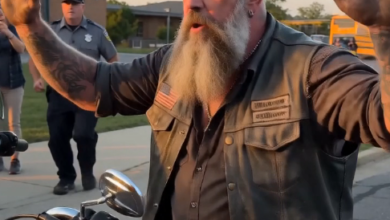
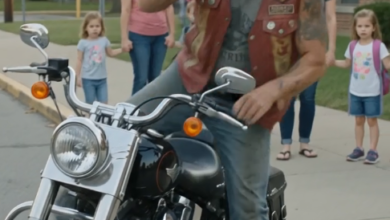
On the third night, a neighbor named Margaret Lowell watched Lucas from behind her curtains. She saw a large tattooed man sleeping in a truck, a little girl’s face appearing at the upstairs window, and no obvious relationship between them.
Margaret contacted two other neighbors.
By morning, the private neighborhood group was filled with photographs of Lucas’s truck.
One resident claimed he had been studying the child’s schedule.
Another said bikers sometimes scouted houses before robberies.
Nobody knocked on Claire’s door to ask whether she knew him.
Nobody approached Lucas.
Fear created the story before facts had a chance to arrive.
At 5:42 a.m., two patrol cars entered the street and boxed in his truck.
Lucas woke to flashing lights filling the windshield.
PART 4
Officer Renee Watkins approached from the driver’s side while her partner remained near the rear of the truck.
“Keep your hands visible.”
Lucas placed both palms against the steering wheel.
Renee studied the interior. There were no weapons in sight, no binoculars, no photographs of Sophie, and nothing suggesting he had been watching the child for any reason beyond the explanation he gave.
There was only a thermos, a folded blanket, a phone charging on the dashboard, and three empty coffee cups.
“You have been here three nights?” Renee asked.
Lucas nodded.
“Why didn’t you contact the family?”
“I know the mother.”
“That was not my question.”
Lucas looked toward the white house.
“Because she would have told me to go home.”
“You understand how this looks.”
“Yes.”
“And you stayed anyway.”
“Yes.”
Renee asked for identification and ran his information. His record showed an old bar fight from his twenties, several traffic citations, and no history involving children, stalking, or domestic violence.
Then Claire’s car turned into the street.
She had just finished her shift.
At first, she saw the police cruisers.
Then she saw Lucas standing beside his truck.
Her face changed from confusion to alarm.
“What happened?”
Renee asked whether she knew him.
Claire looked at Lucas.
“He’s the accident patient I told you about,” she said. “The one from the highway.”
Renee explained the neighbors’ concerns and Lucas’s claim that someone had been frightening the household at night.
Claire stared at him.
“You’ve been sleeping out here?”
Lucas nodded.
“For three nights?”
Another nod.
Claire’s anger arrived before gratitude.
“You should have told me.”
“I knew what you’d say.”
“You do not get to decide what happens around my daughter.”
Lucas lowered his eyes.
“You’re right.”
That answer slowed her.
He did not defend himself.
He did not turn the favor into ownership.
Then Helen opened the front door and called Claire’s name.
Before anyone could answer, a dark sedan appeared at the far end of the street.
Lucas recognized it immediately.
The same car from the previous night.
It slowed when the driver saw the police.
Then it accelerated.
Renee’s partner returned to his cruiser.
“Stay here.”
The patrol car turned after the sedan while Renee requested additional units and asked Lucas to show her the photograph he had taken.
The numbers matched enough of the visible plate to narrow the search.
For the first time, everyone looked at the parked truck differently.
PART 5
Police located the sedan twenty minutes later at a gas station three miles away.
The driver was not a violent criminal planning to enter Claire’s home. The truth was less dramatic but still disturbing.
He was the estranged boyfriend of a hospital employee Claire had reported for stealing prescription medication. He blamed Claire for the investigation that cost the employee her job, though Claire had only documented what she witnessed and followed hospital procedure.
The man admitted driving past the house.
He denied knocking.
Then officers found videos on his phone showing Claire’s porch at night, along with messages joking that he intended to make her “too scared to keep playing hero.”
The attempted doorknob entry had not been recorded clearly enough to prove he committed it, but the evidence supported harassment charges and a protective order.
Renee returned to the house with the update.
Claire sat on her porch steps wrapped in a hospital sweatshirt, listening while Sophie leaned against her side. Helen remained inside, watching through the screen door.
Lucas stood near his truck.
He kept his distance.
When Renee finished, Claire asked Sophie to go inside with her grandmother. The little girl hesitated, then walked across the yard toward Lucas instead.
Claire started to call her back but stopped.
Sophie stood several feet from the biker.
“Were you the truck light?” she asked.
Lucas knelt carefully.
“What truck light?”
“The little blue one on the dashboard. I could see it through my curtains.”
Lucas glanced toward the charging indicator on his phone.
“I guess I was.”
Sophie held her stuffed fox against her chest.
“Grandma said not to be scared because the truck man was still there.”
Lucas looked at Helen through the doorway.
The older woman gave him a tired nod.
Claire covered her mouth.
Everything she had been carrying finally reached her face: the overnight shifts, the threatening knocks, the guilt of leaving Sophie, and the realization that someone had quietly occupied the darkness without asking her to repay him.
She walked toward Lucas.
“I saved you because it was my job.”
Lucas stood.
“No. You stopped after your job was already finished.”
Claire looked toward the truck.
“You slept upright for three nights.”
“I’ve slept in worse places.”
“That is not funny.”
“No, ma’am.”
She almost smiled despite herself.
Then Renee asked the question Claire had not.
“Why didn’t you report your plan before parking here?”
Lucas looked at the nurse still wearing her identification badge.
“I didn’t want her choosing between saving strangers and wondering who would save her child.”
Nobody spoke for several seconds.
Even the neighbors watching from their porches lowered their phones.
PART 6
Lucas did not stay outside a fourth night.
Once police understood the threat, they increased patrols, helped Claire install improved cameras, and documented the protective order. The hospital also provided workplace-security support because the harassment originated from a report connected to Claire’s job.
Lucas accepted that his role was finished.
That mattered to Claire.
He did not treat one good action as permission to remain involved forever. He did not call himself Sophie’s protector or assume the family now belonged to him. He helped install a reinforced porch light, showed Helen how to activate the emergency button on the new alarm, and then prepared to leave.
Before driving away, Lucas visited every neighbor whose camera had captured the street.
He did not demand apologies.
He gave each person his phone number.
“If another strange vehicle appears,” he said, “call the police first. Then call me if Claire wants you to.”
Margaret Lowell, the neighbor who made the original report, looked ashamed.
“I thought you were watching the girl.”
“You were trying to protect her.”
“I was wrong about you.”
Lucas considered that.
“You were right to notice. You were wrong to stop at suspicion.”
Margaret nodded slowly.
The following week, the neighborhood established a voluntary night-watch schedule coordinated through the police department. No one sat outside Claire’s house specifically. Instead, residents checked on one another, reported broken streetlights, shared camera footage responsibly, and stopped treating unfamiliar people as guilty before asking questions.
Claire’s porch light no longer stood alone.
Lucas returned to ordinary life at his motorcycle repair shop. He expected his connection with Claire’s family to fade once the danger passed.
Instead, Sophie began visiting the shop with her mother on Saturday mornings.
She liked sitting on an overturned bucket and organizing clean bolts by size. Lucas gave her protective glasses even when she was nowhere near active tools.
One morning, she brought him a drawing.
It showed the white house at night, a yellow porch light, and a gray pickup parked across the street. Inside the truck, a stick figure with a large beard held a coffee cup.
Above the vehicle, Sophie had drawn a speech bubble.
YOU CAN SLEEP NOW. WE ARE SAFE.
Lucas stared at the picture for a long time.
Then he taped it inside the truck above the sun visor.
PART 7
Claire eventually changed shifts.
Not because fear drove her away from emergency nursing, but because the hospital created a rotating schedule that allowed her more nights at home. She continued reporting misconduct when she saw it, though the experience taught administrators that employees who protected patients sometimes needed protection beyond the hospital doors.
The harassment case moved through court.
The man received probation, mandatory counseling, and a no-contact order. Some people considered the consequences too light. Claire focused less on punishment than safety. Cameras worked. Patrols came. Neighbors paid attention. The knocking stopped.
Sophie began sleeping without checking the window.
Lucas never asked whether that happened because of him.
Two years later, Claire was working an evening shift when another motorcycle accident arrived at the emergency department. The injured rider was young, terrified, and calling for a mother who lived three states away.
Claire remained beside him until surgery.
The next morning, she found Lucas waiting outside with coffee.
“How did you know?”
“The kid belongs to a riding group that knows my club.”
Claire accepted the cup.
“You planning to sleep in the parking lot?”
Lucas shook his head.
“I learned to announce myself.”
She laughed.
That was how their friendship continued: not as a debt passed back and forth, but as two people who understood that rescue rarely ends when an ambulance leaves.
When Sophie turned ten, her class received an assignment to write about a person who made them feel safe. Claire expected her daughter to choose a police officer, teacher, or family member.
Sophie wrote about a truck.
She described the small blue charging light visible from her bedroom and the bearded man who never came to the door because he understood that protecting someone did not require entering their life without permission.
Her final sentence read:
“He made the dark look occupied.”
Claire sent a photograph of the essay to Lucas.
He replied with only four words.
Your mother did first.
Years passed, and the old pickup eventually stopped running. Lucas sold it for parts but removed the sun visor before the buyer arrived.
Sophie’s drawing remained taped above it.
The paper had faded, and the edges curled, but the yellow porch light was still visible.
Whenever people later told the story, they focused on the suspicious biker sleeping outside a little girl’s home or the dramatic moment police discovered the threatening driver.
Lucas remembered something quieter.
A tired nurse had once crawled into the rain beside a dying stranger because she refused to let darkness decide whether he lived.
Months later, when darkness gathered outside her own home, he simply returned the favor by remaining where it could see him.
He did not rescue Claire.
He did not replace the police.
He did not become Sophie’s guardian.
He merely made sure that for three difficult nights, the porch light was not the only thing awake.
Follow this page for more unforgettable biker stories about misunderstood loyalty, quiet protection, and ordinary people who repay kindness when nobody else is watching.