Part 2: A 63-Year-Old Biker Was Accused of Threatening a Bus Station Clerk Over a Young Mother’s Unpaid Tickets — Until Police Learned Why He Was Begging Them Not to Send Her Back Into the Cold
PART 2
Walter Bennett had not planned to be at the bus terminal that night.
His motorcycle was locked inside a repair trailer outside Lincoln because the highway had become too dangerous to ride, and his club brothers had insisted he take a bus home instead of proving that old bikers were just young fools with worse knees.
Walter hated buses.
He hated schedules, narrow seats, fluorescent lighting, and the feeling of surrendering control of the road to somebody wearing a company tie. He had spent forty years deciding when to leave, where to stop, and how long to remain beneath an open sky.
That night, however, the snow had made the decision for him.
He had been sitting near Gate Seven with burnt coffee and a paperback book when he first noticed Evelyn.
She entered through the sliding doors at 11:21 p.m., carrying Sophie against her chest while Caleb pulled a battered suitcase with one broken wheel and Mia carried the grocery bag.
They did not look like travelers.
They looked like people who had left before packing became possible.
Evelyn checked the lobby twice before approaching the counter. She watched every man who entered. She kept the children close enough that Mia repeatedly stepped on the back of her shoes.
Walter recognized the pattern.
Not because he was an expert.
Because his younger sister had once arrived at his house in exactly the same condition, wearing slippers beneath a winter coat and carrying nothing except her son’s birth certificate.
She had returned to her husband three days later.
Six months after that, she returned again with a broken wrist.
Walter never forgot how frightened people often defend the person hurting them before they trust the person offering a door.
So he watched without staring.
Evelyn counted crumpled bills twice. Then she emptied coins from a plastic sandwich bag and lined them across the ticket counter while Martin tried not to look embarrassed for her.
The children remained silent.
That silence bothered Walter most.
Children usually complain when tired, hungry, or cold. These three behaved like noise itself had consequences.
When Martin told Evelyn she was short, Caleb immediately opened his backpack.
“I have five dollars from Grandma.”
Evelyn shook her head.
“No, baby.”
Walter looked away for a moment.
He knew then that whatever happened next would not be solved by pretending he had not noticed.
PART 3
Walter approached the counter carefully.
He stopped several feet from Evelyn, leaving enough space that she would not feel surrounded, and spoke to Martin instead of asking the mother questions in front of her children.
“How much is missing?”
Evelyn turned sharply.
“We’re fine.”
Walter nodded.
“All right.”
That was not agreement.
It was permission for her to keep some dignity while he helped anyway.
Martin glanced at the total.
“Thirty-seven dollars and eighty cents.”
Walter reached for his wallet.
It contained fourteen dollars, a fuel receipt, an old photograph, and an expired diner coupon. He had paid cash for the repair trailer and assumed his bus ticket would be the final expense of the night.
“ATM?” he asked.
“Across the parking lot inside the convenience store,” Martin replied.
Walter looked through the station doors.
Snow was already covering the sidewalk.
“Let them wait here.”
Martin shook his head.
“The ticketed passenger area is restricted after midnight.”
“There are children.”
“I understand, but the policy—”
Walter’s patience cracked.
“Your policy is about to put a two-year-old in a snowstorm because her mother is thirty-seven dollars short.”
People began watching.
Evelyn pulled Sophie closer.
“Please,” she whispered to Walter. “Don’t make trouble.”
The sentence stopped him.
Not because she wanted him to leave.
Because she had learned that angry men always made trouble cost her something.
Walter lowered his voice.
“I’m not angry at you.”
The transit officer approached then. His name was Marcus Reed, a forty-year-old Black American man with steady brown eyes, a dark blue uniform, and the cautious posture of someone accustomed to separating loud strangers before arguments became dangerous.
“Sir, step away from the counter.”
Walter obeyed immediately.
“I’m going to the ATM.”
“Then go.”
“But she and the kids stay inside.”
Marcus looked at Evelyn, then at the sleeping toddler.
Before he could answer, Evelyn’s phone buzzed.
The message appeared across the cracked screen.
I know where you’re going. You won’t make it.
Her hand began shaking harder.
Walter saw it.
So did Marcus.
The argument changed in that moment.
It was no longer about tickets.
PART 4
Officer Marcus did not ask Evelyn to explain in front of the crowd.
That was the first right thing anyone did after the phone message appeared.
He moved to the side of the counter, lowered his voice, and asked whether she knew the sender. Evelyn stared at the screen without answering. Her thumb hovered over the power button as if turning off the phone might erase the person behind the words.
Walter remained several feet away.
He did not interrupt.
He did not tell her what she should do.
He had learned that frightened people need choices returned to them, not another stranger taking control.
Finally, Evelyn nodded.
“My husband.”
“Does he know you’re here?”
“I don’t know.”
“Has he threatened you before?”
Evelyn looked at her children.
That was answer enough.
Marcus asked Martin to unlock the heated family waiting room immediately. The clerk hesitated only a second before reaching for the keys. Policy suddenly felt smaller than the frightened woman standing in front of him.
Walter pulled on his gloves.
“I’m getting the money.”
Marcus looked toward the storm.
“I can have another officer go.”
“You stay with them.”
Walter’s tone was firm, but no longer confrontational.
Evelyn caught his sleeve before he turned away.
“You don’t have to do this.”
Walter looked at Sophie’s uncovered arms, then at the two older children trying not to appear afraid.
“Somebody does.”
He crossed the parking lot on foot because the snow had buried the curb and the wind nearly pushed him sideways twice. The ATM accepted his card, but Walter withdrew more than the ticket money.
He stopped inside the convenience store afterward.
There were no children’s winter coats, only oversized sweatshirts, knitted gloves, two fleece blankets, and a bright red jacket meant for a teenage girl. Walter bought everything warm enough to be useful.
Then he called someone.
Detective Laura Mendoza was a fifty-one-year-old Latina American woman who had helped Walter’s sister obtain a protection order years earlier. She now worked with a family violence response unit and still answered late calls when the person making them sounded serious.
Walter explained the situation.
Laura did not ask whether Evelyn had “really decided” to leave.
She only said, “Keep her inside. I’m coming.”
When Walter returned through the station doors, snow covered his beard and shoulders.
In one arm, he carried the red coat and two blankets.
In the other hand were four bus tickets.
PART 5
Evelyn began crying when Walter placed the coat around Sophie.
Not loudly.
She turned her face away and pressed her lips together, trying to keep the sound from waking the toddler. Walter pretended not to notice because some tears are easier to release when nobody watches.
The red jacket was much too large.
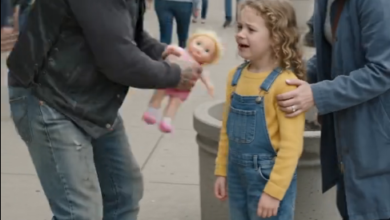
Its sleeves swallowed Sophie’s hands and the bottom reached below her knees, but it was warm. Mia received one of the fleece blankets, while Caleb wrapped the other around his shoulders and insisted he was not cold.
Walter gave him the knitted gloves anyway.
Martin printed four tickets to Des Moines, where Evelyn’s older sister lived. Walter paid for them, then bought food vouchers for the children because their bus would not arrive until 1:40 a.m.
“You withdrew too much,” Evelyn said when she saw the receipt.
Walter folded it before she could read the total.
“I’m bad at math.”
“You don’t know me.”
“No.”
“You don’t know whether I’ll pay you back.”
“No.”
Her face tightened.
“Then why?”
Walter glanced at Caleb, who was dividing one sandwich into three equal pieces even though Walter had purchased four.
“Because the longest road is usually the stretch where nobody believes you really need to leave.”
Evelyn covered her mouth.
Officer Marcus returned with information from dispatch. The threatening phone number belonged to Evelyn’s husband, and the local department had already documented two prior domestic calls at their address.
Then the station doors opened.
Detective Laura Mendoza entered wearing a dark winter coat over plain clothes, snow melting across her shoulders. She approached Evelyn slowly and introduced herself without using the words victim, abuse, or husband within earshot of the children.
Walter handed Evelyn a folded piece of paper.
Laura’s direct number was written on it.
“This officer helped my sister,” he said. “She knows what the next part looks like.”
Evelyn stared at the number.
“There’s a next part?”
Laura sat beside her.
“Yes,” she said gently. “And you won’t do it alone.”
Across the lobby, Martin looked down at the counter where Evelyn’s coins still lay in small uneven stacks.
For the first time, he understood how close the station had come to sending four people back into the cold because the rules had asked only whether she could pay.
Not why she needed to leave.
PART 6
The threatening husband never reached the terminal.
Laura contacted patrol officers near Evelyn’s home, and they located him driving toward downtown less than ten minutes later. He was stopped several blocks away with an overnight bag, Evelyn’s photograph, and messages on his phone that made his intentions difficult to explain away.
Laura did not tell Evelyn every detail before the bus departed.
She told her only what mattered.
“He cannot come inside this station.”
Evelyn’s shoulders dropped for the first time that night.
The children ate in the family waiting room while snow gathered outside the windows. Sophie woke briefly, looked down at the enormous red jacket around her, and smiled as though she had been given a royal robe.
Walter sat near the door.
Not beside Evelyn.
Near enough to be useful, far enough that she never felt watched.
At 1:25 a.m., the bus was announced.
Martin came from behind the counter to help carry the broken suitcase. He apologized to Evelyn quietly.
“I should have let you wait inside.”
She nodded.
She did not absolve him immediately.
That was fair.
Officer Marcus walked the family to the gate. Laura had already contacted a shelter advocate and Evelyn’s sister in Des Moines, confirming that someone trusted would meet them upon arrival.
Walter carried Sophie until Evelyn reached the bus steps, but only after asking permission.
The little girl slept against his leather vest, one red sleeve swinging near his knee.
Caleb looked up at him.
“Are you a police officer too?”
Walter smiled.
“No.”
“Then why did everybody listen to you?”
“They didn’t at first.”
Caleb considered that answer.
Before boarding, Evelyn tried to return the folded money Walter had slipped into the diaper bag.
He closed her fingers around it.
“For breakfast.”
She shook her head.
“I can’t take everything.”
“You’re not taking everything. You’re taking enough to reach tomorrow.”
Tears filled her eyes again.
Then she surprised him by placing one hand gently against the old patch on his vest.
“Thank you for believing I needed to go.”
Walter nodded because his throat would not cooperate.
The bus doors closed.
He remained on the platform until the taillights disappeared into the snow.
PART 7
Walter heard from Evelyn three weeks later.
The message came through Detective Mendoza because Evelyn had changed her phone number and did not want the old one connected to anyone who helped her. She was living temporarily with her sister, the children had enrolled in school, and a court had issued a protection order.
The red jacket still did not fit Sophie.
Evelyn sent a photograph of the toddler wearing it anyway, sleeves rolled seven times, grinning beside a snowman taller than she was.
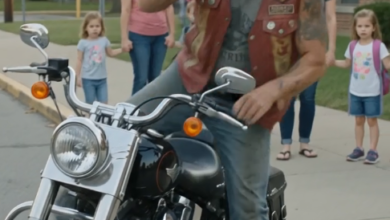
Walter printed the photograph and kept it inside the storage compartment of his Harley.
Martin changed too.
The bus terminal created a written cold-weather policy allowing families with children and vulnerable travelers to remain in the heated waiting room while emergency payment or support was arranged. A small card appeared beside every ticket terminal with contact numbers for shelters, transportation grants, and family violence services.
Officer Marcus made sure Laura’s unit was included.
No one named the policy after Walter.
He preferred it that way.
Months later, Evelyn mailed him thirty-seven dollars and eighty cents.
Walter sent it back with another twenty.
She sent the full amount again.
He returned it again with a note.
Stop making the mailman participate in this argument.
Eventually, Evelyn stopped sending money.
Instead, on the anniversary of that night, she and the children purchased four bus tickets for a mother leaving a shelter in Des Moines. She sent Walter a photograph of the tickets with one sentence beneath it.
We helped someone reach tomorrow.
Walter stared at the picture for a long time.
Then he took his Harley out despite the cold.
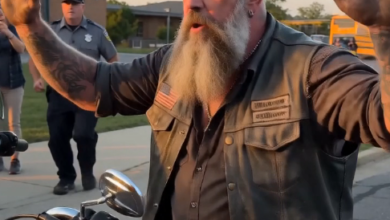
Years later, people at the Omaha terminal still remembered the gray-bearded biker who appeared to be shouting at a clerk over unpaid fares. Some remembered the police approaching him. Others remembered the toddler wearing the enormous red coat or the young mother boarding a bus with one folded phone number in her pocket.
Walter remembered something quieter.
He remembered the way Evelyn kept looking back at the station doors, expecting the man she feared to appear before the bus arrived.
He remembered how her shoulders finally lowered when Laura said he could not enter.
Most of all, he remembered Caleb dividing one sandwich among three children because even at nine years old, the boy had already learned that survival meant taking less.
Whenever Walter told the story, he never described himself as the person who rescued them.
“I bought four tickets,” he would say. “She did the hard part.”
Because help can purchase a seat, open a waiting room, or offer a warm coat.
But the frightened person is still the one who must step onto the bus.
And sometimes the longest, bravest journey in the world begins with a stranger standing at a ticket counter and saying:
“Please don’t send them back outside.”