Part 2: A Massive Biker Wore a “My Daughter’s Security Team” Shirt to Her School Family Day — But His Quiet Answer Exposed a Bullying Problem No One Had Dared to Report
PART 2
Marcus Lawson had spent most of his life learning how quickly strangers decided who he was.
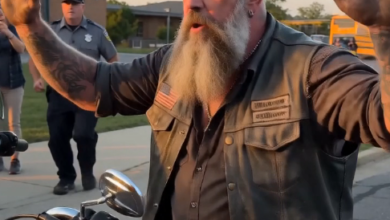
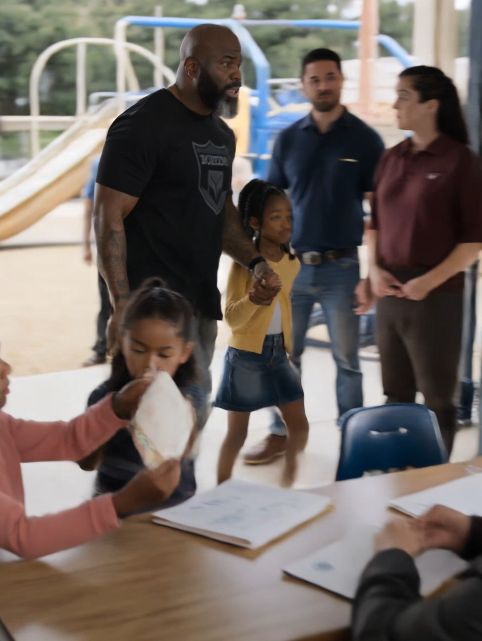
At six-foot-four, with broad shoulders and tattooed arms, he could empty the seat beside him on a bus without saying a word. Store employees followed him through expensive aisles, parents pulled children closer when he entered playgrounds, and police officers sometimes watched his hands before they looked at his face.
He understood caution.
He also understood prejudice disguised as caution.
Marcus had joined the Iron Guardians Motorcycle Club in his twenties after returning from military service with an injured knee and no clear direction. The club was not perfect, but its members gave him practical work, community, and rules built around responsibility rather than appearance.
They repaired homes for disabled veterans, delivered groceries to elderly residents, and organized winter clothing drives.
Zoe had grown up inside that community.
To her, leather vests meant people arriving with tools when a neighbor’s roof leaked. Motorcycles meant eighteen adults attending a child’s hospital fundraiser without asking whose name appeared on the donation receipt.
Her father’s tattoos were stories.
One represented Marcus’s mother.
Another honored a friend who died overseas.
A small yellow flower near his wrist matched the first picture Zoe had drawn for him in kindergarten.
Until fourth grade, she had never considered that other children might see those things differently.
The problem began after Zoe’s teacher asked students to bring family photographs for a classroom project called “The People Who Help Me Grow.”
Zoe selected a picture taken during an Iron Guardians food drive. Marcus stood beside her wearing his leather vest while both held boxes of canned soup.
Two boys stared at the photograph.
“Your dad is in a gang,” one said.
“No, he’s in a motorcycle club.”
“That’s the same thing.”
Another student asked whether the skull-shaped memorial patch meant Marcus had killed someone.
Zoe tried explaining.
The children laughed.
By the end of the week, rumors had transformed Marcus into a criminal who carried weapons, fought police officers, and threatened teachers.
None of it was true.
Zoe became ashamed of defending him because every answer produced another joke.
The children responsible were not hardened bullies. They were nine-year-olds repeating adult assumptions, then discovering that Zoe’s discomfort made them feel powerful.
The behavior continued because no adult saw the entire pattern.
Zoe remained silent because she feared reporting it would bring Marcus to school—and prove everyone right about how frightening he looked.
PART 3
Marcus first noticed the uneaten lunches.
Zoe had always returned from school hungry, but suddenly her lunchbox came home full while she claimed she had eaten snacks with friends.
Then she stopped wearing the small motorcycle pin Marcus had given her.
She removed his photograph from the clear sleeve inside her school binder.
When Family Day was announced, Zoe placed the permission form beneath several advertisements on the kitchen counter and said the event was probably boring.
Marcus knew his daughter.
Zoe loved school events, especially any occasion involving cupcakes and games adults pretended children were not cheating at.
He waited until Thursday evening, then sat beside her while she completed homework.
“You don’t want me at Family Day?”
Zoe erased the same word three times.
“It’s fine if you’re busy.”
“I’m not busy.”
“You could become busy.”
Marcus leaned back.
“Are you embarrassed by me?”
The question frightened her more than he expected.
Zoe’s eyes filled immediately.
“No.”
“Then what is it?”
She refused to speak until Marcus promised he would not visit anyone’s house, bring the club, or become angry.
He agreed.
Zoe told him everything.
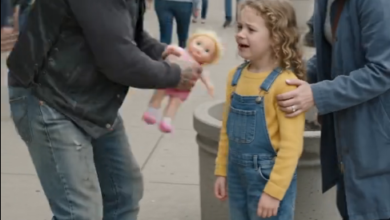
She explained the jokes, the questions about prison, the comments during lunch, and the afternoon one child said Marcus would probably “come beat up the school” if Zoe complained.
Marcus listened without interrupting.
Anger rose inside him, but he understood that displaying it would confirm the exact fear trapping his daughter.
“What do you want me to do?” he asked.
Zoe looked confused.
“You’re not going to decide?”
“This happened to you. The adults still have responsibilities, but you deserve a voice.”
She considered several possibilities.
She did not want the children expelled.
She did not want a dramatic assembly mentioning her name.
She wanted Marcus to attend Family Day, but she feared his leather vest would attract attention.
“I can leave it on the motorcycle.”
Zoe nodded.
Then she remembered a blank T-shirt they had purchased for a school craft project. She spent the evening painting words across it with white fabric paint.
MY DAUGHTER’S SECURITY TEAM.
Marcus studied the finished shirt.
“Security team sounds intimidating.”
“You are the team.”
“One person isn’t a team.”
“You’re big enough.”
Marcus laughed.
The following morning, he contacted Principal Rebecca Harris privately. He explained the situation, requested a meeting during Family Day, and made one thing clear.
“I’m not coming to frighten children.”
Rebecca assured him the school would investigate.
What she did not tell him was that Zoe’s complaint might not be the only one.
PART 4
Family Day began beneath clear skies and nervous smiles.
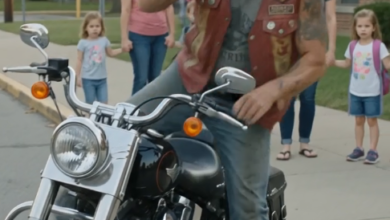
Marcus parked his Harley at the far end of the lot and left his vest across the locked saddlebag. He wore the shirt Zoe had made, though several letters leaned sideways because nine-year-olds rarely respect spacing.
People noticed him immediately.
A father near the entrance glanced at the shirt and pulled his own son closer.
A staff member quietly notified security that a large biker had arrived, even though Marcus had checked in correctly and worn the required visitor badge.
Marcus saw the caution.
He did not react.
Zoe held his hand tightly while guiding him toward her classroom. She showed him her science project, introduced him to one friend, and avoided looking toward the two boys who had mocked her.
Marcus recognized them from her description.
He did not approach.
That restraint confused the children more than anger would have.
One boy’s mother studied Marcus from across the room. She had heard her son mention “Zoe’s scary biker dad,” but she had assumed the description was exaggerated.
Marcus was intimidating.
Yet he spent the next hour helping children tape paper wings onto model insects, carrying folding tables for a teacher, and kneeling so younger students could speak to him without looking upward.
When Zoe’s class gathered for a family photograph, she hesitated before standing beside him.
Marcus offered to remain outside the frame.
Zoe grabbed his wrist.
“No. You’re my person.”
The two boys heard her.
One whispered something.
Zoe’s shoulders stiffened.
Marcus placed one hand lightly between her shoulder blades but said nothing.
Afterward, Principal Harris invited Marcus, Zoe, her teacher, and the families of the involved students into a quiet classroom.
Rebecca asked Marcus what resolution he expected.
Several adults appeared tense, bracing for demands.
That was when he gave the answer Zoe remembered for the rest of her life.
“I don’t need anybody afraid of me,” Marcus said. “Fear is already the problem. I need Zoe to know she doesn’t stand alone, and I need every child in this room to understand that somebody’s family is not a costume for jokes.”
The mother of one boy lowered her eyes.
Before she could respond, a woman waiting outside the classroom began crying.
Her name was Amanda Pierce.
Her ten-year-old son had been hiding something too.
PART 5
Amanda entered the room carrying a backpack belonging to her son, Caleb.
She apologized for interrupting, then explained that Caleb had been mocked for wearing secondhand clothes and speaking with a stutter. The teasing occurred mostly during recess, where rotating supervisors heard isolated comments but never saw the pattern.
Caleb had asked his mother not to report it.
He believed complaining would make everything worse.
A second father stepped forward after overhearing Amanda. His daughter had been excluded from games because she wore a hearing aid.
Another parent described anonymous messages sent through a classroom application.
Within twenty minutes, the discussion had moved beyond Zoe.
Principal Harris asked the school counselor to join them. Teachers compared notes, and small incidents previously dismissed as arguments between children began connecting into a larger picture.
No single child controlled the school.
Different groups had discovered different vulnerabilities and used them whenever adults were not looking.
The school’s existing policy relied heavily on students reporting repeated behavior.
The students most frightened by retaliation were therefore responsible for producing evidence that adults had failed to notice.
Marcus listened as parents spoke.
Nobody blamed motorcycles anymore.
The mother of one of Zoe’s classmates eventually turned toward her son.
“Did you say those things about Mr. Lawson?”
The boy’s face reddened.
“My uncle said biker gangs hurt people.”
“Did Mr. Lawson hurt you?”
“No.”
“Did Zoe?”
“No.”
The teacher invited Marcus to explain his club, but he declined to give a speech designed to prove he was one of the “good” bikers.
“I passed the same visitor screening as every parent,” he said. “Zoe shouldn’t need my résumé before her family deserves respect.”
That distinction changed the conversation.
Marcus later answered the children’s questions privately. He explained that some motorcycle organizations committed crimes, just as some people in any large group harmed others. A leather vest alone could not tell them what a person had done.
One boy pointed toward the small flower tattoo on Marcus’s wrist.
“What is that one?”
“Zoe drew it when she was five.”
Zoe smiled for the first time during the meeting.
The child who had mocked her stared at the yellow flower.
“It doesn’t look scary.”
“It wasn’t made for you to fear,” Marcus replied.
Before the families left, the two boys apologized.
Marcus did not force Zoe to accept immediately.
She listened.
Then she said, “You can show me by stopping.”
It was the most practical answer anyone in the room gave.
PART 6
Meadowbrook Elementary did not solve its bullying problem with one assembly or a poster in the hallway.
Principal Harris began with an anonymous student survey. The answers revealed that many children could identify bullying but did not know how to report it without attracting attention.
The school created multiple reporting paths, including private counselor boxes, scheduled check-ins, and a digital form parents could complete without naming another child publicly.
Teachers received additional training on repeated social exclusion, rumor-spreading, and comments disguised as jokes.
Students practiced being witnesses rather than silent audiences.
The program was called Stand Beside Me, a phrase borrowed from Marcus’s explanation without using Zoe’s name.
Families were invited to share cultures, occupations, disabilities, and nontraditional family structures, but no one was required to become an educational exhibit for others.
Marcus attended one session about judging appearances.
He arrived in ordinary work clothes and placed his leather vest on a table.
Instead of defending himself, he asked students what they believed each patch meant.
Most guesses were wrong.
Then he explained them.
One honored military service.
One came from a charity ride for childhood cancer.
Three memorialized deceased friends.
A small patch shaped like a book came from a literacy fundraiser.
The children learned that curiosity could begin with a question, but respect determined how the question was asked.
The two boys who had targeted Zoe participated in restorative meetings with the counselor. Their punishment included consequences, but it also required them to understand impact and demonstrate changed behavior.
One boy later joined Zoe during lunch after noticing another student mocking her father’s motorcycle pin.
“You don’t know him,” he said.
Zoe looked surprised.
The boy shrugged.
“I do now.”
Trust did not return instantly.
Zoe watched him carefully for weeks.
Marcus encouraged patience but never demanded forgiveness.
“People earn their way back,” he told her. “You don’t owe anyone a shortcut.”
Three months after Family Day, reports of repeated bullying decreased, while requests for counselor support initially increased.
Principal Harris considered that progress.
Children had not suddenly become crueler.
They had become less silent.
Amanda Pierce’s son began receiving speech support without classmates mocking him. The girl with the hearing aid joined an after-school art group where communication did not depend on noisy playground conversations.
Zoe wore her motorcycle pin again.
She did not become fearless.
She learned fear did not require isolation.
PART 7
The shirt remained inside Marcus’s closet long after the fabric paint began cracking.
He wore it only once more, during the school’s first Stand Beside Me community night. By then, families recognized him, and children approached to inspect the yellow flower tattoo.
One kindergartner asked whether Marcus was a real security guard.
“No.”
“Then why does your shirt say security?”
Marcus looked toward Zoe.
She answered for him.
“Because he makes sure I know somebody will come.”
That was the lesson Marcus hoped she carried forward.
Protection was not always confronting danger with force. Sometimes it meant arriving calmly enough that a frightened child could borrow your steadiness.
Zoe’s relationship with her classmates changed gradually. One of the boys transferred schools for unrelated family reasons. The other remained, completed the restorative program, and eventually became someone Zoe could work beside without fear.
They did not become best friends.
Not every repaired harm needed a perfect ending.
Years later, Zoe entered middle school and encountered new forms of cruelty. Rumors traveled faster. Messages followed children home. Marcus could no longer solve anything simply by standing beside her during Family Day.
He continued asking the same question.
“What kind of support do you want?”
Sometimes Zoe wanted advice.
Sometimes she wanted him to contact the school.
Sometimes she wanted ten minutes to complain while Marcus repaired a motorcycle and resisted offering solutions.
At fifteen, she volunteered as a peer mentor for younger students. During training, the counselor asked why she joined.
Zoe described a day when her father stood in a schoolyard wearing a ridiculous shirt.
Marcus later objected to the word ridiculous.
“It was your design.”
“I was nine.”
“You had creative authority.”
Zoe explained that she once believed courage meant becoming as physically intimidating as her father. Family Day taught her something else.
“My dad didn’t make the people hurting me afraid,” she said. “He made it safe for the quiet people to start talking.”
Marcus heard the recording afterward and turned away before Zoe noticed his eyes.
She noticed anyway.
“You crying?”
“Dust.”
“We’re in the kitchen.”
“Traveling dust.”
Zoe laughed and hugged him.
That evening, she repeated the sentence she had first said at nine years old after they returned from Family Day.
“Dad, you didn’t scare anybody.”
Marcus smiled.
“That was the plan.”
“You made me stop being scared.”
He looked at the daughter who had once hidden his photograph inside her binder and now wore the yellow flower tattoo design on a small necklace.
“No,” he said gently. “You told the truth while you were scared. I just stood where you could see me.”
The Stand Beside Me program later expanded into other schools across the district. Its materials never included Marcus’s photograph or the viral-friendly image of a giant biker protecting a child.
He preferred it that way.
The story was not about a frightening father arriving to punish bullies.
It was about a father refusing to let fear choose his behavior, a daughter discovering that asking for help was not weakness, and three other families finally speaking because somebody else went first.
Marcus never needed the school to fear him.
He needed Zoe to look across the yard and understand something every child deserves to know.
When the world tries to make you smaller, someone will still stand beside you without taking away your voice.
Follow this page for more unforgettable biker stories about family, quiet courage, and the misunderstood people who protect others without becoming the thing everyone feared.