Part 2: A Massive Tattooed Biker Snatched a Little Girl’s Favorite Doll and Threw It Across the Plaza — Then Everyone Saw Smoke Coming From Its Battery Compartment Before It Burned Her Hands
PART 2
Rachel Brooks had not bought Emma many new things that year.
The bills had arrived in layers. Car repair first, then a dental emergency, then a rent increase that seemed small to the landlord and enormous to a mother counting grocery money in the kitchen after her daughter fell asleep.
Emma never complained directly. That made it worse.
She would stand in front of toy-store windows with both hands behind her back, as if touching the glass too eagerly might make her mother feel guilty. She circled dolls in old catalogs but crossed them out when she saw Rachel’s face. She learned to say “I don’t need it” before anyone asked whether they could afford it.
Rosie Belle became different.
The doll was displayed in Maplewood Toy Market for weeks, wearing a pink dress and holding a tiny plastic blanket. Emma loved the voice because it sounded gentle and silly, with a little stutter in the batteries that made the lullaby imperfect. Rachel placed a jar on top of the refrigerator labeled Rosie Fund, and Emma added coins from chores, birthday money from her grandmother, and one crumpled dollar she found in a coat pocket.
When they finally bought it, Emma held the box like something fragile and holy.
Marcus noticed them before the incident because he had parked his Harley near the craft fair and was waiting for a friend from the Iron Saints Motorcycle Club. He saw Rachel count cash at the register. He saw Emma’s face when the cashier handed her the doll. He saw the way the child hugged it immediately, as if afraid the world might still change its mind.
He almost smiled.
Then the smell reached him.
Electrical heat has a specific scent when plastic begins to soften near a battery pack. Marcus knew it because he had spent fourteen years repairing old motorcycles, cheap radios, broken Christmas lights, and anything else the people in his neighborhood could not afford to replace.
He also knew it because of one night he never discussed unless he had to.
A battery-powered toy had once started a small fire in his younger sister’s bedroom when Marcus was sixteen. Nobody died. Nobody even called it a tragedy. But his sister carried a pale scar across two fingers for the rest of her life because adults had dismissed the smell as “probably nothing” for too long.
Marcus did not dismiss it anymore.
When Emma hugged Rosie Belle against her sweater and the broken voice box began stuttering faster, Marcus saw the tiny curl of smoke.
He had less than two seconds to choose between looking polite and acting useful.
He chose useful.
PART 3
The crowd did not forgive him quickly.
It rarely does when the first image is ugly.
A large biker snatching a doll from a little girl looks cruel before it looks protective. It looks like bullying. It looks like the kind of moment strangers record because they believe they have captured proof of a bad man harming someone small.
Rachel moved between Marcus and Emma, pulling her daughter against her coat while shouting for someone to call security.
Emma cried so hard she could barely breathe.
“You threw Rosie!”
Marcus accepted every word.
“Yes.”
“She loved that doll!”
“I know.”
Rachel’s eyes flashed.
“You know nothing about my daughter.”
Marcus looked toward the planter, where the doll continued to smoke in small pulses.
“I know she was holding a battery pack that was overheating.”
The store manager arrived with an emergency fire blanket and a metal bucket normally used for damaged electronics returns. He was a forty-year-old Asian American man named Kevin Park, with short black hair, glasses, and a green store apron. Kevin immediately recognized the risk and told everyone to move back.
One of the craft vendors had a pair of insulated gloves used for hot glue equipment. Kevin used them to lift the doll carefully into the bucket. The back panel had begun to warp near the battery compartment, and the plastic smelled sharp enough that Rachel covered Emma’s nose with her scarf.
A woman who had been filming lowered her phone.
“Oh my God,” she whispered.
Rachel looked at Marcus again, but anger takes time to turn into understanding when fear has already chosen a target.
“You could have told her,” she said.
“I tried.”
“She’s seven.”
“That’s why I didn’t argue with her.”
The answer landed heavily.
Marcus had not waited for a child to understand a danger she could not see.
He had removed the danger, even if that made him look like the monster in everyone else’s story.
Police were not called, but security took a report. Kevin reviewed the store camera footage and confirmed that Marcus had pointed toward the doll before moving. The footage also showed smoke beginning before he touched it.
Emma did not care about footage.
She cared that Rosie Belle was gone.
Marcus knew that too.
He looked at Rachel and said, “Let me buy her another one.”
Rachel almost refused.
Then Emma asked through tears, “Can Rosie be fixed?”
Kevin shook his head gently.
“I’m sorry, sweetheart. This one cannot go home with you.”
Emma buried her face in Rachel’s coat.
Marcus looked away.
Saving someone did not always feel like saving them.
Sometimes it felt like being hated while the smoke cleared.
PART 4
Rachel followed Kevin into the store office because the damaged doll needed to be documented.
Marcus waited outside the door, sitting on a bench near the craft tables with both hands folded between his knees. He did not leave. That mattered to Rachel, though she did not admit it yet.
A guilty man might have walked away after being proven right.
Marcus stayed because there was still a crying child.
Emma sat beside her mother inside the small office, holding the empty doll box against her chest. The box had survived because Rachel had folded it carefully and tucked it inside her shopping bag. On the side panel, Rosie Belle smiled in perfect pink plastic, untouched by smoke, heat, fear, or the sudden violence of being thrown into a planter.
Kevin explained that battery defects were rare but serious. He removed the other dolls from the shelf until the distributor could be contacted and gave Rachel a refund immediately. He also offered store credit.
Rachel nodded automatically, still shaken.
“I should have noticed,” she said.
Kevin shook his head.
“Most adults would not have. The smoke was tiny.”
Marcus heard that from the hallway.
He did not interrupt.
Emma whispered, “I should have dropped her when he said.”
Rachel turned sharply.
“No, baby. You did not do anything wrong.”
“But I didn’t listen.”
“You didn’t understand.”
That sentence, unintentionally, echoed what Marcus had said outside.
Rachel looked toward the office doorway.
For the first time, she wondered what it had cost a man that size to accept being screamed at by strangers instead of pausing long enough to explain himself.
When they stepped back into the store, Marcus stood.
“I’m sorry I scared you,” he told Emma.
Emma’s chin trembled.
“You threw Rosie.”
“I did.”
“She was mine.”
“I know.”
His honesty made her cry again.
Marcus did not try to erase it with a joke. He did not say she should be grateful or brave. He simply crouched several feet away, making himself smaller.
“When I was a teenager,” he said, “my little sister had a toy that got hot like that. We waited too long because nobody wanted to ruin her favorite thing.”
Emma looked at him through tears.
“Did she get hurt?”
“A little.”
“Because nobody threw it?”
Marcus nodded.
“Because nobody threw it soon enough.”
Rachel covered her mouth.
Emma looked toward the empty box.
Marcus added, “I can buy another doll. I could not buy another pair of your hands.”
PART 5
The replacement doll became complicated.
Emma did not want a different one at first. She wanted Rosie Belle, the exact doll she had chosen, the one bought with coins and patience, the one that had said “I love—love—love” in the broken voice that made her laugh.
Kevin checked inventory.
There was one more Rosie Belle in the back room, unopened. He refused to sell it until the manufacturer responded, which was both responsible and heartbreaking.
Marcus walked with Rachel and Emma to the shelves where safer, non-electronic dolls sat in neat rows. There were soft cloth dolls, wooden dolls, baby dolls with painted eyes, and one old-fashioned rag doll wearing a green dress and mismatched socks.
Emma touched the rag doll’s yarn hair.
“This one doesn’t talk.”
Marcus nodded.
“That means she listens better.”
Emma almost smiled, then tried not to.
Rachel noticed.
The rag doll cost less than Rosie Belle, but Marcus asked Kevin to include a small wooden cradle and a tiny blanket set. Rachel began to protest immediately.
“We can’t accept all that.”
Marcus looked at Emma, not Rachel.
“May I replace what I threw?”
Emma hugged the empty box.
“You didn’t throw the box.”
“No. But I threw the part you loved.”
Rachel’s eyes softened.
“You saved her.”
Marcus did not accept the sentence easily.
“I scared her first.”
Kevin rang up the items at a discount he pretended was a seasonal sale. The craft vendors, who had watched the entire scene, quietly added small things. A knitted doll hat. A handmade bracelet. A tiny quilt.
Emma watched strangers repair the afternoon piece by piece.
Finally, she chose the rag doll and named her Rosie Too.
Marcus paid.
He also gave Rachel his phone number for the security report and insisted on covering any medical check if Rachel wanted Emma’s hands examined, even though there were no visible injuries. Rachel appreciated the offer but declined after a nurse at the first-aid station confirmed Emma was fine.
Before leaving, Emma approached the planter where the first Rosie had landed.
The doll was gone, sealed safely in the store’s metal container.
Only a faint gray mark remained on the concrete.
Emma stood there quietly.
Marcus came near but did not crowd her.
“She was still my first Rosie,” Emma said.
“Yes.”
“Can I be sad even if she was dangerous?”
Marcus looked at Rachel.
Rachel nodded.
Marcus answered, “You can be sad about something and still be glad it didn’t hurt you.”
Emma held Rosie Too tighter.
That became the first lesson of the day.
It would not be the last.
PART 6
The story spread because the woman who filmed Marcus posted the first half before understanding the second.
The clip showed an enormous biker taking a doll from a small child and throwing it away while the child screamed. It did not show the smoke clearly. It did not show Kevin placing the doll into a metal container. It did not show Rachel learning that her daughter had been holding an overheating battery pack.
For two hours, strangers called Marcus cruel, unstable, dangerous, and everything else people say when a short video confirms what they already believe about a man in a leather vest.
Then Kevin posted the store’s security footage with Rachel’s permission and Emma’s face blurred.
The second video changed everything.
It showed Marcus noticing the smoke. It showed him warning Emma. It showed the tiny curl from the battery compartment before he moved. It showed the doll smoking in the planter after it left Emma’s hands.
The comments turned around so fast they almost became another kind of cruelty.
People who had insulted Marcus began calling him a hero. Some demanded that Rachel apologize publicly. Others mocked the mother for not noticing the danger herself.
Marcus hated that most.
He posted one comment from the Iron Saints Motorcycle Club page.
The mother did nothing wrong. The child did nothing wrong. A toy failed, a stranger acted fast, and everyone got scared. Do not turn a rescued child’s afternoon into a new excuse to shame her family.
Rachel read it twice.
Then she cried.
Not because Marcus defended himself, but because he defended her.
A week later, the toy company requested the damaged doll for inspection and issued a safety notice for that production batch. Kevin removed all related items until replacements could be verified. Rachel received a refund, a written apology from the store, and a voucher she almost threw away because pride is hardest when life has already taken so much.
Marcus convinced her to use it.
“Let a company fix what a company sold,” he said. “That isn’t charity.”
Emma kept Rosie Too.
The rag doll did not sing, blink, or say “I love you.” Emma gave her the voice instead. At bedtime, she made Rosie Too say things in a squeaky whisper.
One night, Rachel heard her daughter whispering to the doll.
“The scary biker didn’t hate you. He just didn’t want you to hurt me.”
Rachel leaned against the doorway and closed her eyes.
Children often understand things in softer words than adults do.
PART 7
Three months later, Emma saw Marcus again at Maplewood Toy Market.
This time, the store was hosting a safety day for families. Firefighters taught children how to check smoke alarms, nurses demonstrated basic first aid, and Kevin had a table about battery safety in toys, remote controls, and small electronics.
Marcus stood awkwardly beside the Iron Saints donation booth, holding a cardboard box of new stuffed animals for a children’s shelter.
He looked even more uncomfortable with praise than he had with blame.
Emma ran toward him holding Rosie Too.
Rachel followed more slowly, smiling.
Marcus crouched when Emma reached him.
“Still listening better than the talking one?”
Emma nodded.
“She doesn’t say ‘I love you’ unless I say it for her.”
“That gives you control of the conversation.”
Emma considered that seriously.
Then she held the rag doll toward him.
“Rosie Too says thank you.”
Marcus accepted the message with the solemn respect children deserve when they speak through toys.
“You’re welcome, Rosie Too.”
Emma touched his scarred hand.
“My mom says you bought her because you broke my first doll.”
“I bought her because I threw your first doll.”
“Because it was getting hot.”
“Yes.”
“Because you didn’t want my hands hurt.”
“Yes.”
Emma thought for a moment.
Then she asked, “Did your sister have another toy after hers got hot?”
Marcus’s face changed.
“No. My family didn’t have money for another one.”
Emma turned Rosie Too around so the doll faced him.
“She says that’s sad.”
Marcus swallowed.
“She’s right.”
Rachel stood beside them, holding two coffees from the craft table.
“You never told me your sister’s name.”
“Anna.”
“Is she okay now?”
Marcus nodded.
“She’s a nurse in Arizona. Still tells people I once ruined her favorite robot.”
Emma’s eyes widened.
“You did?”
“I pulled the batteries out and threw the robot into a sink.”
“Did she cry?”
“For three days.”
“Did you buy her another one?”
Marcus shook his head.
“I couldn’t.”
Emma looked at Rosie Too, then back at him.
“You bought mine.”
“Yes.”
“Then maybe you bought one for little-you too.”
The words hit Marcus so unexpectedly that he had to look toward the parking lot for several seconds.
Rachel saw his eyes shine.
She did not tease him.
Later that afternoon, Kevin asked Emma whether she wanted to help choose a new sign for the toy aisle. She picked a simple sentence written beneath a drawing of a smiling battery.
If a toy gets hot, smells strange, or makes smoke, put it down and tell an adult.
Emma insisted on adding one more line.
Even if it is your favorite.
The sign stayed there for years.
So did the story.
Not as a tale about a biker who threw a little girl’s doll.
Not even as a tale about a defective toy.
It became a story parents repeated when explaining that love is not always gentle in the moment danger appears. Sometimes love grabs the thing you are holding. Sometimes it ruins the afternoon. Sometimes it lets you cry because crying over a lost toy is better than hurting over something no replacement can fix.
Marcus kept visiting Maplewood Toy Market every December to donate dolls without batteries.
Emma grew older and eventually laughed about how much she had hated him for ten terrible seconds.
Marcus always corrected her.
“You were allowed to hate me.”
“I was?”
“You lost something you loved.”
“But you saved me.”
“Both can be true.”
That was the lesson Emma carried longer than the doll itself.
A scary-looking biker did not become kind because he bought a replacement. He was kind because he acted before applause, accepted anger without punishing a frightened child for it, paid for what he destroyed, and understood that even when a toy must be thrown away, a child’s grief should still be held gently.
Follow this page for more unforgettable biker stories about misunderstood heroes, split-second kindness, and the people willing to be hated for a moment so someone vulnerable can stay safe forever.
Dưới đây là Part 1 — Version 2, mở theo kiểu “đám đông tưởng biker vừa làm điều tàn nhẫn với một bé gái”, rồi lật dần sang dấu hiệu khói từ món đồ chơi khiến người xem phải đọc tiếp. 🖤🧸🏍️
PART 1 — VERSION 2
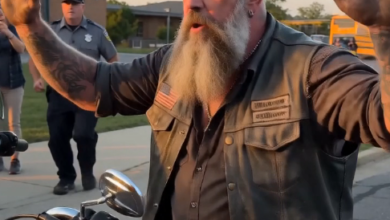
The first video made Marcus “Grave” Walker look like a monster: a huge tattooed biker snatching a doll from a crying seven-year-old girl and throwing it across the plaza while her mother screamed his name.
Emma Brooks had saved for three months to buy Rosie Belle.
She was a small white American girl with pale skin, curly light-brown hair, blue eyes, a yellow sweater, denim overalls, glittery pink sneakers, and the kind of careful smile children wear when they know money is tight.
Her mother, Rachel Brooks, was a thirty-two-year-old white American single mother with tired green eyes, auburn hair in a loose ponytail, a faded blue coat, and one hand always touching her purse as if counting every dollar by memory.
Rosie Belle was not just a doll.
She blinked, sang lullabies, and said “I love you” when hugged.
Emma held her against her chest outside Maplewood Toy Market like she was carrying a miracle.
Then the doll’s voice began skipping.
“I love—love—love—”
Most shoppers laughed softly.
Marcus did not.
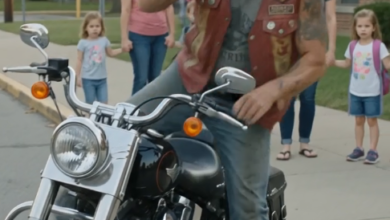
He was a fifty-one-year-old white American biker, six-foot-three and powerfully built, with weathered pale skin, shaved head, long gray beard, neck tattoos, scarred hands, faded jeans, heavy black boots, and a worn leather vest.
He smelled it before he saw it.
A sharp, hot, electrical smell.
Then a thin gray wisp curled from the seam near the doll’s battery compartment, pressed directly against Emma’s sweater.
“Sweetheart, put it down,” Marcus said.
Emma hugged Rosie tighter, frightened by the stranger’s voice.
The smoke thickened.
Marcus moved before the crowd understood why.
He took the doll from Emma’s arms and threw it into an empty concrete planter.
Emma screamed.
Rachel shoved herself between Marcus and her daughter.
“What is wrong with you? She just bought that!”
Phones rose.
Shoppers shouted.
Marcus stood still with open hands, accepting every angry word.
Then Rosie Belle jerked once inside the planter.
A crackling sound came from her back.
The plastic around the battery door began to darken.
Rachel stopped breathing.
Marcus pointed toward the smoking toy and said quietly, “That doll was heating up in her hands.”
Emma looked at him through tears.
The biker’s voice softened.
“I can buy another doll, kid. I can’t buy another pair of hands.”
Then the store manager opened the damaged battery compartment and found something that made him pull every Rosie Belle doll from the shelf.
Read the full story in the comments to discover what was wrong with the doll—and why Marcus recognized the smell before anyone else did.