Part 2: A 51-Year-Old Biker Stopped His Harley in Traffic to Retrieve a Little Girl’s Lost Princess Shoe — Then One Word from the Child Made Her Mother Break Down
PART 2
Sofia Vega knew her father through photographs, bedtime stories, and the black leather vest hanging inside her mother’s bedroom closet.
Captain Mateo Vega had been a thirty-four-year-old Latino American Army medic with warm brown eyes, a short black beard, and an old Harley he restored during every period of leave. He had married Marisol six years earlier and learned she was pregnant only days before his final deployment.
Mateo never held his daughter.
He died during an overseas convoy mission four months before Sofia was born, leaving behind a folded flag, several recorded messages, and a nursery he had painted pale yellow before leaving home.
Marisol never told Sofia that her father had simply gone away.
She explained that he had died, though the meaning changed as Sofia grew old enough to ask harder questions. Some nights, the child accepted that Daddy lived only in pictures. On other nights, she watched motorcycles pass their apartment window and asked whether one might be bringing him home.
The pink shoes had arrived from Sofia’s grandmother for her third birthday. They were inexpensive plastic shoes, slightly too bright and covered in glitter that spread through every room of the apartment.
Sofia adored them.
She called them her “brave shoes” because Mateo once told Marisol in a recorded message that their daughter should grow up believing she could be both brave and gentle.
That Friday afternoon, Marisol had taken both children to a pediatric appointment. Her infant son, Gabriel, had cried through most of the visit, and Sofia had become tired during the walk toward the bus stop.
Marisol was watching the stroller, the traffic signal, the diaper bag slipping from one shoulder, and the time remaining before their bus arrived.
She did not see the shoe fall.
Hawk did.
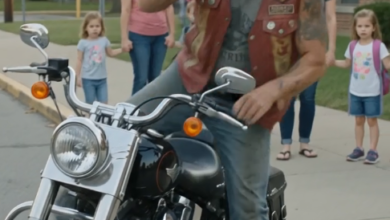
He had been riding several car lengths behind them when he noticed the glitter flash against the painted crossing line.
At first, he assumed it was a toy.
Then he saw Sofia limping slightly while trying to keep pace beside her mother.
The signal changed.
A delivery van began turning toward the shoe.
Hawk could have continued riding.
The shoe was worth perhaps fifteen dollars.
Replacing it would have been easier than inconveniencing traffic.
But Hawk remembered what small objects meant to children, especially when the adults protecting them were already carrying too much.
So he stopped.
PART 3
Hawk had once been the father of a little girl who believed every lost object could be rescued.
His daughter, Hannah, was now twenty-eight and living in Denver, but Hawk still remembered the afternoon she dropped a stuffed rabbit from the passenger window of his truck.
Hannah was six.
They had driven nearly five miles before she noticed.
Hawk turned around, searched two shoulders and a muddy drainage ditch, then found the rabbit lying beneath a road sign with one ear torn.
His wife laughed when they returned home.
“You would not stop that quickly for a human being,” she teased.
“I understand rabbits better.”
Years later, after Hawk’s wife died unexpectedly from an aneurysm, the easy warmth inside his family changed. Hawk retreated into motorcycle work and long-distance rides because engines did not ask him to describe grief.
Hannah interpreted his silence as absence.
She moved away after college, and their relationship slowly became a sequence of birthday messages, holiday calls, and conversations where both avoided the things that mattered.
Hawk kept the damaged stuffed rabbit inside a cabinet in his garage.
He did not fully understand why until he saw Sofia’s shoe.
He knew children remembered the moments adults chose to stop.
That did not mean his decision in traffic was perfect. Stopping a heavy motorcycle inside an active intersection created risk, so Hawk first checked the turning lane, signaled visibly, positioned the Harley as a temporary barrier, and moved it toward the curb immediately after retrieving the shoe.
The entire interruption lasted less than thirty seconds.
To the drivers behind him, it felt longer.
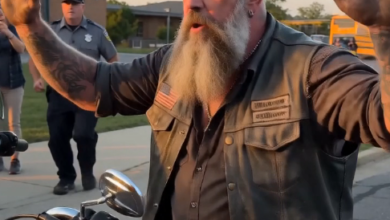
A man inside a silver sedan began recording after assuming Hawk was deliberately blocking traffic. The first seconds of the video showed only an intimidating biker standing beside a motorcycle while horns sounded behind him.
Then the camera followed Hawk toward the sidewalk.
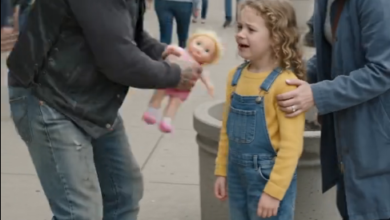
It captured the pink shoe in his hand.
It captured Marisol turning.
And it captured the exact moment Sofia looked into his bearded face and asked whether he was her father.
The driver stopped shouting.
So did everyone else close enough to hear.
Hawk could have laughed awkwardly or corrected the child quickly.
Instead, he lowered himself onto one knee so he no longer towered over her.
“No, sweetheart,” he said gently.
Sofia’s smile disappeared.
Hawk continued before the disappointment could settle.
“I’m only the man bringing the shoe back to the right princess.”
PART 4
Marisol cried before she could stop herself.
She turned her face away because Sofia often became frightened when adults cried, but the child had already noticed.
“Mommy, why sad?”
Marisol crouched beside her.
“I’m not sad, baby. I just remembered Daddy.”
Sofia looked from the photograph she carried in memory to the stranger kneeling before her. Hawk did not resemble Mateo closely, but children do not compare faces the way adults do.
She saw leather.
A gray beard.
Heavy boots.
A motorcycle waiting behind him.
Those details were enough to open a door Marisol spent three years learning how to close gently.
“I’m sorry,” Marisol told Hawk. “Her father rode too.”
Hawk nodded without asking the question strangers often asked next.
How did he die?
People sometimes believed grief became public information once uniforms or folded flags entered the story. Hawk understood better.
He held out the shoe.
“May I?”
Sofia lifted one foot.
Hawk slipped the princess shoe back on and secured the small strap carefully. His tattooed fingers looked enormous beside the glittering plastic crown.
“Perfect fit,” he said.
Sofia studied him.
“Do you know my daddy?”
“No.”
“He had a motorcycle.”
“I heard.”
“He was brave.”
Hawk looked toward Marisol before answering.
“I believe you.”
The silver sedan driver had stopped recording. He approached and apologized for honking, but Hawk dismissed it with a small wave.
“You saw a motorcycle blocking traffic,” he said. “I saw a shoe. We were looking at different parts of the same moment.”
Marisol thanked him again.
Hawk returned to the Harley, but before placing on his helmet, he heard Sofia calling.
“Motorcycle man!”
He turned.
She lifted the pink shoe several inches from the sidewalk, showing him that it remained safely attached.
Hawk raised two fingers in a rider’s salute.
Then he rode away.
He did not ask for Marisol’s telephone number.
He did not photograph the children.
He did not present himself as the father Sofia had lost.
He had stopped for one small reason, returned something that belonged to her, and understood when the moment was finished.
That restraint mattered almost as much as the kindness.
PART 5
The driver inside the silver sedan was named Kevin Brooks, a thirty-seven-year-old Black American delivery supervisor and father of two young children.
He watched the video several times that evening.
The first half embarrassed him. His own voice could be heard complaining about the biker and telling him to move.
Then Sofia said, “Daddy?”
Kevin nearly deleted the recording.
He understood that the moment belonged to a grieving family, not to strangers online. Before sharing anything, he returned to the intersection the following week, spoke with nearby shop employees, and eventually located Marisol through a community parenting group.
He showed her the video privately.
Sofia’s face was visible.
So was Marisol’s grief.
Kevin asked whether she wanted it erased.
Marisol watched the clip twice.
The second time, she paused when Hawk knelt and placed the shoe onto Sofia’s foot.
“Can you blur my children’s faces?” she asked.
“Yes.”
“And don’t use my husband’s full name.”
Kevin agreed.
Marisol allowed him to post a shortened version because she wanted people to see something beyond the mistaken word.
She wanted them to see Hawk’s response.
Kevin uploaded the clip with a caption of his own:
Not every hero arrives to stay. Some people simply stop at the right moment.
Within days, the video spread across social media. People praised the biker, criticized the honking drivers, and shared stories about strangers who had returned blankets, toys, pacifiers, and shoes dropped by exhausted parents.
Several viewers tried to identify Hawk.
He refused interviews when a local reporter eventually reached him.
“I picked up a shoe,” he said. “The mother has the real story.”
When the reporter asked what went through his mind after Sofia called him Daddy, Hawk remained silent for several seconds.
Then he answered honestly.
“I remembered there is still someone in this world allowed to call me that.”
That evening, he telephoned Hannah.
She answered on the fourth ring.
“Dad?”
The word sounded different when it came from his own daughter.
Hawk gripped the phone more tightly.
“I owe you a better conversation than the ones I’ve been giving you.”
Hannah became quiet.
Then she said, “I’ve been waiting.”
PART 6
The viral video did not repair Hawk and Hannah’s relationship instantly.
It started a conversation.
Hawk admitted that after his wife died, he had behaved as though surviving grief privately protected the people around him. In reality, his silence forced Hannah to grieve both parents at once—the mother she had lost and the father who remained physically present but emotionally unreachable.
Hannah did not excuse him simply because he had performed one kind act for a stranger.
“I’m glad you stopped for that little girl,” she said. “But I needed you to stop running years ago.”
Hawk accepted the sentence without defending himself.
Two weeks later, he rode to Denver.
He brought the stuffed rabbit he had recovered from the roadside when Hannah was six. She laughed when she saw it, then cried because she believed he had thrown it away decades earlier.
“I kept the things I knew how to keep,” Hawk said.
“You could have kept talking to me.”
“I know.”
They began again slowly.
Meanwhile, Marisol used the attention surrounding the video to support a Gold Star family organization that helped children whose military parents died before or shortly after their births.
She did not create a fundraiser in Hawk’s name.
She created it in Mateo’s.
The campaign collected children’s shoes, winter coats, and transportation support for surviving military families. Its symbol became a small pink crown beside a motorcycle wheel.
Hawk donated privately.
He requested that nobody publish the amount.
Several months later, Marisol invited him to a memorial ride benefiting those families. She made it clear that he was welcome as the man who stopped for Sofia, not as a replacement for Mateo.
Hawk understood.
At the event, Sofia wore new pink sneakers because she had outgrown the princess shoes. Marisol kept the old pair inside a memory box beside Mateo’s photographs and service medals.
Sofia approached Hawk carrying one of the shoes.
“Motorcycle man, remember?”
“I remember.”
She pointed toward his Harley.
“Can princess sit?”
Marisol permitted Sofia to sit on the stationary motorcycle while Hawk remained beside her and the engine stayed off.
The child placed both hands on the handlebars.
“My daddy had one.”
“Yes, he did.”
“Is he still a biker?”
Hawk looked toward Mateo’s photograph displayed near the memorial banner.
“I think some riders stay part of the road even after we cannot see them.”
Sofia considered this, then nodded.
Children sometimes accept truths adults spend years resisting.
PART 7
The video remained online for years, though most people eventually forgot the names involved.
They remembered the sentence.
Not every hero arrives to stay. Some people simply stop at the right moment.
The words appeared beneath photographs of strangers helping elderly drivers, returning lost pets, carrying groceries, repairing wheelchairs, and standing beside frightened people until help arrived.
Hawk felt uncomfortable whenever someone called the phrase his legacy.
He had not written it.
He had only lived inside one small example.
His real legacy was quieter.
He called Hannah every Sunday.
Sometimes their conversations lasted an hour. Sometimes they lasted six minutes because neither had much to report. The consistency mattered more than the drama.
When Hannah became engaged, she asked Hawk to ride with her to the wedding venue on the morning of the ceremony.
She did not sit behind him.
She rode beside him on a motorcycle she had learned to operate after completing a professional safety course.
At a red light, she lifted two fingers in a rider’s salute.
Hawk returned it.
Years later, Sofia grew old enough to understand why she had mistaken a stranger for her father. Marisol showed her the blurred video and explained that grief sometimes taught the heart to recognize people before the eyes had finished looking.
Sofia felt embarrassed by the word “Daddy.”
Hawk told her not to.
“You were three,” he said. “You saw something familiar.”
“What did you see?”
“A little girl who trusted the world enough to ask.”
Sofia looked toward the pink princess shoes preserved inside their clear memory box.
“Were you sad?”
“Yes.”
“Because I called you Dad?”
“Because your father should have been there to answer.”
She lowered her eyes.
Hawk continued.
“But he left enough love behind that you were still looking for him. That is not something to be ashamed of.”
Sofia eventually became involved with the same organization her mother had supported. Every winter, she helped collect shoes for children in military families.
She always inspected the straps carefully.
She always paired every shoe correctly.
And whenever a single shoe appeared at the bottom of a donation box, she refused to discard it until someone searched for its missing partner.
Hawk continued riding well into his seventies.
He never passed a toy, backpack, blanket, or child’s shoe lying near a roadway without checking whether someone ahead had lost it.
Most objects were trash.
Some were already damaged.
Occasionally, he found the person searching.
Those moments rarely became videos.
No caption appeared.
No crowd applauded.
That was fine.
Kindness did not become more valuable because strangers watched it.
The most important part of that Friday afternoon was never that a biker stopped traffic or that millions of people later shared his words.
It was that a tired mother crossed one difficult street carrying two children, and for thirty seconds, a stranger noticed something she could not.
He did not rescue her family.
He did not fill the empty place beside them.
He simply returned one tiny shoe before the road could take it.
Then he allowed the princess to continue without him.
Follow this page for more unforgettable biker stories about quiet kindness, unexpected connections, and ordinary people who choose to stop when the rest of the world keeps moving.